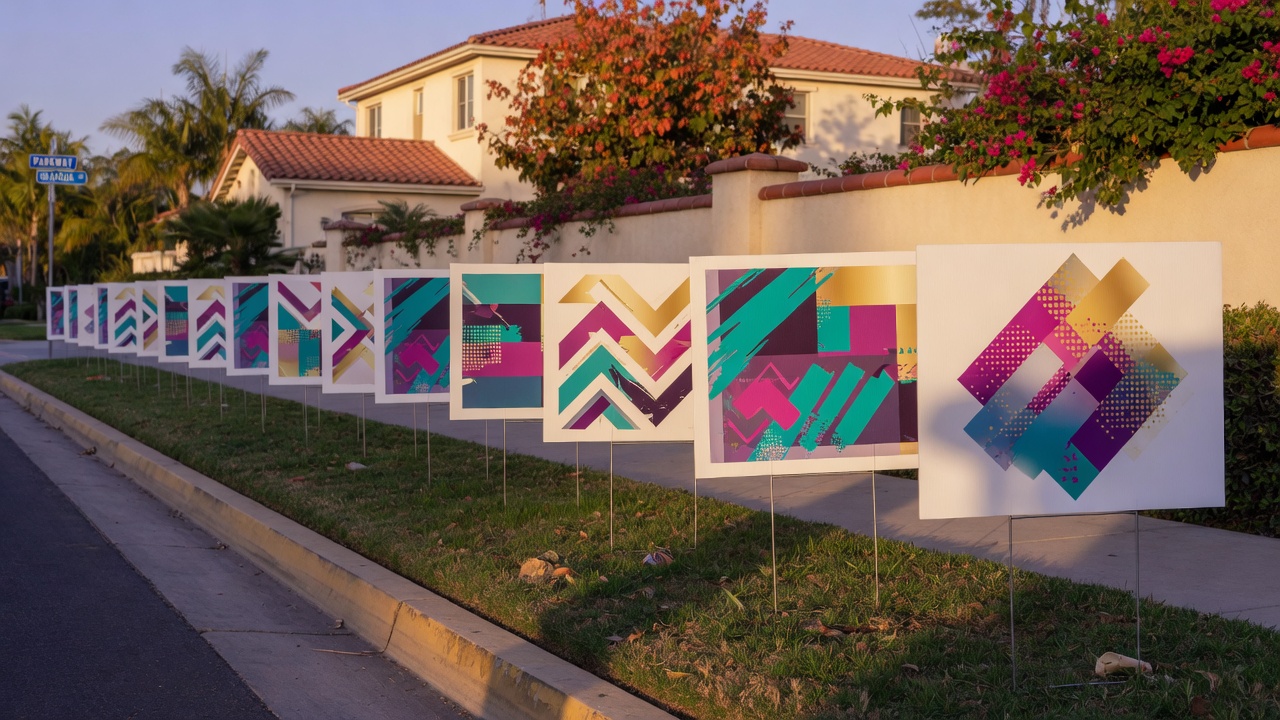
Yard signs in Irvine are usually 18×24 corrugated plastic (coroplast) on wire H-stakes. Real estate, elections, school events, and weekend open houses all run on that board. Avanti Printing at 15321 Barranca Pkwy, Irvine, CA 92618 prints them with UV-cured ink. Quotes confirm size, material, quantity, finish, and date.
The search is “yard signs Irvine.” The product is smaller than that phrase. You are buying a three-square-foot sail, a pair of wires, and a message that has to read from a car on Barranca, Culver, or a village loop. Get the size, the flute direction, the stake, and the copy hierarchy right and the board does its job for a listing, a campaign window, or a Saturday event. Get them wrong and you own a stack that will not take a stake, a phone number sitting in wet turf, or a legally printed rectangle in dirt you do not control.
This is a yard-sign article: 18×24 (and the riders and arrows that travel with it), 4 mm fluted polypropylene, H-stakes, quantities, Orange County wind, and the City/HOA paperwork you should read yourself. It is not a materials catalog for parking-lot monuments, not a banner article, and not legal advice. We put the graphic on the board in the same building as rigid sign printing in Irvine. You still have to decide where the wires go in the ground. Call (949) 387-0787 if you already have a bent stake in the trunk and you want the next run specified like an estimator instead of a clip-art pack.
Who this is for in Irvine and Orange County
You are shopping yard signs Irvine because someone said “put signs out” and then went quiet on size, sides, stakes, how many, and whether the village or the City will leave them there. Typical callers from Irvine, Tustin, Lake Forest, Costa Mesa, Laguna Hills, Santa Ana, and the John Wayne Airport office corridor are not asking what plastic is. They are asking for a board they can plant on Saturday and still find on Monday.
Drive-in radius is local. We are at 15321 Barranca Pkwy, Irvine, CA 92618. Agents working Woodbridge, Turtle Rock, Northwood, University Park, Quail Hill, Portola Springs, Orchard Hills, and the Spectrum-adjacent neighborhoods treat this as a counter job. Campaigns and school groups do the same when the window is short. If the stack has to ride to Anaheim, Newport, or a vote center you do not control, say so before we cut a quantity you cannot fit in a sedan with the stakes.
This guide is for California buyers who will own the install. It is written in second person because you are the one who will push wire into irrigated HOA turf at 7 a.m., argue with a parkway, or explain a yellow 18×24 to a neighbor. It is not for someone collecting mood boards. If the graphic is actually a hanging vinyl, a window film, a vehicle, or a multi-year parking panel, stop forcing a yard sign to do that work. Keep the ticket on yard-size sign printing when the object is a fluted board, a stake, and a short outdoor clock.
- Residential listing agents and teams who need 18×24 mains, hanging riders, and directional arrows for open-house weekends in Irvine villages.
- Campaigns, measures, and independent expenditures that live on 18×24 double-sided boards and a calendar someone else wrote.
- Schools, PTAs, churches, youth sports, and civic groups who need a weekend of corners, not a monument.
- Homeowners running a garage sale, a lost-pet notice, or a one-day event who should still confirm they are allowed in that parkway.
- Small contractors and home-based businesses who were told “just get yard signs” and need to hear that HOA turf is not a storefront.
If you are a home-based business in a planned village, read the HOA section before you fall in love with a 24×36. We will still print it. The architectural committee will not grade us on flute direction, and they will not grade you on how sharp the UV ink looks.
18×24 is a size, not a personality
Start with the rectangle. Eighteen by twenty-four inches is three square feet. That is the everyday yard-sign blank in this trade, and it is the size the City of Irvine’s temporary non-commercial exhibit has used for boards near intersections. Portrait or landscape is not a vibe. It is whether the name fits, whether a rider hangs under the board, and whether the flutes run the way the stake wants.
| Blank | Finished inches (W×H, view-side) | What it is for | Stake habit |
|---|---|---|---|
| 18×24 portrait | 18 wide × 24 high | Classic listing look; room for a rider under the board; many campaign names | One H-stake into vertical flutes; keep live copy off the bottom few inches |
| 24×18 landscape | 24 wide × 18 high | Street-reading names and arrows; “OPEN HOUSE” as a short line | Still one H-stake if flutes run the 18-inch height; say landscape on the ticket |
| 12×18 | 12 wide × 18 high | Smaller HOA-sensitive boards, riders that become mini-mains, dense corners | Shorter stake; easier to hide; easier to ignore from a moving car |
| 6×24 or 8×24 rider | Strip under or over the main | OPEN SAT 1–4, POOL, SOLD, price, “under contract” | Often hangs from the same stake or clips to the main; do not treat it as a free-flying kite |
| 24×36 | 24 wide × 36 high | A louder board, not a “big yard sign” | Two stakes minimum in open wind; I will ask why you are not on 18×24 |
Write width by height, view-side, in inches. “Yard sign size” is not a size. Some people mean 18×24 portrait. Some mean 24×18 landscape. Some mean the metal-frame listing post their broker already owns, which is a different object. If you already have a frame, measure the insert. If you are planting wire in turf, 18×24 is the default until a City exhibit, an HOA packet, or a brand kit says otherwise.
Portrait versus landscape changes flute direction. H-stakes slide into the flutes. The flutes must run vertical on the installed board. For an 18-wide by 24-high portrait, flutes run the 24-inch height. For a 24-wide by 18-high landscape, flutes still run the 18-inch height — the short side — so the wires drop in from the bottom. If we cut the parent sheet with flutes running the long way on a landscape board, you will stand in a parkway inventing a mount with packing tape. Mark “flutes vertical for stakes” and portrait or landscape on the quote. That sentence is cheaper than a reprint.
Riders are not decoration. A listing 18×24 without a date rider is a pretty rectangle. A campaign 18×24 with a date the ordinance cares about is a calendar. Print the rider as its own SKU when the date will change and the main board will not. Tape, clips, or a second pair of slots beat reprinting fifty mains because the open-house hours moved. Put rider size on the same email as the main. Do not assume 6×24. Measure the hardware you already own.
Parent sheets commonly land at 4×8 feet. We nest 18×24s out of that parent. Finished size and parent size are different numbers. A full-sheet “yard sign” is not a yard sign. It is a sail. If you need a graphic that large outdoors, you have left this product family and you should be talking about posts, a fence-mounted panel, or large-format printing for oversized panels — not eight wire stakes and optimism.
An 18×24 yard sign is a three-square-foot message meant to be planted and pulled. The minute you start talking about a two-year hang, a parking-lot post, or a 4×8, you are specifying a different board. Say that out loud before we cut fluted polypropylene.
Real estate, elections, and events on the same counter
The board is the same. The program is not. A listing, a measure, and a pancake breakfast all want 18×24 coroplast. They do not want the same quantity, the same copy, or the same permission story. Decide which job you are actually running. Mixing them into one “just make signs” email is how an open-house arrow gets printed like a monument, or a campaign gets twenty boards for a citywide race.
| Program | Typical blank | Sides | Quantity starting point (shop talk, not a rule) | Clock that actually matters |
|---|---|---|---|---|
| On-site listing | 18×24 + riders | Double if the street sees both ways; single if it only faces the curb | 2–6 at the property, plus reprints when status changes | Listing period; rider changes beat full reprints |
| Open-house / directional | 18×24 or 12×18 arrows | Double | 8–20 for a worked set of corners, plus extras | Hours of the event; often same-day plant and pull |
| Election / measure | 18×24, sometimes 12×18 | Double | 50 is a small run; 100–250 is a neighborhood blanket; more is a logistics problem | The window the City currently publishes, then a pull date |
| School / church / civic event | 18×24 | Double | 10–40 depending on how many corners you will staff | The week of the event, not “whenever we get to it” |
| Garage sale / one-day | 18×24 or 12×18 | Double | 6–12 | Day-of; many local rules treat these as short-hours signs |
Those quantity bands are typical industry starting points for Orange County work, not a formula and not a promise that your village will look like that. A team that already owns twenty metal frames is not a stake job. A candidate in one City Council district is not a citywide 500-piece run. Tell us the geography in one sentence: “Woodbridge open house, eight corners,” or “district race, plant on private lawns with owner OK.” Geography is a quantity spec.
Real estate has a second product hiding in the same sentence. The listing post some brokerages still use is a metal or wood frame with a rigid insert. That insert may be coroplast, PVC, or a printed panel the frame was built for. If you already have the frame, we print the insert to that opening, with a hole or a lip that matches. If you do not have a frame, do not order “realtor signs” and assume we will invent a post. H-stake 18×24 is the default yard product. The framed listing post is a hardware conversation you should have before the file.
Elections have a calendar conversation you should have before the file too. A beautiful board planted early is still a board someone may pull. A beautiful board left up after the event is how you donate inventory to a public-works truck. We will print to your date. We will not pretend the printer is the City Clerk.
Events fail on copy more than on plastic. “Spring Carnival” without a date, a time, or a place is a decoration. “Sat 9–2, parking lot, Culver” is a sign. If the date will move, keep the date on a rider or on a cheaper 12×18 you can reprint. The main board can stay generic. That is how school groups stop reprinting fifty 18×24s every time a rain date happens.
4 mm coroplast is the yard-sign board
Coroplast is a brand that became a noun. The sheet is corrugated polypropylene: two walls and a flute structure, light, waterproof, and slightly ribbed when you catch light across it. Print shops buy 4 mm for 18×24 work because it cuts clean, it takes a stake in the flutes, and it is cheap enough to reprint when the date, the candidate, or the price changes. That last clause is the product. If you wanted a board you would never reprint, you wanted a parking-lot panel, not a yard sign.
The mill that owns the name publishes the construction as an extruded twin-wall polypropylene copolymer sheet aimed at print, display, and packaging. Their Coroplast product-properties notes describe a waterproof, chemical-resistant flute board; UV packages exist as an add-on, not as a magic coating that makes an 18×24 look new for years on a west parkway. We will print the sheet we stock. If you already bought a named mill and a color, bring a corner so we can test adhesion instead of guessing from a website swatch.
Four millimeter is the everyday outdoor yard blank. Six millimeter is stiffer, heavier in the hand, and still stakeable if the flute is sized for the wire. It is a reasonable upgrade when a 24×36 will sit in open wind and you still insist on fluted PP. It is not a secret aluminum. Ten millimeter exists; it is not what you want for a fifty-piece H-stake run. Say millimeters on the quote. “Standard coroplast” is not a thickness any more than “standard yard sign” is a size.
White sheet is the default. Colored sheet — yellow especially — is a political and event habit. Colored sheet means the unprinted edge and any chip is that color, and it means white ink if you want opaque color that is not the sheet. Build a white channel when the face is not white. Do not send a flattened RGB file and a note that says “yellow board, make the logo pop.” White in a CMYK file is a hole. On yellow polypropylene, the hole is yellow.
The print face is not a smooth PVC. You will see a hint of flute under grazing light, especially on large flood fields and photographs. Type and logos at street distance still read. An agent headshot that looked sharp on a phone will pick up rib and look like a phone photo at five feet. If the viewing distance is a parkway from a moving car, coroplast is honest. If someone will stand over the board and judge skin texture, you ordered the wrong object.
Direct UV ink on a clean, dry sheet is the process we run on the rigid bed. Adhesion is generally good on the polypropylene faces we stock. It is not a powder-coat. First-surface ink on coroplast will scuff if you stack boards print-to-print and slide them in a trunk. Keep a slip sheet. Do not drag a printed face across asphalt while you wrestle a stake. That scuff is handling, not “the ink failed in the sun” on day one. If you want the process background — bed size, vacuum, edge-to-edge — that lives under UV printing on corrugated plastic and other rigid boards. This page is the 18×24 program, not how the gantry thinks.
Double-sided is the normal ask on yard-size coroplast. We print both faces. Opacity is decent on 4 mm white. A heavy flood of bright yellow on one side can still ghost a little onto a very light opposite face in strong sun. If both faces are busy photographs, say so. A one-color mark on each side of white 4 mm is not a ghosting drama. A full-bleed photo of a house on one side and a light cream brand field on the other can be. Tell us both faces, not “it’s a sign so obviously both.”
Outdoor life without fake year-counts: polypropylene in Orange County sun does not rot. It weathers. The sheet chalks, the edges get tired, impact starts to crack instead of flex, and the ink looks less new. Typical shop talk for an unshaded 4 mm yard board that is still doing brand work is weeks to a season. A shaded north patio board can look presentable longer. A west-facing 4 mm panel left up from January to January will usually look like you forgot it. Those are typical industry ranges, not a warranty and not a promise about your exact magenta. The mill’s weathering talk is about brittleness in a lab-equivalent exposure, not about whether the listing still photographs like the brand kit. If you need two summers of a parking-lot message, stop specifying yard-sign coroplast because last month’s open house used it.
Water is not the enemy. Coroplast does not wick like cardboard. Standing irrigation, rain, and a hose are fine for the sheet. The enemy is UV plus time plus a stake that pulled out of wet soil. Plan the hang for the program: a weekend, a listing, a campaign window. Then pull the board. A forgotten 18×24 in a parkway is how a professional office looks like a leftover election.
H-stakes, step stakes, and soil that is not a foundation
Hardware is the other half of yard signs Irvine. The board you love will fail on the mount you improvised. Pick the stake with the board, not after the stack is in the trunk.
An H-stake is two wires with a horizontal bar, sized so the uprights slide into coroplast flutes. Typical pairing in this trade is an 18×24 board on a 10×24-class stake. That pairing is shop practice, not a wind-load table and not a City height calculation. Push the stake into soil first, then slide the board down, or assemble and push as a unit if the ground is soft. Rocky Irvine planters, decomposed granite parkways, and root-bound HOA turf will bend cheap wire. That is a site problem. A heavier stake, a second stake, or a different location is the fix — not a thicker ink film.
Step stakes and heavier wire exist for harder ground. They still are not a 4×8 mount. They still are not HOA-proof. If the ground is a thin crust over drip line, no wire is a foundation. If the ground is a median you do not control, no wire is a permit.
| Mount | Belongs with | Where it behaves in OC | Watch-outs |
|---|---|---|---|
| H-stake (wire, slides into flutes) | 4 mm / 6 mm coroplast, typically 18×24 or 12×18 | Turf and planters you are allowed to use; short-term | Wet soil after irrigation; one-stake 24×36; flutes running the wrong way |
| Step stake / heavy wire | Coroplast; some boards if the stake clamps, not slides | Harder ground, slightly windier corners | Still not a wall; still not a right-of-way |
| Framed listing post | Insert cut to the frame, not a random 18×24 | On-site listings that already own hardware | Measure the insert; do not assume H-stake geometry |
| Zip-tie to a fence | Short-term coroplast on a fence you control | Private job-site or backyard fence | Not a light pole, not a City tree, not a traffic signal |
Two stakes on a 24×36 coroplast board are the minimum I will call honest in an open parkway. One stake is a pivot. A 36×48 on H-stakes is a conversation about whether you meant a frame. Full 4×8 coroplast on stakes is how you donate a billboard to the wind. Stay on 18×24 unless you have a reason and a mount.
Height is a separate spec from board size. An 18×24 sitting on a 10×24-class H-stake does not sit with its top at 24 inches. The stake sticks out of the ground, the board slides onto the uprights, and the top of the graphic ends up higher than buyers sketch on a napkin. Near intersections, the City’s temporary non-commercial exhibit has used a three-foot-above-ground cap for boards in the public right-of-way. That is a placement and stake-choice problem, not a print problem. If you need the top of the board under a published height, say the height. We can talk about a shorter stake or a 12×18. We cannot shrink physics after you already planted a tall wire.
Soil moisture in this city is often irrigation, not rainfall. A stake that felt immovable at 2 p.m. can sit in soup at 6 a.m. after the clocks run. Walk Monday morning after a windy Sunday. Retrieving your 18×24 from a neighbor’s hedge is not a print warranty. It is a Monday.
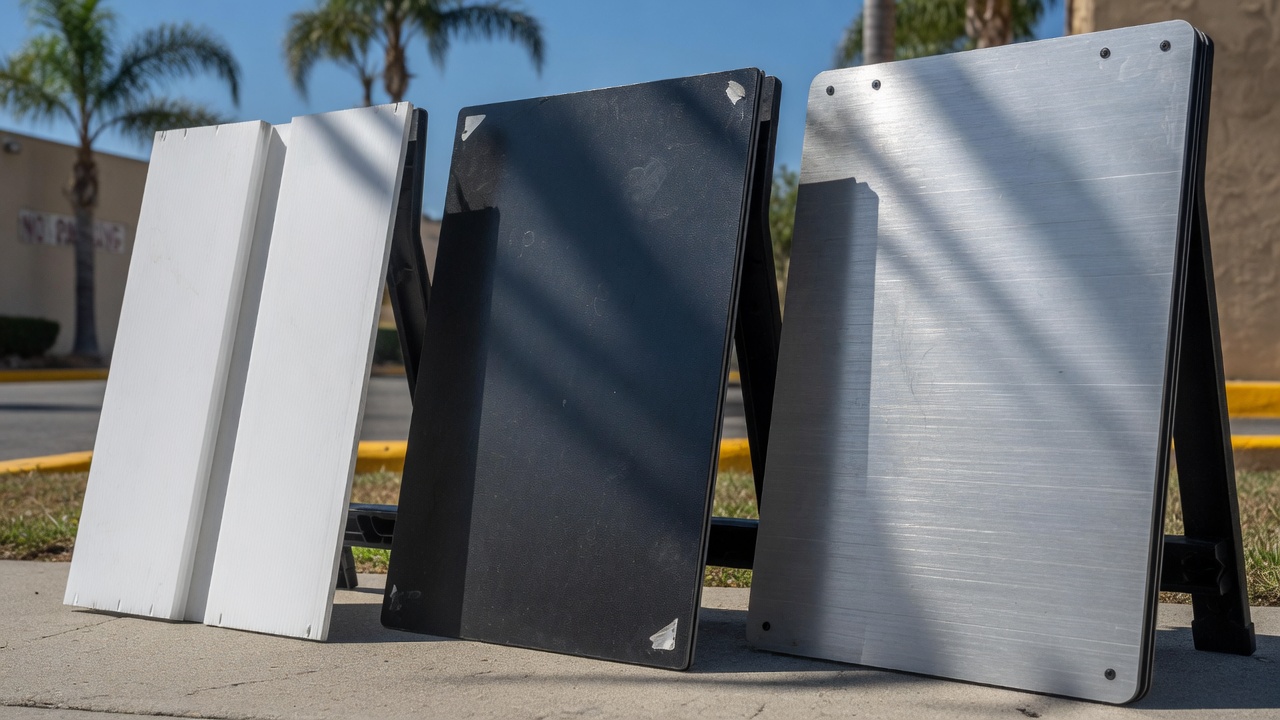
Do not put ACM, solid aluminum, or expanded PVC on an H-stake as if it were coroplast. There are no flutes for the wire to enter. People drill holes and zip-tie PVC to a stake anyway. That hang is a tear and a pivot in wind. ACM on wire is worse: you paid for a metal skin so you could hang it like a campaign board. Yard signs want fluted polypropylene and a stake sized for the flute. Other boards want frames, posts, and screws. If you are torn, you are probably mixing two jobs.
Stakes are a line item. “Signs” in an email does not include wire unless you say so. Count boards and count stakes. A fifty-piece run with forty stakes is a ten-board problem on Saturday morning. Tell us who supplies hardware. We can include H-stakes when you ask. We will not guess that you have a garage full of last year’s wire.
Install technique that actually holds: clear the drip-flag and the obvious root. Push the stake straight, not at a tourist angle. Leave the horizontal bar close to grade so the board cannot climb the wires in a gust. Slide the board down until the flutes bottom on the bar. If the board rattles, the flutes are the wrong direction or the stake is the wrong gauge. Do not solve rattle with packing tape and a speech about wind. Recut or restake.
How many yard signs to print
Quantity is the question under “yard signs Irvine” that buyers skip, then regret. Too few and you staff three corners of a ten-corner open house. Too many and you store a political inventory in a garage until the sheet gets brittle. The right number is a geography problem, a spoilage problem, and a reprint problem. It is not a round number you saw in an online pack.
Start with corners, not with a catalog. Walk or drive the route. Count the plant spots you are allowed to use: private lawns with owner consent, on-site listing dirt, event parking-lot edges you control. Do not count medians, City trees, signal poles, or HOA turf you have not cleared. The honest count of plant spots is your first quantity. Then add spoilage.
Spoilage on this product is not a mystery. Boards fly. Boards get pulled. Boards get hit by mowers. Boards scuff in a trunk. Irrigation lifts stakes. Neighbors relocate messages they did not ask for. A typical industry cushion for a worked outdoor stake run is on the order of 10 percent extra, more if you are planting in open wind or in a contested campaign weekend. That is a range, not a formula. Ten boards for ten corners with zero extras is how you finish Saturday with eight corners.
Real estate inventory
A single listing is not one sign. It is an on-site main, maybe a rider for status, and a set of directional arrows for the days you hold the house open. Teams that work Irvine villages often keep a reusable arrow kit and reprint only the address rider or the date rider. That is the grown-up way to buy this product. The kit might be 8, 12, or 20 arrows plus a handful of mains. The reprint is the rider. If every open house is a brand-new 18×24 with a new address welded into the art, you will pay to reprint the whole board every weekend. Separate the durable message from the date.
Status changes are rider work: coming soon, new price, open Sunday, pending, sold. Print those strips in small batches. Do not overprint “SOLD” in a quantity that assumes every listing closes tomorrow, and do not underprint “OPEN SAT 1–4” if that is your actual lead engine. If the brokerage already specified a frame and a rider slot, follow the slot. A 6×24 that does not fit the clips is scrap.
Photos of the house on an 18×24 are a taste decision. From a moving car, the photo is a blur and the address is the job. If you want the photo, keep type huge and the photo secondary. If the listing is a walking neighborhood where people stop, the photo earns its keep. Say which. We will still print either. Only one of them reads at 30 miles an hour.
Campaigns and measures
Campaign quantity is density versus logistics. Fifty 18×24s will cover a small set of supportive lawns. A hundred starts to look like a presence if the geography is one district. Two hundred fifty is a neighborhood blanket and a pickup-truck problem. Five hundred is a warehouse-in-the-garage problem unless you have a volunteer machine that plants and pulls on a schedule. I would rather you order 100, plant them, and reorder than sit on 400 extras that chalk in a stack.
Versioning shows up here: English/Spanish, district names, “vote by mail” versus “Election Day,” a date that the City treats as the event. If the art is a template plus a name list, send the template and the list. Fifty names are not fifty unique design jobs if you build them as variable copy. Fifty unrelated layouts are. Say which.
Pull date is part of quantity. If the City currently tells you to take event-related boards down within a stated number of days after the event, plan the labor. A stack you cannot retrieve is litter with a logo. Order a quantity you can plant and a quantity you can collect. Those are the same number if you are honest.
Events, schools, and one-day boards
A carnival, a registration night, a church fair, a youth-soccer weekend: count the intersections you will actually stand, plus the on-site boards at the driveway. Ten to forty 18×24s covers most of those programs in this city. Garage-sale directional runs are smaller. If you cannot staff the corners, do not print as if you could. Unattended arrows in a parkway are the first boards a complaint pulls.
Reuse is real for generic event boards (“Woodbridge Community Sale,” “Campus Open House”) and fake for dated boards. If the date is in 200-point type on the main, you will reprint next year. If the date is a rider, you will print a strip. Build the file like you know that.
Identical versus mixed SKUs change the quote. Twenty matching 18×24s are one setup. Twenty boards that are left-arrow, right-arrow, straight, and “sold” are four setups or a template with four versions. List the versions. Do not write “assorted arrows” and hope.
Batching: we nest 18×24s on a parent sheet. Very small quantities are still a real job; they are not always the cheapest per-board story. If you know you will need a second wave in two weeks, say so. One larger identical run is usually cleaner than two panicked tens. That is shop practice, not a coupon. Put both dates on the email if you already know them.
Copy that reads from a moving car
Yard signs fail in prepress as often as they fail on a stake. The printer is not confused. The file was built for Instagram.
Viewing distance sets the type. A driver on Culver or Barranca has a second, not a paragraph. Three to five words at a size you can read from across the street is the job. The phone number, the URL, the license number, the fine-print “paid for by” block, and the QR code are secondary. If a disclosure is required, it still has to live on the board — put it in a band that does not kill the name. If a QR is the point, the viewer has to be able to stop. Open-house lawn: maybe. 45-mile-an-hour arterial: the QR is a decoration.
Hierarchy that works on 18×24: name or offer first, date/time second, place third, contact last. Arrows should be arrows, not a logo with a small chevron. If the board is a directional, the arrow is the art. If the board is a listing, the status and the identity are the art. Do not put both jobs on one face unless you like neither.
Send vector for marks and type: PDF, AI, or EPS, fonts outlined, logos as paths. Photographs can be raster. An 18×24 that people will stand over while they pull a stake wants on the order of 150–200 ppi at output size — a typical industry band, not a lab spec. A 72 ppi web hero stretched to 18×24 will look like a web hero. Flutes will not hide it; they will add noise.
Work in CMYK. RGB neons are a monitor event. If a brand red must hit a coated PMS number, say the number and understand the ground: that chip was printed on white paper. On yellow coroplast the same ink recipe is a different visual. Approvals that matter should be on the actual board. We can get close. We cannot promise a spectro reading from a paper book will land on a west-facing parkway at 4 p.m.
Bleed: 1/8 inch past trim if ink goes to the edge and we cut after print. Safe type: keep live copy off stake insertion zones (the bottom few inches of a fluted yard board) and off any rider clips. A phone number in the dirt is a reprint. A QR under a stake bar is a decoration. If you do not know the stake yet, keep a keep-out along the bottom until we lock hardware.
White channel: a spot color or a layer named WhiteInk, 100% where white ink should print, when the sheet is not a white ground. Yellow coroplast, colored sheet, and any “we want the plastic to show” design need this decision. Do not bury white in a flattened TIFF.
Notes that belong in the email, not in a Slack screenshot: finished size (width × height, view-side); portrait or landscape; board and thickness (4 mm coroplast unless we agree otherwise); flute direction; single or double-sided; sheet color; stakes yes/no and who supplies; quantity by version; date needed. If the boards are versioned (arrows left/right, addresses, dates), that is a template plus a list, not twelve files named FINAL.
Photographs of a previous sign, a website screenshot, and “it’s on our Instagram, can you pull it” are not print files. Rebuild time is design time. Put rebuild / not rebuild on the quote with size, material, quantity, finish, and date.
Agent photos, team photos, and candidate portraits: they print. They also shrink. A head that is two inches tall on an 18×24 is a suggestion, not a likeness. If the face is the brand, give it real estate and accept that the paragraph will not fit. If the name is the brand, skip the photo. I will not talk you out of a photo if you insist. I will tell you it will not look like the file on your laptop when it is in a parkway.
Wind, irrigation, and the Orange County hang
In this county the climate is not a footnote. It is the filter that should kill half the “can we go bigger?” ideas before anyone talks about CMYK.
Santa Ana events — dry offshore wind, most common from fall through spring, often warm as the air drops toward the coast — do not need to be a hurricane to matter. You need a gust that turns an undersized stake into a pivot, or a 24×36 on one wire into a kite. Area, height above grade, and whether the soil is soup matter more than whether the sample felt sturdy in an air-conditioned lobby.
Geometry that actually fails here:
- 18×24 on one tired H-stake in wet turf after an irrigation cycle, then a canyon-fed gust. The board is fine. It is in the next driveway.
- 24×36 or 4×8 coroplast treated like a yard sign. That is a kite. Two stakes do not make a 4×8 a wall.
- Boards planted in a sight triangle or tight to a curb where a gust plus a car wake finishes the job.
- Stacks left in a closed car on Barranca in August. Coroplast will take a set. If the boards arrive bowed, we may wait, weight them, or recut. That wait belongs on the calendar.
- Print-to-print stacks in a hot trunk. Faces scuff and can offset. Slip sheets, or stack unprinted faces together until you stake.
Irrigation is the supporting actor in Irvine villages and office-park edges. Clock-driven spray hits the bottom of a yard sign every night with mineral water. The board is waterproof. The soil around a stake is not a foundation. Calcium spots on a dark face look like fade until you rinse them. Walk the install at 7 a.m. if the landscaping contractor is proud of coverage. A listing main that sits in a spray head’s path will look older than the listing.
West- and south-facing parkways along Barranca, Jamboree, Culver, and the parking-lot side of Spectrum-area retail take a long UV dose and a lot of heat. Dark floods chalk sooner in the eye than light floods. That is not a reason to print pale gray type on white. Contrast still wins. It is a reason not to promise that a magenta flood will look new in October if you planted in March on a west corner.
Coastal jobs — Newport, Costa Mesa near the water, Huntington — add salt to hardware. The plastic is not the first thing to quit. Cheap steel wire is. Inland Irvine still cooks color. It just rusts slower. If you are hanging for a season near marine air, say so. A heavier coated stake is a hardware choice. It will not turn 4 mm PP into aluminum.
Theft and “helpfulness” are part of the hang. Boards walk. Opponents relocate campaign signs. Neighbors “tidy” a parkway. Count that in quantity. Do not count it as a print defect. A second small run beats a conspiracy theory about the press.
HOA villages and City rules, without a lawyer hat
Irvine is a planned city with a planned attitude toward signs. The print can be perfect and still be the wrong object in the wrong dirt. This section is not legal advice, not a permit, and not a promise that a given 18×24 is allowed on a given corner. Read the current City exhibit and your HOA packet. Then print. We print. We do not issue a right-of-way.
Check three desks, in this order: property owner or HOA, then the City if the board is in the public right-of-way or visible from the public side, then us. Reverse that order and you buy a stack you may be asked to pull before the ink has a weekend on it.
The City of Irvine publishes sign rules and a set of sign-type exhibits. Start at the City’s Irvine sign regulations and permit page and read the exhibit that matches the use — temporary residential real estate, temporary off-site commercial / open-house directional, temporary non-commercial (the bucket campaigns and many events get pointed to), garage-sale identification, and the rest. Those exhibits change. Dates, sizes, heights, and “permit required?” lines have moved before and will move again. If a number in this article disagrees with the PDF you pull tomorrow, the PDF wins. Call Planning or Code Enforcement with placement questions. Call (949) 387-0787 with print questions.
What the exhibits have commonly cared about, in shop language rather than as your compliance plan:
- Size caps that make 18×24 (3 sq ft) the comfortable blank near intersections, and larger boards a different conversation farther away.
- Height caps that interact with stake choice. A tall wire plus an 18×24 can overshoot a three-foot top-of-sign line even if the board itself is only 24 inches.
- Time windows for event-related boards (plant no earlier than X days before, pull no later than Y days after) and separate windows for boards not tied to a dated event. City notices in 2026 have discussed a 39-day-before / 10-day-after pattern for event-related temporary non-commercial signs, with the event defined as Election Day for elections. Confirm the current text. Do not use this paragraph as a calendar.
- Private property with owner consent versus public right-of-way. Owner consent is not optional just because the board is pretty.
- Spacing, sight-distance triangles, and a ban on attaching boards to City property: utility poles, trees, traffic signals, regulatory signs. Zip-ties on a light pole are not a mount. They are a complaint.
- No illumination on these temporary types. Your 18×24 does not need a solar spotlight to look like a yard sign.
- District elections limited to the district, not citywide, when the City says so.
Real estate has more than one exhibit. On-site listing identification is not the same ticket as off-site open-house arrows. Some exhibits have historically specified materials, hours, or “one per intersection per change in direction.” Off-site arrows that stay up from Thursday to Sunday may collide with an hours rule even if the print is perfect. Read the open-house exhibit before you order a week-long directional kit. I will still print the kit. I will not tell a broker the City “probably doesn’t care.”
HOAs in villages such as Woodbridge, Turtle Rock, Northwood, University Park, Quail Hill, Portola Springs, and Orchard Hills are often stricter than the City, not looser. CC&Rs, architectural guidelines, and a manager who has already written a newsletter about signs will beat your brand kit. Home-based businesses run into this constantly. If the documents say no commercial signage, a beautiful 18×24 will not charm the committee. Open-house boards and campaign boards are not automatically exempt just because “everyone does it.” Ask the association in writing. Bring us the size they already approved if they approved one.
Office parks and apartment communities add another desk. Irvine Company parks, University Research Park, medical campuses on Barranca and Alton, and Spectrum-area retail usually have a sign program. A temporary 18×24 on private turf at a job site may be fine. The same board on street-facing HOA lawn or in a parking-lot island the property already dressed may not. Ask the property manager for the PDF before we cut fifty.
UCI and other campus facilities have their own brand and facilities rules. A temporary event board on coroplast is one queue. A board in a campus lot is another. Bring the spec they already wrote. Anaheim, Costa Mesa, Newport, Tustin, and Lake Forest jobs that still pick up on Barranca bring their own city rules. Do not assume Irvine’s packet applies in Tustin. The constant is the quote: board plus location plus permission.
Construction and contractor boards are a different habit. If the City or the GC handed you a spec for an official project sign, follow that spec. Do not replace a required construction panel with 4 mm 18×24 because yard signs were cheaper on a previous campaign. We will print the board they specified. We will not invent compliance.
State right-of-way is not a village parkway. Caltrans and freeway on-ramps are their own no. If your volunteer wants to plant at an off-ramp because “everyone will see it,” that is a campaign-management problem, not a print problem. I will mention it once. Then I will print the quantity you still want.
Quote 18×24 yard signs and H-stakes
Mistakes that reprint a yard sign, or dump it
Reprints on this product hurt because you paid for a board, a cut, and often a stake, not only for ink. The pattern is boring and preventable.
- No size, just “yard signs.” We do not know portrait or landscape. You pick up 18×24s that do not match last year’s 24×18 arrows.
- Flutes running the wrong way. Stakes will not enter. The Saturday crew invents a mount with packing tape.
- One H-stake on a 24×36 in open wind. Pivot, then flight. Stay on 18×24 or use two stakes and a better story.
- ACM, PVC, or aluminum specified for a fifty-piece stake run. There are no flutes. Use coroplast, or budget frames.
- Coroplast specified for a two-year wall. The ink held longer than the polypropylene looked new. That is a different product.
- Type in the stake zone. The phone number lives in the dirt. Keep a keep-out at the bottom.
- RGB or 72 ppi art, or a Facebook download of the logo. The parkway will see the jaggies even if you do not on a phone.
- No white on yellow coroplast. The logo is a stain. Build the channel.
- Single-sided boards on a two-way parkway. The walk-back face is blank plastic. Say double-sided if two directions of traffic matter.
- Date welded into fifty mains. The rain date, the new open-house hours, or the moved election-related copy forces a full reprint. Use a rider.
- Quantity = number of corners, zero extras. Wind and a mower will make you short. Add a cushion.
- Stakes not on the ticket. Fifty boards, thirty-eight wires. Saturday fails.
- Print-to-print stacks in a hot trunk. Scuff and offset. Slip sheets.
- Landlord, HOA, or City surprise. The board is perfect. The parkway was never yours. Check the binder first.
- Missing size, material, quantity, finish, or date. You get a range instead of a price, and a stack the day after the event.
A quieter mistake: attaching a legally printed 18×24 to a utility pole because the turf was hard. The mount is the violation. The print is fine. Do not ask us to add grommets so you can commit that more efficiently.
Another: ordering 24×36 because the name is long instead of editing the name. Long names fit on 18×24 in two lines at a size people can read. They also fit on 24×36 at a size that turns the board into a sail. Edit the type. Keep the blank.
What to send so the quote is real
Send one email a person can estimate from. If you skip fields, you get a range, not a price. Walk-ins Monday–Friday, 8:00 a.m. to 5:00 p.m. at 15321 Barranca Pkwy, Irvine, CA 92618 are welcome if you bring a dead sign, a bent stake, or a tape-measured size. You can also start on the Irvine Printing site with the same fields. Quotes confirm size, material, quantity, finish, and date. Add stakes and portrait/landscape on this product line so we do not guess.
- Size. Width × height, view-side, in inches. Portrait or landscape. Rider size if any. If it is 18×24, say 18×24, not “yard sign size.”
- Material and thickness. 4 mm white coroplast is the default yard blank. Say 6 mm if you have a reason. Say sheet color if not white. Say “recommend from duration and mount” if you are unsure, and then describe duration and mount.
- Quantity. Identical versus versioned. Twenty matching boards are a different setup than ten left arrows and ten right arrows. List versions.
- Finish and hardware. Single or double-sided; flute direction for stakes; H-stakes yes/no and who supplies; rider clips if you already own them; any grommets (usually the wrong ask on a stake board).
- Site. Turf, planter, private lawn, event lot. Facing if you know it. HOA or City constraints if you know them. Neighbor city if it is not Irvine.
- Date. The day it must be in the ground, not “ASAP.” A clean-file stack of 18×24 coroplast is a different clock from a rebuild, a yellow-sheet white-ink job, and a proof a treasurer has to sign.
Attach the file or say you need a rebuild. State pickup versus delivery. State whether a broker, a campaign treasurer, or a principal must approve a proof. If a brand kit or a City exhibit already drew the panel, send that drawing. We would rather print to their inches than guess and recut.
If the same campaign also needs a wall panel, a window graphic, or a vehicle, list those as separate lines. Different process, different file, different finish. Mixing them into one “just make signs” instruction is how yard-sign coroplast gets specified like a monument, or a monument gets specified like a stake board.
Pickup logistics: 18×24 stacks are light and awkward. A hundred boards plus a bundle of stakes will not hide in a hatchback under a grocery bag. Bring a vehicle that fits the quantity, or say so and we will talk about splits. Keep slip sheets in the stack until you plant. Peel banding in the lot, not on the freeway.
Send size, quantity, and date for a quote
Questions buyers ask before they plant 18×24
What size should yard signs be in Irvine?
18×24 is the everyday blank: three square feet, one H-stake, readable from a slow street if you keep the word count down. Portrait (18 wide × 24 high) is the listing-and-rider habit. Landscape (24 wide × 18 high) is the arrow and street-name habit. 12×18 is the smaller, quieter cousin. 24×36 is a louder board that wants more stake and more honesty about wind. Near intersections, City exhibits have used 18×24 as the size that fits a 3-square-foot cap. Read the current exhibit for your use. Do not order 24×36 because a template looked lonely on a laptop.
Do I need double-sided printing?
Yes on parkway and corner boards that face two directions of traffic — most 18×24 yard signs in this city. Yes on arrows that will be read coming and going. No on a board that only has an audience on one side, such as a listing main hard against a hedge, facing the street. Double-sided 4 mm white coroplast is routine. Do not assume we will print the back because “it’s a sign.” Write front only or both sides on the ticket. If the two faces are different (arrow on one side, event copy on the other), say that and send both.
Which way do the flutes run, and how many H-stakes do I need?
Flutes vertical on the installed board so the wires slide in from the bottom. One H-stake per 18×24 or 12×18 is the normal pairing. Two stakes for a 24×36 in open wind. Order the same count of stakes as boards unless you already have a working inventory — then say how many you still need. Push the stake, then slide the board. If the stake will not enter, the flutes are wrong or the board is not coroplast. Do not drill ACM and call it a yard sign.
How long will a 4 mm coroplast yard sign last in Orange County sun?
Plan on weeks to a season of looking like you meant it, unshaded. Shade and a north face stretch that. A full year on a west parkway usually looks like a leftover. The sheet will not dissolve in rain. It will chalk, get brittle, and look tired. Those are typical industry ranges, not a warranty. Manufacturer weathering talk is about the plastic becoming brittle in a lab-equivalent exposure, not about your magenta still matching a brand kit. If you need two summers of a parking-lot message, stop buying 4 mm fluted PP because it worked for last month’s open house.
Can I put yard signs in the parkway or on HOA turf?
That is not a print question. Private property needs the owner’s consent. HOA turf needs the association’s rules, which are often stricter than the City’s. Public right-of-way in Irvine is covered by the City’s sign-type exhibits, including size, height, spacing, sight triangles, and time windows. Do not attach boards to poles, trees, or signals. We will print an 18×24 that looks like a yard sign. We will not tell you a given corner is legal. Read the current City page and your CC&Rs. If you already have a written OK on a size, send that size.
How many signs should I order?
Count the plant spots you are allowed to use, then add a cushion for wind, mowers, and disappearance. Real estate directional kits often live in the 8–20 range plus on-site mains and riders. Event weekends often live in the 10–40 range. Campaigns start making sense around 50 and become a logistics problem somewhere past a couple hundred if you do not have a pull crew. Those are typical starting points, not a quota. Identical boards are cheaper to run than a pile of one-offs. Split dates onto riders so you are not reprinting mains. Order a quantity you can plant and a quantity you can collect.
What files do you need, and how fast is this?
Vectors for marks and type, CMYK, white as a spot or layer when the sheet is not white, actual size or a labeled scale, bleed if we cut after print, flute direction named, single- or double-sided named, portrait or landscape named. Photos at a sensible ppi at size. Straightforward 18×24 coroplast with a clean file is a different clock from yellow-sheet white-ink, a rebuild from a screenshot, and a treasurer proof. Rush exists when the sheet is in house, the file is clean, and the finish is simple. Put the needed-by date on the quote. “ASAP” is not a date. Call (949) 387-0787 if the date is already too close; we will say yes or no.
Should I use a bigger board or a different material?
Use a bigger board only if you have a mount and a permission story that match the area. Use a different material when the hang is measured in years, the mount is a post or a wall, and Santa Ana wind plus OC sun are part of a long brief — that is ACM or aluminum, and it is not an H-stake product. Stay on 4 mm 18×24 coroplast when the hang is short, the quantity is real, and you expect to reprint when the date changes. Forcing one substrate to do all three jobs is how you get a compromise that satisfies nobody, including the wind. If you are unsure, describe duration, sun, and hardware in one sentence. We will steer the board.
Plant it like you will have to pull it
Yard sign printing in Irvine is an 18×24 program: 4 mm fluted polypropylene, vertical flutes, H-stakes, double-sided faces for two-way streets, and a quantity that matches the corners you can actually staff. Real estate, elections, and events share the board and do not share the calendar. Direct UV ink on those faces is how we put the graphic on the object at 15321 Barranca Pkwy. The soil, the wind, the HOA, and the City still run the hang. We will not pretend otherwise.
Avanti Printing is at 15321 Barranca Pkwy, Irvine, CA 92618. (949) 387-0787. Bring size, material, quantity, finish, and date. Bring portrait or landscape, flute direction, and whether you need stakes. If the file is ready, we can talk like an estimator instead of a mind reader. If it is not, say that too. The stack will still be here. It will last the weekend you actually meant if we do not have to guess whether your “yard signs” are 18×24 portrait, 24×18 arrows, or a 4×8 with ambition.