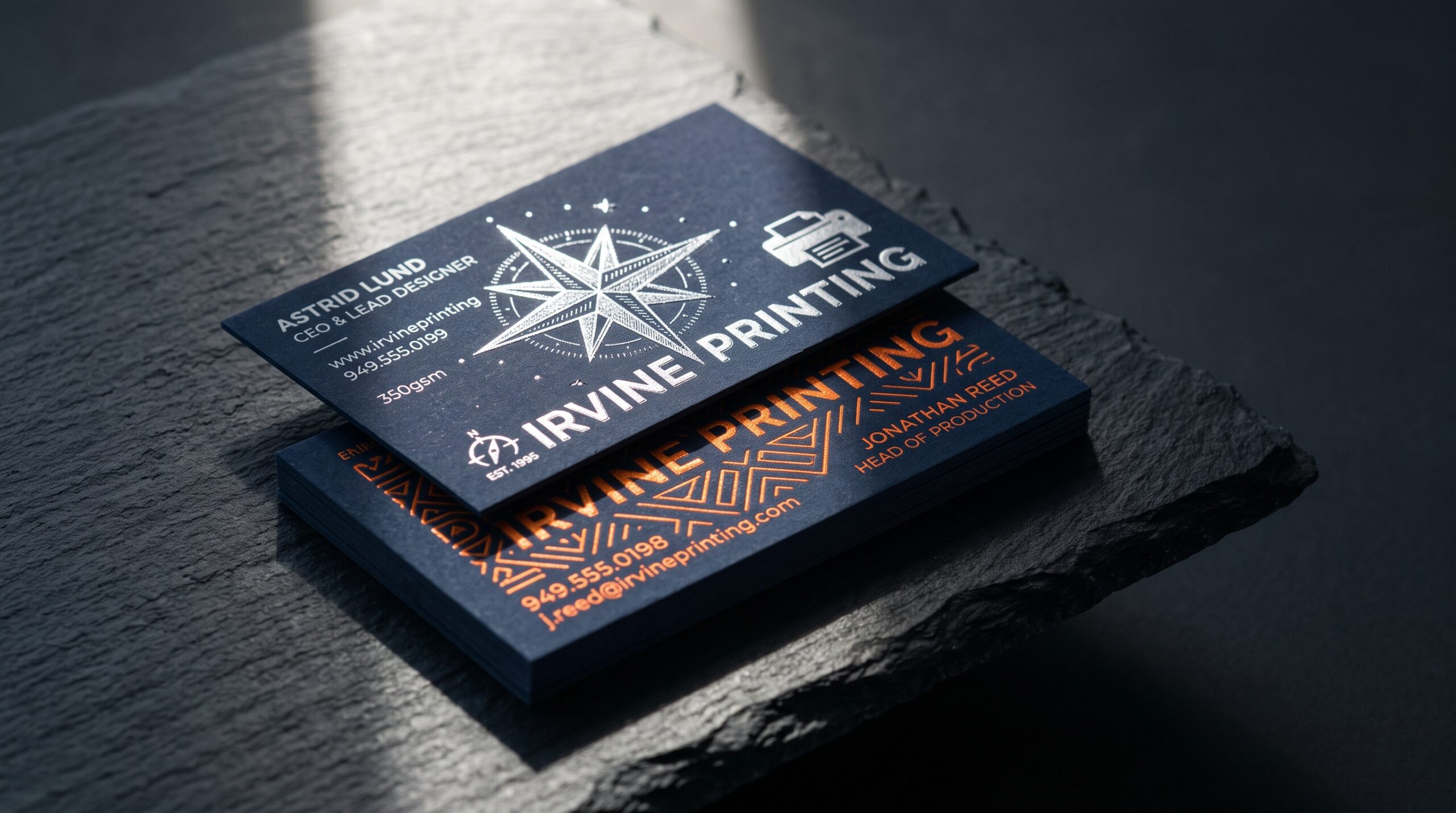
When you order premium business cards in Irvine, the two finishes you’ll most often debate are spot UV and soft-touch. Spot UV adds a glossy, raised coating to specific areas of the card, while soft-touch gives the entire card a matte, velvety feel. The right choice depends on your industry, how you distribute the cards, and the impression you want to leave. If you want a card that feels expensive and gets noticed, spot UV is often the stronger option. If you want understated elegance and a surface that resists fingerprints, soft-touch is worth a serious look.
What Spot UV Actually Does to a Business Card
Spot UV applies a clear, glossy coating to selected parts of the card—usually your logo, name, or a graphic element. The coating is applied after printing, and it sits on top of the paper. On thick stock, the UV coating creates a physical raised texture you can feel with your fingertip. This contrast between the matte base and the glossy highlight is what makes the card pop.
In Irvine, where tech startups and creative agencies compete for attention daily, the raised effect is a proven way to make a card memorable. It’s not subtle. When someone runs their thumb across the card and feels the raised logo, they pause. That pause is the entire point of a business card.
Direct-to-Substrate UV Printing Options
Most print shops in Irvine use standard offset or digital presses for spot UV on paper. But some, like Irvine Printing, also run an Océ Arizona 460 GT flatbed UV printer. That machine prints and cures UV ink directly onto rigid materials like acrylic, wood, and metal up to 4×8 feet and two inches thick. For business cards, this matters if you want a card that isn’t paper at all—a thin acrylic or metal card with spot UV is a completely different product and commands attention in a way paper never will.
What Soft-Touch Coating Feels Like
Soft-touch is a matte laminate or aqueous coating that leaves a velvety, almost suede-like texture across the entire card. It’s a full-surface finish, not a spot treatment. The coating softens the colors underneath, giving them a muted, sophisticated tone. Black cards with white text are the classic soft-touch application—they look like they cost twice what you paid.
The main advantage is tactile. People tend to hold soft-touch cards longer because the texture is pleasant. It also resists fingerprints and smudges far better than standard glossy or uncoated cards. If you hand out cards at networking events in Irvine where people are holding coffee and shaking hands, that resistance to smudging is a practical benefit you’ll appreciate.
Where Soft-Touch Falls Short
Soft-touch has a real weakness: durability. The coating can scuff or wear down over time, especially if the card lives in a wallet or gets rubbed against other cards. The velvety feel can become smooth or shiny in high-wear areas. It also doesn’t offer the raised dimensional effect that spot UV provides. If your goal is to make the card visually jump out of a stack, soft-touch won’t do that.
Spot UV vs. Soft-Touch: A Direct Comparison
| Factor | Spot UV | Soft-Touch |
|---|---|---|
| Texture | Raised, glossy on selected areas | Velvety, matte across the entire card |
| Visual Contrast | High—gloss vs. matte base | Low—uniform matte finish |
| Fingerprint Resistance | Good on coated areas, less on base | Excellent across the whole card |
| Durability | Very good—UV coating is tough | Fair—can scuff with heavy use |
| Best For | Logos, icons, creative layouts | Minimalist, text-heavy designs |
| Perceived Value | Modern, high-tech, premium | Luxury, understated, elegant |
Cost Factors in Irvine: What Drives the Price
Both finishes add cost over a standard matte or glossy card, but spot UV typically costs more. The reason is setup and labor. Spot UV requires a separate plate or a digital mask to define exactly where the coating goes. That setup fee is baked into the job. Soft-touch is a full-coverage lamination process, which is simpler and faster to run.
Here are the main cost drivers for both:
- Card stock weight: 16pt or 32pt thick stock costs more than standard 14pt, but spot UV needs thick stock to create a meaningful raised effect.
- Coverage area: A spot UV logo covering 10% of the card is cheaper than covering 80% of the card with a glossy pattern.
- Quantity: Setup costs spread across 1,000 cards make each card expensive. At 5,000 cards, the per-card cost drops significantly.
- Turnaround time: Rush orders in Irvine typically add 20–30% to the total. Plan ahead if you’re on a budget.
- Material choice: Standard paper is cheapest. Acrylic, metal, or wood cards with UV coating are a different price tier entirely.
In practice, a run of 500 spot UV cards on 16pt stock might cost $120–$180, while the same run in soft-touch might be $90–$140. That gap narrows as quantity increases. For a run of 2,500, the difference often shrinks to less than $40 total.
How to Choose Based on Your Industry
Your industry should drive the decision more than personal preference. A real estate agent in Irvine handing cards to home sellers wants a card that feels substantial and trustworthy—soft-touch with a dark, muted color scheme works well. A graphic designer or branding agency wants to show off visual skills—spot UV with a bold logo on a matte base demonstrates exactly what they do.
Industries That Favor Spot UV
- Tech and software: The glossy, raised effect reads as modern and precise.
- Creative agencies: Shows off design capability and attention to detail.
- Photography and videography: A glossy highlight on a photographic image enhances the visual.
- Architecture and construction: The dimensional feel aligns with building and structure.
Industries That Favor Soft-Touch
- Real estate: Understated luxury matches high-end property marketing.
- Finance and legal: Conservative, professional, and fingerprint-free.
- Beauty and wellness: The velvety texture feels soft and approachable.
- Luxury retail: Matches the tactile experience of high-end packaging.
Common Mistakes to Avoid When Ordering
The most common mistake is choosing a finish before confirming your card stock. Spot UV on 14pt paper barely raises at all—you need 16pt or thicker to feel the effect. If you order spot UV on thin stock, you’ll pay for a premium finish you can’t actually feel.
The second mistake is ignoring the back of the card. A spot UV logo on the front and a plain uncoated back feels unbalanced. Either apply spot UV to both sides or leave the back completely clean. The same logic applies to soft-touch—if you laminate only the front, the card will curl slightly as the moisture content changes.
Third, don’t use spot UV on tiny text. The coating is applied in a separate pass, and registration can shift a fraction of a millimeter. For text smaller than 8pt, the UV coating can blur the edges. Reserve spot UV for your logo, icons, or large typography.
Finally, watch your contrast. Spot UV works best when the base card is matte or uncoated. If your entire card is already glossy, the spot UV effect disappears. The whole point is the contrast between the two surfaces.
What to Ask Your Printer Before You Order
Before you commit to a finish, ask your Irvine print shop these specific questions:
- What stock weight do you recommend for spot UV to get a visible raised effect?
- Do you offer a digital proof showing where the UV coating will be applied?
- Is the soft-touch coating water-based or a laminate film? Film is more durable.
- What is the turnaround time for a 1,000-card run with spot UV?
- Can you show me physical samples of both finishes on the same stock?
Physical samples matter more than any online description. A sample lets you feel the difference between a 16pt spot UV card and a soft-touch card on the same paper. That comparison is the only way to make a confident decision.
Frequently Asked Questions
Can you combine spot UV and soft-touch on the same card?
Yes. This is a popular combination—soft-touch as the base coating and spot UV on top of it. The result is a velvety card with a raised glossy logo. It’s the most premium option available and costs more because it requires two separate coating passes. If your budget allows, this combination is the best of both worlds.
How long do spot UV business cards last?
Spot UV coating is durable and won’t peel or flake under normal use. The raised effect can wear down slightly over months of constant rubbing in a wallet, but the card itself will last years. Soft-touch is more prone to scuffing and can develop shiny spots where it rubs against other cards.
Which finish is better for scanning or writing on the card?
Neither finish is ideal for writing. Spot UV areas are slick and resist ink. Soft-touch is slightly porous, so ballpoint pen works but can smudge. If you need to write notes on cards, leave an uncoated area on the back for that purpose. Some Irvine businesses order cards with a spot UV front and a completely uncoated back for this reason.
Making the Final Call
If you’re still deciding, start with how the card will be used. Cards handed out at a trade show booth in Irvine need to survive a day of being shuffled, dropped, and pocketed—soft-touch handles that better. Cards handed to a single client in a one-on-one meeting can be more delicate and impressive—spot UV on thick stock creates the memorable moment.
For most businesses, the safest premium choice is spot UV on a matte base with 16pt or thicker stock. It gives you the visual contrast, the tactile raised effect, and the durability to last. Soft-touch is the better choice when you want understated elegance and don’t need the card to stand out visually. And if you have the budget, combining both gives you a card that feels like a product, not a piece of paper.
Whichever you choose, order physical samples first. In Irvine, where the bar for design and production quality is high, a sample run of 10–20 cards is a small investment compared to a full run you’re unhappy with. Get the samples, feel the difference, and then commit.
Visit Irvine Printing