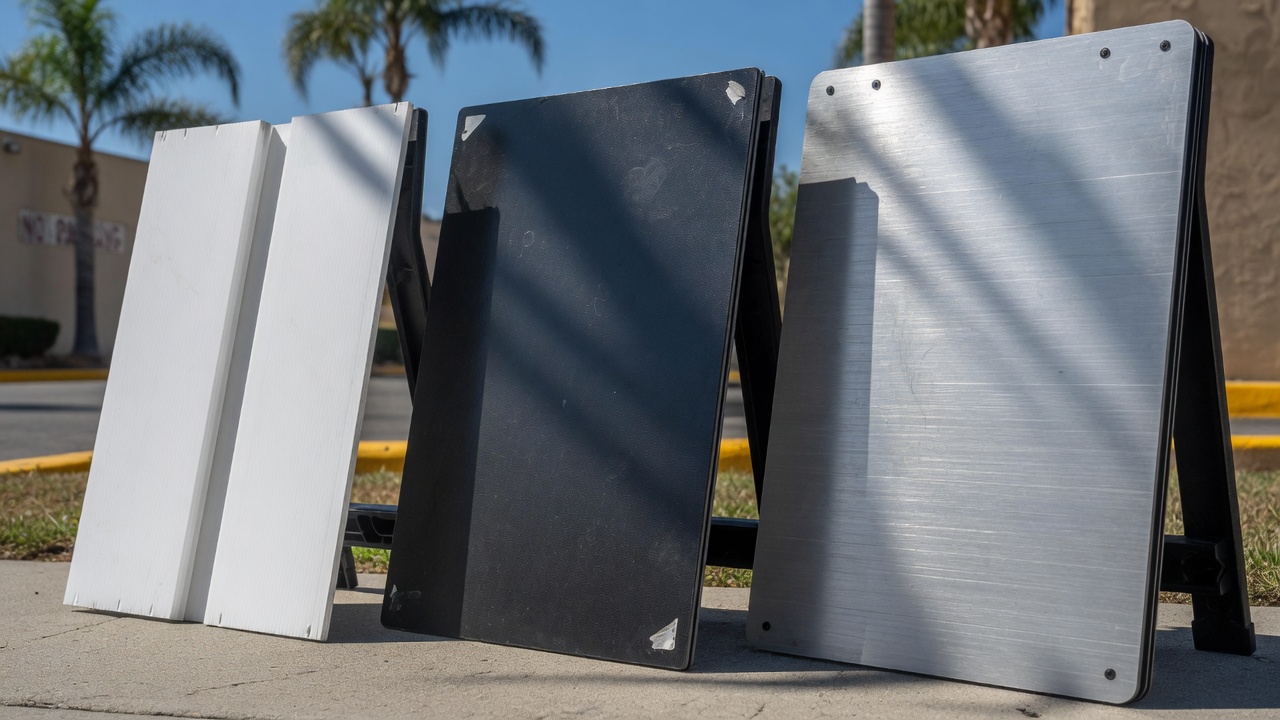
Coroplast vs aluminum signs is a duration and hardware choice. Coroplast is the short-term outdoor board you slide onto H-stakes. Solid aluminum and ACM are the long-term panels you frame, screw, or post-mount. Expanded PVC sits between them. Avanti Printing at 15321 Barranca Pkwy, Irvine, CA 92618 prints those boards. Quotes confirm size, material, quantity, finish, and date.
The search phrase sounds like a materials-science argument. On the counter it is simpler. How long does the graphic have to look intentional in Orange County sun? Will Santa Ana wind treat it as a flag? Are you pushing wire stakes into turf, hanging a frame on a post, or screwing a panel to stucco? Answer those three and the board almost picks itself. Get them wrong and you own a faded rectangle that flew into a planter, or a metal panel you tried to hang like a campaign sign.
This is an outdoor rigid-sign article: corrugated polypropylene (the product everyone still calls Coroplast), expanded PVC (Sintra and cousins), aluminum composite (ACM / Dibond), and solid aluminum sheet. It is not a hanging-vinyl article, not a lobby-materials catalog, and not a debate about which press family prints short-run work. We put UV-cured ink on these boards in the same building as rigid sign printing in Irvine. The board, the thickness, and the hardware are the job. Call (949) 387-0787 if you already have a dead sign in the car and want the next one specified like an estimator instead of a catalog page.
Who this is for in Irvine and Orange County
You are shopping coroplast vs aluminum signs because someone on your team said “we need signs out front” and then went quiet on how long they stay, what they mount to, and whether the landlord will allow them. Typical callers from Irvine, Tustin, Costa Mesa, Lake Forest, Laguna Hills, Santa Ana, Newport Beach, and the John Wayne Airport office corridor are not asking what plastic is. They are asking which board will still be on the property after a weekend, a quarter, or a few summers.
Drive-in radius is local. We are at 15321 Barranca Pkwy, Irvine, CA 92618. Buyers from the Spectrum, the Irvine Business Complex, University Research Park, medical suites on Barranca and Alton, and retail along Jamboree treat this as a counter job. If the panels have to be crated to a job site in Anaheim or a store in Costa Mesa, say so before we print a 4×8 of ACM you cannot stand on edge in a sedan.
This guide is for California buyers who will own the install. It is written in second person because you are the one who will push stakes into wet HOA turf, drill a parking-lot post, or explain a west-facing wall to a property manager. It is not for someone collecting mood boards. If the graphic is actually a hanging vinyl, a window film, or a vehicle, stop forcing a rigid board to do that work. Keep the ticket on rigid sign printing when the object is a board with a face, hardware, and a place to live outdoors.
- Retail and restaurant operators near Irvine Spectrum Center who need a sidewalk board, a parking-lot directional, or a “now open” panel that will not look tired in six weeks of west sun.
- Leasing and property teams in Irvine Company parks who need temporary occupancy signs that come down clean, plus longer-term lot panels the sign program will actually accept.
- Contractors and developers who need job-site ID, safety, and wayfinding on posts or fences — as boards, not as a substitute for a scaffold wrap.
- Campaign, school, church, and civic groups who live on 18×24 coroplast and H-stakes and want to know when that product stops being honest.
- Facilities people who were handed “aluminum signs” in an email and need to know whether that means ACM, painted sheet, or a traffic-grade blank.
If you are a home-based business in Woodbridge, Turtle Rock, or Northwood, read the HOA section before you fall in love with a 24×36. We will still print it. The architectural committee will not grade us on flute direction.
Four outdoor boards, one decision
Start with duration and mount, not with a PDF named FINAL_v12. The same artwork is four different products on 4 mm fluted polypropylene, on 6 mm expanded PVC, on 3 mm ACM, and on 0.063-inch aluminum. If your email says “outdoor signs” and attaches a PNG, you have not specified a job. The table below is shop practice for Irvine outdoor work, not a warranty table and not a lab report.
| Board | What it is | Typical outdoor life in OC (honest range) | Default hardware | Do not use it for |
|---|---|---|---|---|
| Coroplast (fluted PP, often 4 mm) | Corrugated polypropylene; light, waterproof, slightly ribbed face | Weeks to a season looking intentional; longer in shade if you accept chalking and brittle edges | H-stakes, step stakes, A-frame inserts, zip-tied to a fence as a short-term board | A permitted wall sign, a multi-year parking panel, anything you will treat as architecture |
| Expanded PVC (Sintra / Komatex class, 3–6 mm) | Foamed PVC; smooth face, easy to cut, stiffer than coroplast, no flutes | Months to a couple of years if shaded or north-facing; heat and sun retire it sooner on west walls | Frames, screws with washers, A-frame faces, short-term wall; not H-stakes through flutes | Unshaded multi-year monuments, large dark 4×8 sheets that will live in a parked-car heat cycle |
| ACM / Dibond (usually 3 mm) | Two thin aluminum skins on a polyethylene or FR core; flat, sign-shop default | Years on a competent hang; ink and fasteners still age | Screws, frames, posts, standoffs, raceways — not wire stakes | A lawn campaign run, a board you expect to flex in wind like plastic |
| Solid aluminum (often 0.040–0.080 in) | One piece of coated aluminum; no plastic core; dents instead of warping | The long outdoor clock if the coating and ink were meant for weather | Posts, frames, radius-corner blanks with holes, bands on poles | A cheap 18×24 you will toss after Open House |
Read the hardware column twice. Coroplast vs aluminum signs is not “which one photographs better on a conference table.” It is whether you have turf and a weekend, or a post and a year. Expanded PVC is the board people order when they wanted aluminum smoothness at plastic money. Sometimes that is correct. On a west parking-lot face in August, it is how you buy a potato-chip.
Thickness is part of the material name. “Coroplast” is not a thickness. Four millimeter is the everyday yard-sign sheet in this trade. Six millimeter and 10 mm exist when you want more stiffness and you still want flutes. “PVC” without 3 mm or 6 mm is a shrug. “Aluminum” without 0.040, 0.063, or 0.080 — or without ACM versus solid — is how two quotes disagree by a factor of two and both are technically aluminum. Put thickness on the ticket with size.
If you are torn, decide what has to win: cheap replaceability, a smooth face, a flat hang in sun, or a metal edge that will still be metal after a cart hit. Replaceability means coroplast. Smooth short-term face means PVC. Flat multi-year hang means ACM. Metal edge and dent-not-warp means solid aluminum. Trying to make 4 mm fluted PP do the last two is how a “permanent” sign looks like a leftover election.

Let Irvine sun and Santa Ana wind veto the board first
Other articles in this series walk materials, then weather. Flip it. In Orange County the climate is not a footnote. It is the filter that should kill half the quotes before anyone talks about CMYK.
West- and south-facing walls along Barranca, Jamboree, and the parking-lot side of Spectrum-area retail take a long UV dose and a lot of heat. Dark ACM and dark aluminum become griddles. Dark PVC oil-cans. Coroplast chalks and then gets brittle. North walls and deep overhangs are a different diet. If you do not tell us the facing, we will still print. We will also still ask, because a “two-year outdoor PVC” sentence is marketing copy until you name the wall.
Wind is the fast clock. Santa Ana events — dry offshore wind, most common from fall through spring, often warm as the air drops toward the coast — do not need to be a hurricane to matter. You need a gust that turns an undersized stake into a pivot, or a 24×36 of ACM on two drywall screws into a sail.
A rigid outdoor sign is a small sail with a brand on it. Area, height above grade, and whether air can get behind the panel matter more than whether the sample felt “sturdy” in an air-conditioned lobby.
Geometry that actually fails here:
- 18×24 coroplast on one tired H-stake in wet turf after an irrigation cycle, then a canyon-fed gust. The board is fine. It is in the next driveway.
- 24×36 or 4×8 coroplast treated like a yard sign. That is a kite. Two stakes do not make it a wall.
- PVC or ACM screwed only at two corners on a stucco face, with a gap that lets air get behind. The fasteners become the tear points — or the stucco does.
- A-frames left out overnight in a named wind event. They walk, they flop, they take a corner chip. Bring them in or weight them on purpose.
- A 4×8 of 3 mm ACM carried across an open dock on a Santa Ana day as a one-person job. That is a kinked 4×8, not a print defect.
Irrigation is the supporting actor in Irvine office parks. Clock-driven spray hits the bottom of post-and-panel signs every night with mineral water. The board may be waterproof. The soil around a stake is not a foundation. Calcium spots on a dark face look like fade until you rinse them. Walk the install at 7 a.m. if the landscaping contractor is proud of coverage.
Heat storage before the install counts too. Expanded PVC and coroplast left in a closed car on Barranca in August will take a set. ACM cares less. If the boards arrive bowed, we may wait, weight them, or recut. That wait belongs on the calendar. Do not make the needed-by date the same afternoon you discovered the banana.
Coastal jobs — Newport, Costa Mesa near the water, Huntington — add salt to hardware. The plastic and the aluminum skins are not the first things to quit. Steel screws, cheap frames, and untreated posts are. Spec stainless or coated fasteners for a long hang near marine air. Inland Irvine still cooks color. It just rusts slower.
Coroplast: flutes, 4 mm, and the honest short-term board
Coroplast is a brand that became a noun, the way people say Kleenex. The sheet is corrugated polypropylene: two walls and a flute structure, light, waterproof, and slightly ribbed when you catch light across it. Print shops buy it because it cuts with a knife or a board cutter, it takes a stake in the flutes, and it is cheap enough to reprint when the date changes. That last sentence is the product. If you wanted a board you would never reprint, you wanted a different row in the table.
Thickness and flute direction
Four millimeter is the everyday outdoor coroplast in this trade: 18×24 and 24×18 yard-size boards, 12×18 riders, small parking inserts. Six millimeter is stiffer, heavier in the hand, and still stakeable if the flute is sized for the wire. Ten millimeter exists for when someone wants a fluted board that does not flutter as much; it is not a secret aluminum. Say millimeters on the quote. “Standard coroplast” is not a thickness any more than “standard aluminum” is.
Flute direction is the spec buyers skip and then blame on the stake. H-stakes and many step stakes slide into the flutes. The flutes must run vertical on a portrait board if you want the wires to drop in from the bottom. If we cut the sheet with flutes running the short way, you will stand in a parkway on Saturday morning trying to invent a mount. Mark “flutes vertical for stakes” on the ticket. If the board is a fence tie-on or an A-frame face with no stake, flute direction is a stiffness choice, not a hardware slot. Vertical flutes make a portrait board stiffer in the up-down axis. Horizontal flutes make a landscape board stiffer across the width. Tell us how it stands.
Parent sheets commonly land at 4×8 feet. We cut 18×24s out of that parent. Finished size and parent size are different numbers. If you need a 48×96 fluted panel, say whether that is the sign or the sheet we start from. A full-sheet coroplast “wall” in Santa Ana wind is still a sail made of polypropylene. I will try to talk you out of staking it. I will print it if you insist and you have a real frame.
What the face will and will not do
The print face is not Sintra-smooth. You will see a hint of flute under grazing light, especially on large flood fields and photographs. Type and logos at yard-sign distance still read. A reception-distance photograph on 4 mm fluted PP is the wrong object. If the viewing distance is a parking-lot aisle or a parkway, coroplast is honest. If someone will stand two feet away and judge smoothness, move to PVC or ACM.
Direct UV ink on a clean, dry sheet is the process we run on the rigid bed. Adhesion is generally good on the polypropylene faces we stock. It is not a powder-coat. First-surface ink on coroplast will scuff if you stack boards print-to-print and slide them in a trunk. Keep a slip sheet. Do not drag a printed face across asphalt while you wrestle a stake. That scuff is handling, not “the ink failed in the sun” on day one.
Double-sided is the normal ask on yard-size coroplast. We print both faces. Opacity is decent on 4 mm white. A heavy flood of bright yellow on one side can still ghost a little onto a very light opposite face in strong sun. If both faces are busy photographs, say so. We may talk about a heavier sheet or a different board. A one-color mark on each side of white 4 mm is not a ghosting drama.
White sheet is the default. Colored coroplast (yellow, especially) is a political and event habit. Colored sheet means the unprinted edge and any chip is that color, and it means white ink if you want opaque color that is not the sheet. Build a white channel when the face is not white. Do not send a flattened RGB file and a note that says “yellow board, make the logo pop.”
Outdoor life without fake year-counts
Polypropylene in Orange County sun does not rot. It weathers. The sheet chalks, the edges get tired, impact starts to crack instead of flex, and the ink looks less new. Typical shop talk for an unshaded 4 mm yard board that is still doing brand work is weeks to a season. A shaded north patio board can look presentable longer. A west-facing 4 mm panel left up from January to January will usually look like you forgot it. Those are typical industry ranges, not a warranty and not a promise about your exact magenta.
Water is not the enemy. Coroplast does not wick like cardboard. Standing irrigation, rain, and a hose are fine for the sheet. The enemy is UV plus time plus a stake that pulled out. If you need the same message for two summers on a parking-lot post, stop specifying coroplast because last year’s campaign used it. That is how a leasing office looks like a pop-up.
We print this product on the same UV flatbed as other rigid work. If you want the process background — bed size, vacuum, edge-to-edge — that lives under flatbed UV printing on rigid boards. This page is which board you should load, not how the gantry thinks.
Expanded PVC: smooth, handy, and heat-honest
Expanded PVC is the foamed board sold under names like Sintra, Komatex, Celtec, and Palight. People say “PVC sign” and mean this, not a plumbing pipe and not a vinyl banner. The face is smooth. The cut edge is a fine foam. It machines cleanly. It is lighter than ACM. It has no flutes, so an H-stake does not slide into it as if it were coroplast. If your install plan is “same stakes as the yard signs,” PVC is the wrong board or you need a different stake that clamps or screws to the sheet.
Three millimeter is the thin everyday sheet: window-adjacent posters that must stay rigid, small wall boards, A-frame faces that swap often. Six millimeter is the outdoor-leaning thickness in this family — stiffer, a more serious edge, still not a metal panel. Thicker PVC exists. Weight and cost climb. Flatness in sun does not magically become ACM.
Print quality is why people upgrade from coroplast. Floods look like floods. Fine type holds. Photographs do not pick up a flute rib. For a sidewalk menu, a short-term wall panel in a covered walk, or a retail insert, 6 mm PVC is often the right middle. For a two-year unshaded directory on a south stucco wall, it is how you get a bow you will photograph and send us as if we printed a curve.
Heat is the PVC conversation. Dark 3 mm and even 6 mm sheets in a west Irvine parking lot will move. The print can be perfect. The board takes a set. ACM was invented in part so you could stop having that conversation. If the panel is large, dark, and unshaded, I will steer you to ACM. If the panel is 18×24, light-colored, under an overhang, and you will replace it when the offer changes, PVC is proportionate.
Fasteners on PVC want washers. A drywall screw through 3 mm without a washer is a pull-through waiting for a gust. Do not overtighten. Foamed PVC compresses, then splits. Frames (aluminum snap frames, U-channel, poster frames) are the grown-up outdoor mount for this sheet because they support the edge and let you swap the face. That swapability is the feature. If you will never swap it, ask why you are not on ACM.
Cold-snap is a smaller Orange County problem than it is in a mountain town, but a 3 mm sheet flexed hard on a 45-degree morning can still crease. Do not roll PVC. Do not use it as a folding A-frame hinge. It is a rigid board. Treat the score-and-fold trick as a display-shop stunt, not as an outdoor spec.
UV on expanded PVC is real and slower than buyers fear for a seasonal hang, and faster than ACM for a multi-year hang. The sheet can chalk. The ink is still a film. Reverse print is not a PVC trick — the sheet is opaque. A clear coat is a conversation if hands and keys will abuse the face. It is not a five-year outdoor contract. Say outdoor, say facing, say how many months you want it to look like you meant it.
ACM and Dibond: the outdoor default panel
Aluminum composite material is two thin aluminum skins bonded to a polyethylene or fire-rated core. Dibond is the original display-grade brand from 3A Composites; their DIBOND product page describes pre-painted aluminum skins on a core, a very flat panel, and outdoor sign use. Other mills sell ACM. Say ACM or the mill name if you already bought sheet. Do not say “aluminum” if you mean a plastic core with metal faces. The edge tells on you: a black (or mineral) line between two skins is ACM. A solid metal edge is solid aluminum.
Three millimeter is the sign-shop default. Two millimeter exists and oil-cans sooner. Four millimeter and up exist when someone wants more stiffness or a specified system. Skins on display ACM are thin — on the order of 0.012 inch per face on many Dibond constructions — which is why the panel is light relative to a solid aluminum sheet of similar stiffness. 3A’s own language puts ACM at roughly half the weight of solid aluminum. That is a mill claim, not a scale ticket for your exact blank, but it matches why property managers like it: it hangs like a sign, not like plate.
Outdoor behavior is why ACM wins the long hang. It stays flatter than PVC in OC heat. It does not flute. It does not take an H-stake. It takes a screw, a frame, a standoff, a post clip, a raceway. The aluminum faces take UV-cured ink well when they are clean, coated, and meant for inkjet. White gloss and white matte are the everyday print faces. Brushed and color faces exist; brushed is directional — mark the grain. Mill-finish raw ACM is not a pretty print face until you treat it as a coating problem.
The core is the honest limit. A polyethylene core is not a fire-rated wall assembly, and it is not a marine bulkhead. Edge sealers exist for long-term exterior where you do not want the core to show or to take abuse. Many parking-lot panels live with a mill edge. If the panel is a feature at arm’s length, we can dress or cap the edge. If someone will pick at the core with a key, they will. Solid aluminum does not offer them a plastic stripe.
Parent size matters. Display ACM commonly stocks 48×96. Some colors and some lines stock 48×120, 60×120, or metric 49.2×98.4. Our UV bed is a 4×8-class table. A 48×96 parent fits. A 60×120 does not as one piece. If purchasing bought 5×10 because the distributor had it, tell us before we build a file to 48×96. Tiling a larger visual is a planned seam, not a surprise. For graphics bigger than a rigid parent, large-format printing for oversized panels is the other press family in the building — film or tiled boards, not a pretend 5×10 pass on this bed.
Dark ACM on a west wall in Irvine in August is still a griddle. The skins spread heat. Fasteners that pinch a hot panel, or holes with no room to move, oil-can the sheet. Oversized holes, proper washers, and a panel that can expand a little are the metal-shop answers. That is not an ink failure. Write the hanging method on the quote so we drill to it instead of watching someone put four interior screws into a 36×48 in the parking lot.
Two-sided ACM is two print passes, or one pass plus a second face later. A single flood of white is not a blockout if daylight sits behind a thin construction — but 3 mm ACM is already opaque for almost every parking-lot use. Two-sided here means you need copy on the back of a projecting panel or a double-faced post sign. Say which faces. Name the hinge edge if we print both sides before fabrication.
Fire-rated cores (FR ACM) show up when an interior specifier or a building program asks for them. Outdoor parking panels usually do not. If your architect wrote “Dibond FR” or a mineral core, keep that spec. Do not swap in commodity PE-core ACM to save a line item and then fail a submittal. We print after the sheet is the sheet they approved.
Solid aluminum: when you actually need metal
Solid aluminum is one piece of metal. No polyethylene stripe. No flute. It dents if a cart hits it. It does not bow like PVC. It feels like a sign to a city inspector and to a property manager who has been burned by plastic. It also costs more, weighs more, and is the wrong answer for a fifty-piece weekend stake run.
Thickness language in this trade is inches, not millimeters: 0.040, 0.063, and 0.080 are the blanks people actually order. Forty-thousandths is light — fine for small indoor-adjacent or very well-supported faces, easy to oil-can at parking-lot sizes. Sixty-three-thousandths is a common quality outdoor blank. Eighty-thousandths is the heavier parking and regulatory cousin, the one that still feels like a plate after you hang it. Those are typical shop ranges, not a structural calculation for a twenty-foot pole. If an engineer already specified thickness, we print that blank. We do not “value-engineer” 0.080 to 0.040 because it printed fine on a sample.
The coating is the print spec. Pre-painted or powder-coated sign blanks with a clean, fully cured face are what we want under UV ink. Bare mill aluminum is oily and oxidizes; it needs degreasing and usually a promoter or a paint system before it is a graphic. Brushed aluminum is a finish you either show or hide with white ink. If you walked in with a raw sheet from a metals distributor and said “aluminum sign,” we will talk coating before we talk CMYK. Direct UV on a compatible coated face is home turf. Direct UV on mystery mill oil is a tape-pull failure dressed up as printing.
Hardware on solid aluminum is holes, radius corners, frames, and posts. Traffic-style blanks often ship with radius corners and standard hole patterns. Your file should keep live copy off those holes. A phone number under a cap nut is a reprint. If the City or a landlord already drew the panel, send that drawing. We would rather print to their holes than invent a pattern that misses the embeds in a masonry monument.
Reflective sheeting (engineer-grade and high-intensity films used on MUTCD-style work) is a different product than UV ink on painted aluminum. If you need a code-reflective parking sign, say reflective and say which standard you were handed. Do not assume a pretty UV print on white aluminum will return headlights like a DOT blank. We will tell you when you have left graphic-sign territory.
Coastal and irrigation reality still applies. Aluminum oxide and a decent coat handle weather. Steel fasteners in marine air do not. Dissimilar-metal issues show up when someone mixes raw steel screws, aluminum panels, and wet stucco. Use the fastener the hang deserves. Painted heads, stainless, or a specified system — pick it on the quote, not in a hardware-store aisle after pickup.
When ACM is enough, use ACM. You get flatness, outdoor skins, and less weight. When a cart, a skateboard, a picking fingernail on the core, or a sign program that says “aluminum plate” is in the brief, use solid. When the brief is fifty 18×24 boards on H-stakes for Saturday, use coroplast and stop trying to make metal cheap.
Quote coroplast, PVC, or aluminum signs
Stakes versus frames versus wall fasteners
Hardware is the second half of coroplast vs aluminum signs. The board you love will fail on the mount you improvised. Pick the mount with the board, not after the stack is in the trunk.
| Mount | Boards that belong | Where it behaves in OC | Watch-outs |
|---|---|---|---|
| H-stake (wire, slides into flutes) | 4 mm / 6 mm coroplast, typically 18×24 or 12×18 | Turf, planters, parkway edges you are allowed to use; short-term | Wet soil after irrigation; one-stake 24×36; flutes running the wrong way |
| Step stake / heavy wire | Coroplast; some PVC if the stake clamps, not slides | Harder ground, slightly windier corners | Still not a 4×8 mount; still not HOA-proof |
| A-frame / sidewalk frame | Coroplast or PVC inserts; ACM if the frame is built for it | Storefront sidewalks you are allowed to occupy | Santa Ana nights; City and landlord sidewalk rules; take it in |
| Snap frame / poster frame | PVC, thin ACM, sometimes coroplast as a cheap insert | Covered walks, lot kiosks, walls where you will swap offers | Outdoor-rated frames only; indoor snap frames chalk and seize in sun |
| U-channel or angle frame | ACM, aluminum, 6 mm PVC | Posts, fences, long-term lot panels | Drainage at the bottom so the channel is not a planter |
| Direct screws / standoffs | ACM, aluminum, thicker PVC | Stucco, masonry, suite walls you may drill | Oversized holes on hot metal; washers on PVC; landlord permission |
| Post-and-panel | ACM or solid aluminum | Parking lots, driveways, campus edges | Footing, wind area, irrigation at the base; this is a sign, not a poster |
Stakes
An H-stake is two wires with a horizontal bar, sized so the uprights slide into coroplast flutes. Typical pairings in this trade are an 18×24 board on a 10×24-class stake, or a smaller rider on a shorter stake. Those pairings are shop practice, not a wind-load table. Push the stake into soil first, then slide the board down, or assemble and push as a unit if the ground is soft. Rocky Irvine planters and decomposed granite parkways will bend cheap wire. That is a site problem. A second stake, a heavier stake, or a different location is the fix — not a thicker ink film.
Two stakes on a 24×36 coroplast board are the minimum I will call honest in an open parkway. One stake is a pivot. A 36×48 on H-stakes is a conversation about whether you meant a frame. Full 4×8 coroplast on stakes is how you donate a billboard to the wind. If the message needs that much area outdoors, we are in posts, a fence-mounted ACM, or a different product family. I will say that on the quote instead of selling you eight wire stakes and optimism.
Soil moisture in this city is often irrigation, not rainfall. A stake that felt immovable at 2 p.m. can sit in soup at 6 a.m. after the clocks run. Walk Monday morning after a windy Sunday. Retrieving your 18×24 from a neighbor’s hedge is not a print warranty.
HOA turf and City parkways are permission problems. A legally printed board on a stake in a parkway you do not control is still a board you may be asked to pull. We print. We do not issue a right-of-way.
Frames
Frames are how you make PVC and ACM behave like products instead of like leftovers. A snap frame lets a retailer change an offer without reprinting hardware. Specify outdoor-rated springs and a weatherable face. Interior snap frames from a cubicle catalog will chalk, yellow, and seize on a west wall. U-channel on a post is the parking-lot adult: the panel slides or screws in, the post is set, the wind has a smaller gap to work. Drill drain holes or leave a gap at the bottom so the channel does not hold irrigation water against the core of ACM for a year.
A-frames are sidewalk theater. Coroplast inserts are the cheap, fast face. PVC inserts look smoother. ACM inserts last if the frame can take the weight. The failure mode is almost never the print. It is the frame blowing over, walking into a stall, or sitting out in a named wind event. Weight the feet if the manufacturer designed for weight. Take it in at close. Ask the City and the landlord whether a sandwich board is even allowed on that sidewalk. Spectrum-area retail and Irvine Company frontages often already answered that in a criteria book.
Pole bands and post brackets put ACM or aluminum on an existing light pole or lot post. Measure the pole diameter. Measure whether you are allowed to. Many parking lots are not your poles. A beautiful 24×36 banded to a city or utility pole is a beautiful violation.
Walls, stucco, and the “we cannot drill” suite
Direct-to-stucco screws through ACM are common and often ugly if you skip washers and a plan for the hole. Stucco is not a metal stud. Use the anchor the wall deserves. Painted heads that match the panel look like a sign. Four mismatched drywall screws look like a panic. Standoffs are an interior look that sometimes migrates outdoors; on exterior ACM they are a protrusion people hit and a hole pattern that collects water if you do not think. For long exterior wall signs, a frame, a raceway, or a permitted aluminum construction is usually cleaner than decorative barrels.
VHB and construction adhesives on exterior rigid boards are a size, weight, surface, and temperature conversation. A small interior PVC plaque on clean paint is one thing. A 24×36 of ACM on dusty exterior stucco in a heat cycle is how you get a floor sign and a stucco scar. If a building super says “just tape it,” that person will not be there when it falls. Mechanical fasteners or a frame, or a smaller board.
Landlord rules override hardware taste. Irvine Company parks, University Research Park, and medical buildings on Barranca often specify suite plaques, prohibit applied panels on corridor glass, and want approved vendors in common areas. Ask for the PDF before we drill a 3 mm ACM to a corridor standard we invented. Inside your suite you have more freedom. On the public face of the building you have a sign, and someone else may already own the look.
Files, two-sided work, and what the bed needs
Good outdoor boards die in prepress as often as they die on a stake. The printer is not confused. The file was built for Instagram.
Send vector for marks and type: PDF, AI, or EPS, fonts outlined, logos as paths. Photographs can be raster. Viewing distance sets resolution. A parking-lot panel read from thirty feet can live around 100–150 ppi at output size. An 18×24 that people will stand over while they pull a stake wants more — 150–200 ppi is a typical industry band. A 72 ppi web hero stretched to 24×36 on gloss ACM will look like a web hero. Metal and smooth PVC are happy to show you that. Coroplast flutes will not hide it; they will add noise.
Work in CMYK. RGB neons are a monitor event. If a brand red must hit a coated PMS number, say the number and understand the ground: that chip was printed on white paper. On yellow coroplast, on brushed ACM, and on a dark bronze aluminum, the same ink recipe is a different visual. Approvals that matter should be on the actual board. We can get close. We cannot promise a spectro reading from a paper book will land on a west-facing parking panel at 4 p.m.
Bleed: 1/8 inch past trim if ink goes to the edge and we cut after print. Safe type: keep live copy off stake insertion zones (the bottom few inches of a fluted yard board), off hole locations, and off frame lips. A QR code needs quiet field and a size a phone can focus on from the distance you actually expect. A QR dropped on a busy photograph at 0.6 inch on a lot panel is a decoration.
White channel: a spot color or a layer named WhiteInk, 100% where white ink should print, when the sheet is not a white ground. Yellow coroplast, black ACM, brushed aluminum, and colored PVC all need this decision. White in a CMYK file is a hole. On those faces, the hole is the sheet.
Notes that belong in the email, not in a Slack screenshot: finished size (width × height, view-side); board and thickness; flute direction if coroplast; single or double-sided; hole layer named Holes; indoor or sun-exposed and the facing if you know it; stakes, frame, or wall; quantity; date. If the panels are versioned (arrows left/right, suite numbers, dates), that is a template plus a list, not twelve files named FINAL.
Photographs of a previous sign, a website screenshot, and “it’s on our Google listing, can you pull it” are not print files. Rebuild time is design time. Put rebuild / not rebuild on the quote with size, material, quantity, finish, and date.
Mistakes that reprint an outdoor board
Reprints on these materials hurt because you paid for a board, a cut, and sometimes hardware, not only for ink. The pattern is boring and preventable.
- Coroplast specified for a two-year wall. The ink held longer than the polypropylene looked new. Use ACM or aluminum for the long hang.
- Aluminum specified for a fifty-piece stake run. You cannot slide 0.063 into an H-stake. Use coroplast, or budget frames.
- Flutes running the wrong way. Stakes will not enter. The Saturday crew will invent a mount with packing tape.
- One H-stake on a 24×36 in open wind. Pivot, then flight. Two stakes or a smaller board.
- PVC on an unshaded west 4×8. Oil-can. ACM exists for this.
- ACM on wire stakes. There are no flutes. You will drill a poor hole and watch it tear in a gust.
- No washers on PVC, or overtightened caps on ACM. Pull-through or a pinched, buckled panel.
- Type in the stake zone or under a hole. The phone number lives in the dirt or under a bolt.
- RGB or 72 ppi art on gloss ACM. The lot will see the jaggies even if you do not at arm’s length on a phone.
- No white on yellow coroplast or black ACM. The logo is a stain. Build the channel.
- Indoor snap frames left in OC sun. The frame fails first. Buy outdoor hardware.
- A-frames left out in a Santa Ana. The insert may survive. The corner of the frame and your glass may not.
- Steel screws in a coastal long hang. Rust stains on a still-good panel. Spec the metal.
- Landlord or City surprise. The board is perfect. The parkway or the monument was never yours. Check the binder first.
- Missing size, material, quantity, finish, or date. You get a range instead of a price, and a stack the day after the event.
Stacking printed coroplast face-to-face in a hot trunk deserves its own sentence. The boards will scuff and can offset. Slip sheets, or stack unprinted faces together until you stake. Peeling ACM masking in a dusty lot and then laying the panel on gravel is how a “defective” finish becomes dirt in the clear. Peel at install, on a clean surface, with two people on a 4×8.
Irvine landlords, HOAs, and City permits
Irvine is a planned city with a planned attitude toward signs. The print can be perfect and still be the wrong object in the wrong dirt. Check three desks, in this order: landlord or HOA, then the City if the sign is visible from the public side, then us.
The City of Irvine’s building-permit pages are explicit that certain sign types need a permit and that some types are prohibited. Start at the City’s sign rules for Irvine and the companion sign-permit instructions. Wall signs typically need an elevation, sign dimensions, and the length of the leased frontage. Temporary boards in a parkway, a panel on a monument you do not own, and A-frames on a sidewalk can all be someone else’s no. We can print to a permitted drawing. We cannot issue the permit, and we will not tell you an ACM panel on the building face is “probably fine” because the ink is cured.
Office parks — especially Irvine Company properties around the Spectrum, Jamboree, the Irvine Business Complex, and University Research Park — usually have a sign program. Suite plaques, directory strips, monument slots, and even “now leasing” boards may be specified: size, typeface, material, mounting. Your custom 24×36 coroplast may be allowed on a private job-site fence and forbidden on the street-facing turf. A long-term ACM hours panel on the glass may be a criteria violation even if it is a good print. Ask the property manager for the PDF before we cut a full sheet.
Residential HOAs in villages such as Woodbridge, Turtle Rock, Northwood, and University Park are not looking for a commercial aluminum panel on a garage, and they are often not looking for a row of 18×24s in the parkway either. Home-based businesses run into this constantly. If the CC&Rs say no commercial signage, a beautiful 0.080 aluminum blank will not charm the architectural committee. We will still print it if you insist. We will also still say you should read the document.
UCI and other campus facilities have their own brand and facilities rules. A temporary event board on coroplast is one queue. A post-and-panel in a campus lot is another. Bring the spec they already wrote. Anaheim, Costa Mesa, and Newport jobs that still pick up on Barranca bring their own city rules; do not assume Irvine’s packet applies. The constant is the quote: board plus location plus permission.
Construction sites have a separate habit of treating every board like a permit posting. If the City or the GC handed you a spec for an official project sign, follow that spec. Do not replace a required painted plywood or aluminum construction with 4 mm coroplast because it was cheaper on a previous campaign. We will print the board they specified. We will not invent compliance.
What to send so the quote is real
Send one email a person can estimate from. If you skip fields, you get a range, not a price. Walk-ins Monday–Friday, 8:00 a.m. to 5:00 p.m. at 15321 Barranca Pkwy, Irvine, CA 92618 are welcome if you bring the dead sign or a tape-measured size. You can also start on the Irvine Printing site with the same fields. Quotes confirm size, material, quantity, finish, and date. Add hardware and facing on this product line so we do not guess.
- Size. Width × height, view-side, in inches. If it tiles, the tile grid. If it is a standard 18×24, say 18×24, not “yard sign size.”
- Material and thickness. Coroplast 4 mm / 6 mm; PVC 3 mm / 6 mm; ACM 3 mm; aluminum 0.040 / 0.063 / 0.080 — or “recommend from duration and mount.” Sheet color if not white.
- Quantity. Identical versus versioned. Fifty matching 18×24s are a different setup than fifty names.
- Finish and hardware. Single or double-sided; flute direction; holes (count, diameter, offset); stakes (yes/no, who supplies); frame or post; edge treatment on ACM/aluminum; clear coat if the face will be abused.
- Site. Turf, parking lot, stucco wall, sidewalk A-frame, fence. Facing if outdoor. Coastal or inland. Landlord or HOA constraints if you know them.
- Date. The day it must be in the ground or on the post, not “ASAP.” A 4×8 ACM with holes and a double-sided print is not a while-you-wait counter job. A stack of 18×24 coroplast with a clean file is a different clock.
Attach the file or say you need a rebuild. State pickup versus crate versus install. State whether a brand manager, landlord, or GC must approve a proof. If an architect or a sign program already drew the panel, send that drawing. We would rather print to their holes than guess and drill twice.
If the same campaign also needs a wall mural, a window graphic, or a vehicle, list those as separate lines. Different process, different file, different finish. Mixing them into one “just make signs” instruction is how coroplast gets specified like a monument, or a monument gets specified like a stake board.
Send size, board, and hardware for a quote
Questions buyers ask before they pick a board
Is coroplast or aluminum better for outdoor signs in Irvine?
Neither is better in the abstract. Coroplast is better when the hang is short, the mount is an H-stake, the quantity is high, and you expect to reprint when the date or the candidate or the sale ends. Aluminum — ACM for most shop-made panels, solid sheet when you need a metal edge or a specified blank — is better when the hang is measured in years, the mount is a post, a frame, or screws, and Santa Ana wind plus OC sun are part of the brief. If you only remember one sentence: stakes want coroplast; posts and walls want aluminum. PVC sits in the middle for smooth, shorter outdoor faces that will not live on a wire stake.
How long will a 4 mm coroplast sign last in Orange County sun?
Plan on weeks to a season of looking like you meant it, unshaded. Shade and a north face stretch that. A full year on a west parkway usually looks like a leftover. The sheet will not dissolve in rain. It will chalk, get brittle, and look tired. Those are typical industry ranges, not a warranty. If you need two summers of a parking-lot message, stop buying 4 mm fluted PP because it worked for last month’s open house.
Can I put ACM or PVC on H-stakes?
Not the way you put coroplast on H-stakes. There are no flutes for the wire to enter. People drill holes and zip-tie PVC to a stake anyway. That hang is a tear and a pivot in wind. If you must have a smooth face in turf, use a frame designed for a step stake or a small post, not a borrowed H-stake. ACM on wire is worse: you paid for a metal skin so you could hang it like a campaign board. Buy the hardware that matches the board.
What thickness should I order?
Coroplast: 4 mm for 18×24 stake signs; 6 mm if you want more stiffness at similar sizes. PVC: 3 mm for small, protected, or insert work; 6 mm for outdoor-leaning boards that still are not metal. ACM: 3 mm unless a specifier wrote something else. Solid aluminum: 0.063 as a common outdoor blank; 0.080 when you want more plate; 0.040 only when the size is small or the support is continuous. If you are between two thicknesses, look at span, color (dark gets hotter), and whether anyone will lean on it. We would rather you over-spec ACM thickness on a lot panel than watch 2 mm oil-can.
Do I need double-sided printing?
Yes on stake signs that face two directions of traffic — most parkway 18×24s. Yes on projecting lot panels and A-frames. No on a wall-mounted ACM that only has an audience on one side. Double-sided coroplast is routine. Double-sided ACM is two faces of work; say so. Do not assume we will print the back because “it’s a sign.” Write front only or both sides on the ticket.
Will Santa Ana winds destroy the sign?
They will if the area is large, the mount is a single wire, or air can balloon behind a weakly fastened panel. They might not if the board is 18×24 coroplast on two honest stakes in firm ground, or 3 mm ACM in a post frame with real fasteners. Walk the site after a blow. Replace a starting tear or a bent stake. Area and geometry beat the brand name on the sheet. A small aluminum plaque on four anchors will outlast a 4×8 of anything on two screws.
What files do you need, and how fast is this?
Vectors for marks and type, CMYK, white as a spot or layer when the sheet is not white, actual size or a labeled scale, bleed if we cut after print, holes on their own layer, flute direction on coroplast, single- or double-sided named. Photos at a sensible ppi at size. Straightforward 18×24 coroplast with a clean file is a different clock from double-sided 4×8 ACM with a hole pattern and a landlord proof. Rush exists when the sheet is in house, the file is clean, and the finish is simple. Put the needed-by date on the quote. “ASAP” is not a date. Call (949) 387-0787 if the date is already too close; we will say yes or no.
When should I use PVC instead of coroplast or ACM?
Use PVC when you want a smooth face, a clean cut edge, and a hang that is months rather than a weekend or a decade — inserts, covered outdoor walls, short-term directories, A-frame faces that should look less fluted. Do not use it as fake ACM on a dark west 4×8, and do not use it as fake coroplast on H-stakes. If you are unsure, describe duration, sun, and hardware in one sentence. We will steer the board. Forcing one substrate to do all three jobs is how you get a compromise that satisfies nobody, including the wind.
Pick the board like the wind is coming
Outdoor sign printing in Irvine is a board-plus-hardware product. Coroplast vs aluminum signs is the fork: fluted polypropylene on stakes for the short, cheap, reprintable job; ACM or solid aluminum on frames, posts, and screws for the long hang in Orange County sun. Expanded PVC is the smooth middle when you stay honest about heat and mounts. Direct UV ink on those faces is how we put the graphic on the object at 15321 Barranca Pkwy. The climate and the fastener still run the clock.
Avanti Printing is at 15321 Barranca Pkwy, Irvine, CA 92618. (949) 387-0787. Bring size, material, quantity, finish, and date. Bring the facing and the mount if you have them. If the file is ready, we can talk like an estimator instead of a mind reader. If it is not, say that too. The stack will still be here. It will last longer if we do not have to guess whether your “aluminum” is a 4 mm stake board with ambition.