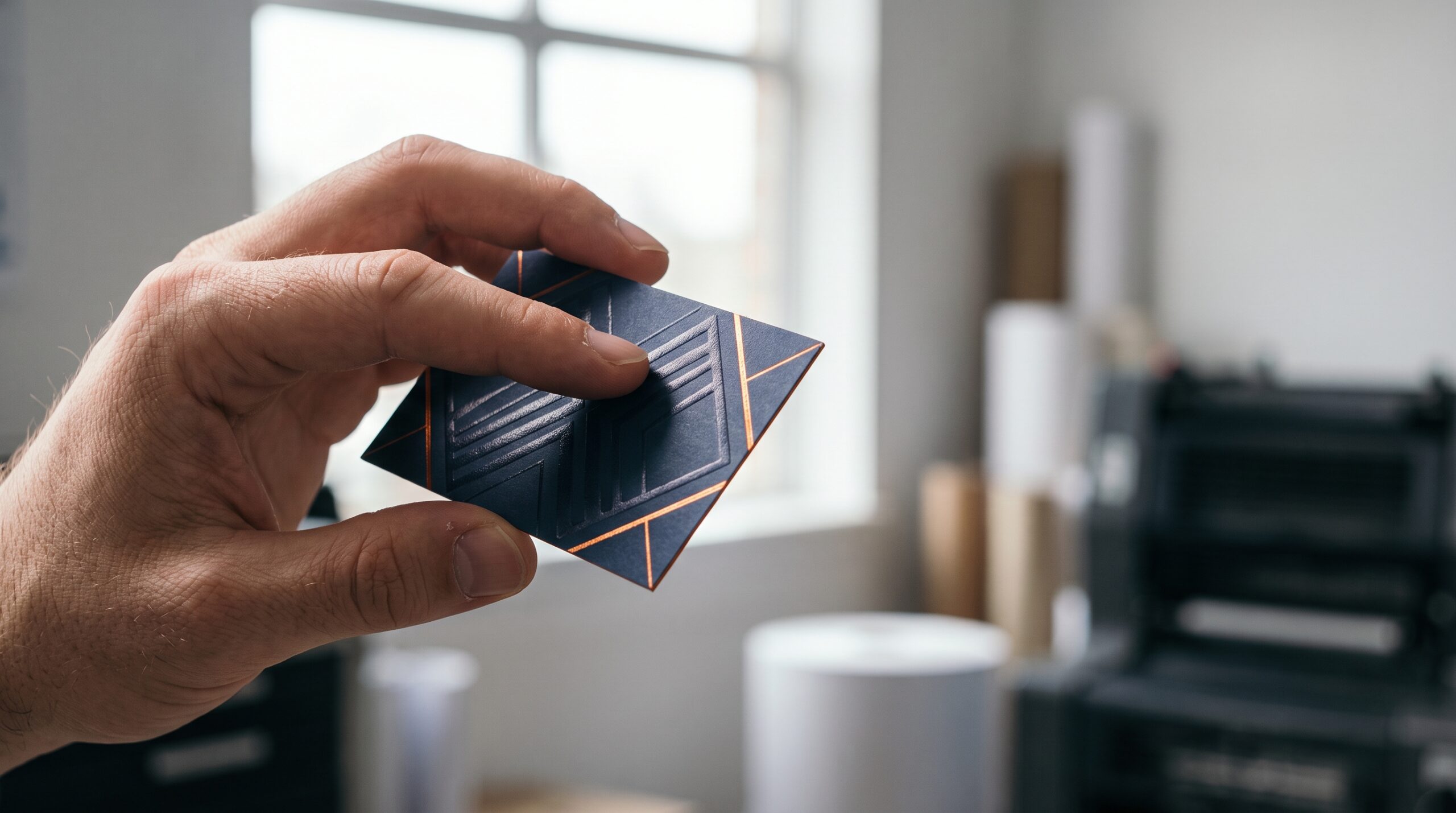
Foil stamping and spot UV coating are two of the most effective ways to make a business card or marketing piece feel expensive. But they are not always the right call. In Firestone Park, where local businesses compete for attention alongside larger Orange County firms, the decision comes down to your audience, your budget, and what you are trying to achieve. If you need a card that gets kept and referenced, these finishes can pay for themselves. If you are printing a high-volume piece meant for quick scanning, you are likely better off spending the money elsewhere.
What Foil and Spot UV Actually Do
Foil stamping applies a thin metallic layer to the surface of your card using heat and pressure. It creates a reflective, tactile finish that catches light. Spot UV does the opposite in some ways: it applies a clear gloss coating to specific areas, leaving the rest of the card with a matte or uncoated texture. The contrast between the shiny spot and the flat background is what draws the eye.
Both techniques add a physical dimension to a flat piece of paper. They signal that someone took time and spent money on their brand. In a stack of business cards collected at a networking event, a foil-stamped card stands out immediately. A spot UV card with a raised texture does the same. That is the core value proposition, and it is a real one for certain businesses.
When Foil Is Worth the Cost in Firestone Park
Foil is not a universal upgrade. It is a premium finish for a specific purpose. You should consider it when your card is a direct representation of your service quality.
High-Ticket Service Providers
If you are a real estate agent selling homes in the $1 million-plus range, a plastic or standard matte card undermines your positioning. Your card is often left on a kitchen counter after a showing. A foil-stamped card with a thick cotton stock feels like a piece of the property itself. The same logic applies to wealth managers, boutique law firms, and high-end interior designers operating around Firestone Park. These clients are not price-sensitive about print; they are sensitive to perceived value.
Luxury and Hospitality Brands
Restaurants, hotels, and event planners use foil to communicate a level of service before a single word is spoken. A gold foil logo on a deep black card says “upscale” instantly. If your Firestone Park business relies on referrals from satisfied customers who pass your card along, the tactile experience matters. People keep beautiful cards. They throw away ordinary ones.
Creative and Design Professionals
Ironically, many graphic designers and photographers underinvest in their own print collateral. If you sell visual work, your card is a sample of your taste. Foil stamping gives you a chance to show that you understand materials and finishes, not just pixels. A photographer handing out a standard glossy card is sending a mixed message.
When Spot UV Makes More Sense
Spot UV is often a better value than foil because it is less expensive and offers a different kind of visual interest. It is also more versatile for complex designs.
Brands with Strong Logos or Patterns
Spot UV works best when you have a specific element to highlight. If your logo has a clean shape, you can gloss that shape and leave the rest matte. The result is subtle but noticeable. It is an excellent choice for businesses with a modern, minimalist brand identity. Tech companies, architects, and fitness studios in the Firestone Park area often prefer this look because it feels contemporary rather than traditional.
Variable Data and High-Volume Orders
Foil stamping requires a metal die, which adds a setup cost. Spot UV also uses a die, but the process is faster and generally cheaper for runs of 1,000 cards or more. If you need 5,000 cards for an upcoming trade show or a direct mail campaign, spot UV gives you the premium feel without the premium price tag per unit.
Direct Mail Postcards
Spot UV is not just for business cards. A postcard with a glossy logo on a matte finish stands out in a mailbox full of standard coated stock. For local Firestone Park businesses running direct mail campaigns, this can lift response rates because the piece feels more substantial. It is a way to make a low-cost format feel like a high-end invitation.
Foil vs. Spot UV: A Direct Comparison
| Factor | Foil Stamping | Spot UV |
|---|---|---|
| Perceived Value | High — metallic, luxurious | Moderate to high — modern, subtle |
| Cost per Card (500–1,000) | $0.50 – $1.50+ | $0.30 – $0.80 |
| Setup / Die Cost | Higher (metal die per color) | Lower (often included or minimal) |
| Durability | Excellent — foil resists wear | Good — but can scratch over time |
| Best For | Luxury, traditional, high-touch | Modern, minimalist, high-volume |
| Design Complexity | Best with simple, bold shapes | Handles fine details and gradients |
| Turnaround Time | Slightly longer (stamping process) | Faster, integrates with digital print |
This is not a strict hierarchy. Some of the most striking cards I have seen combine both techniques: a matte card with a spot UV logo and a foil edge. That is a premium product, and it should be priced accordingly. But for most businesses, choosing one is the smarter move.
Cost Factors to Consider Before You Order
Do not assume foil and spot UV are out of reach. The price depends on several variables you can control.
Stock Weight and Material
Heavier stock costs more. A 14pt card is standard. A 32pt cotton card feels like a small plaque but can double your unit cost. For spot UV, you need a coated or matte laminate base for the gloss to adhere properly. Uncoated paper will absorb the UV coating and dull the effect. Plan for this when choosing your paper.
Quantity and Setup Fees
Foil requires a brass or magnesium die. That is a one-time cost, typically $50–$150 depending on the complexity of your logo. The more cards you print, the lower the per-card cost. At 250 cards, foil might be $1.00 per card. At 2,000 cards, it could drop to $0.40. Spot UV has a similar die cost but it is often lower. Always ask for a quote at two different quantities to see where the sweet spot is.
Number of Colors and Sides
Each foil color requires its own die and a separate pass through the press. Gold and silver are standard. Custom colors cost more. Printing on both sides also increases cost. If you are on a budget, limit foil to one side and keep the back clean for contact information.
How to Choose the Right Finish for Your Business
If you are unsure whether foil or spot UV is right for you, work through this quick checklist.
- Who is the recipient? If they are a potential client for a $50,000 project, invest in foil. If they are a referral source who just needs your number, spot UV is enough.
- What is your brand personality? Traditional and established? Foil. Modern and minimal? Spot UV.
- How many cards do you actually need? Under 500 cards, the setup fee dominates. Over 1,000, the premium finishes become more affordable.
- How will the card be used? Handed out at networking events? Both work. Mailed in a direct mail piece? Spot UV is more practical because it is flatter and less likely to be damaged in transit.
- What does your competitor’s card look like? If everyone in your industry uses standard gloss, either finish will differentiate you. If they already use foil, consider spot UV for contrast.
Common Mistakes to Avoid with Premium Finishes
These finishes can backfire if applied carelessly. I have seen several recurring issues in print jobs.
Overcomplicating the Design
Foil and spot UV are not for busy designs. If your card has a lot of text, small fonts, and multiple colors, the finish will compete with the information. The best results come from a simple layout with one or two focal points. Strip your design down before you add the finish.
Ignoring the Back of the Card
Many people spend all their budget on the front and leave the back blank. That is a missed opportunity. A foil logo on the back can make a card feel like a premium product even if the front is simple. Or use spot UV to highlight a QR code on the back to encourage scanning.
Choosing the Wrong Paper
Foil does not adhere well to rough, textured paper. Spot UV does not work on uncoated stock. If you have a paper you love, ask your printer whether your chosen finish is compatible before you commit. It is a frustrating surprise to find out after ordering.
Skimping on the Quantity
You will lose cards. You will give out more than you expect at a single event. Ordering only 250 cards to save money often leads to a reorder a few weeks later, which means paying the setup fee twice. If you are going to invest in a premium finish, order enough to last at least six months.
Local Considerations for Firestone Park Businesses
Firestone Park sits within the broader Orange County market, which means your card is competing with businesses from Irvine, Anaheim, and Santa Ana. The bar for print quality is high. A standard card from an office supply store will not make an impression. But you also do not need to go overboard if your business serves a local, repeat clientele.
For businesses that rely on local foot traffic—a café, a boutique, a salon—a spot UV card with a clean design is a smart investment. It looks professional without feeling pretentious. For service providers who travel to client offices or meet at properties, foil adds a level of authority that helps justify your rates.
Turnaround time is also worth considering. If you need cards for an event in three days, foil may not be feasible because of the die-making process. Spot UV can often be produced faster, especially if your printer uses a digital press with inline coating. Always ask about production time before you finalize your order.
What to Ask Your Printer Before Ordering
Not all print shops handle these finishes equally. Ask the right questions before you commit.
- Do you have a sample kit I can feel? You need to touch the finished product, not just look at a photo.
- Is the die cost included in the quote? Some shops hide it, which inflates the final bill.
- Can you show me a proof with the actual finish? A digital proof will not show the metallic reflection or the gloss texture.
- What is the minimum quantity for the price you quoted? Prices often change at 500, 1,000, and 2,500 units.
- Will the foil crack if I fold the card? This matters if you are printing a folded card or a mailer.
If you are working with a full-service commercial printer like Avanti Printing Inc, they should walk you through these options and show you physical samples. A good printer will also flag design issues before they become costly mistakes.
Frequently Asked Questions
Can I use foil and spot UV on the same card?
Yes, but it is an advanced technique. The foil is applied first, then the spot UV is layered on top. This creates a rich, multi-textured card. It is also the most expensive option. Use it sparingly for executive cards or special events, not for everyday distribution.
Will foil or spot UV work on a digital print job?
Spot UV can be applied digitally with certain equipment, which keeps costs down for short runs. Foil stamping is a mechanical process that works independently of how the base colors are printed. You can print the card digitally and then run it through a foil stamping press. This hybrid approach is common for small quantities.
How long does it take to get foil or spot UV cards made?
Standard turnaround is 5–7 business days for spot UV and 7–10 business days for foil, including die creation. If you are in a rush, ask about rush options. Some printers can turn around a spot UV job in 3 days if the design is simple and the die is in stock.
Making the Final Call on Foil and Spot UV
The decision is not about which finish is “better.” It is about which finish fits your brand, your budget, and your usage. Foil is a statement. Spot UV is a subtle signal. Both are worth the money when they help you get noticed, remembered, and contacted.
If you are in Firestone Park and you are tired of handing out cards that end up in the trash, the upgrade is worth exploring. Start with a small run of 500 cards to test the response. Track how many times someone mentions the card when they reach out. That feedback will tell you whether the premium finish is paying off. If it is, scale up your next order with confidence.
Visit Avanti Printing Inc