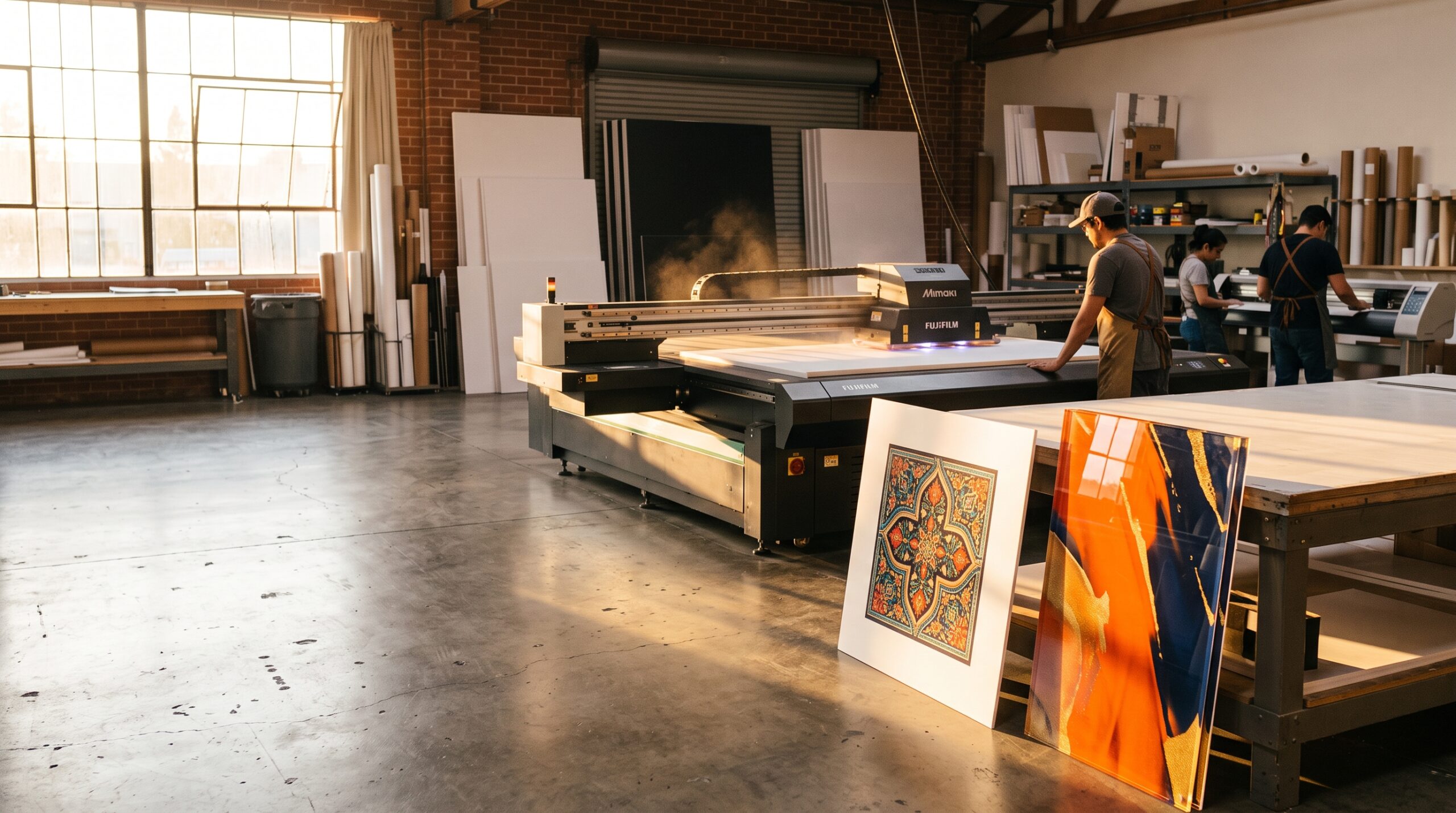
If you manage an office in Irvine, you are likely looking for durable, high-impact graphics for lobbies, conference rooms, or wayfinding. Foam board and acrylic UV prints are the two most common solutions for interior office signage. The short answer: choose foam board for temporary displays, trade shows, and cost-effective framing, and choose acrylic for permanent installations, modern aesthetics, and high-traffic areas. This guide breaks down the material differences, pricing factors, and installation steps specific to the Irvine market.
Why UV Printing Is the Default for Office Graphics
UV printing uses ultraviolet light to cure ink instantly as it is applied to a substrate. Unlike traditional aqueous printing, which soaks ink into paper, UV ink sits on top of the material. This creates a sharper image, better color saturation, and a scratch-resistant surface. For office environments in Irvine, where natural light is abundant and glass walls are common, UV prints do not fade quickly and can handle direct sunlight better than solvent or latex prints.
The process works on rigid materials up to two inches thick. That means you can print directly onto foam board, acrylic, wood, and even metal without mounting or laminating afterward. The result is a single, solid piece with no lamination bubbles or peeling edges.
Foam Board UV Prints: Lightweight and Budget-Friendly
Foam board is a polystyrene core sandwiched between paper or plastic facers. It is lightweight, easy to cut, and inexpensive. For Irvine offices, foam board UV prints are ideal for internal communications, project status boards, and event signage that will be swapped out quarterly.
Best Use Cases for Foam Board
- Internal wayfinding – department directories and restroom signs that need updating.
- Meeting room schedules – printed weekly or monthly on 24×36 inch boards.
- Trade show booth graphics – lightweight panels that ship easily and mount on portable stands.
- Temporary promotional displays – product launch posters in break rooms or lobbies.
Foam board is not ideal for permanent installations. The corners dent easily, and the material can warp if exposed to high humidity. In Irvine, where coastal moisture is less of a concern than inland heat, foam board will hold up fine indoors, but it is not a set-and-forget solution.
Acrylic UV Prints: Premium Look and Longevity
Acrylic, often sold under brand names like Plexiglas or Lucite, is a clear or colored thermoplastic sheet. When printed with UV ink, the result is a glossy, vibrant panel that looks high-end. Acrylic UV prints are the standard for Irvine office lobbies, executive suites, and permanent wayfinding.
Why Acrylic Costs More but Delivers More
Acrylic is heavier and more rigid than foam board. It does not warp, and it resists scratching better than most other rigid substrates. The material can be printed on the back side (reverse UV printing) so the image is protected behind the acrylic face, which is the preferred method for high-traffic areas where people might brush against the sign.
For a typical Irvine office, a 48×48 inch acrylic panel with a reverse print and standoff mounting hardware will run between $300 and $600, depending on thickness and finish. A comparable foam board print is usually under $100. The price difference is justified when the sign is permanent and represents your brand.
Foam Board vs. Acrylic: A Direct Comparison
| Feature | Foam Board | Acrylic |
|---|---|---|
| Thickness options | 3mm to 10mm | 1/8″ to 1/2″ |
| Weight (24×36″) | ~1.5 lbs | ~5-8 lbs |
| Durability | Low – dents and scratches easily | High – scratch-resistant, impact-resistant |
| Indoor lifespan | 1-2 years before fading or warping | 5-10 years with no visible degradation |
| Best mounting | Adhesive tape, Velcro, or frame | Standoff posts or flush mount |
| Typical cost (24×36″) | $25-$50 | $120-$250 |
| Best for | Temporary, replaceable, budget-conscious | Permanent, high-visibility, premium |
How to Choose the Right Substrate for Your Irvine Office
Do not default to one material. Walk through your office and categorize each sign by its expected lifespan and viewing distance. A sign that people will see from across a lobby needs different resolution and materials than a sign they will read up close at a desk.
Decision Criteria
- Viewing distance – If the sign is viewed from 10+ feet away, foam board is fine. If it is viewed from 2-3 feet, acrylic’s sharpness is worth the cost.
- Lighting conditions – Acrylic can be backlit or edge-lit for dramatic effect. Foam board cannot.
- Update frequency – If you change the content quarterly, use foam board. If it stays up for years, use acrylic.
- Mounting surface – Glass walls and painted drywall require different hardware. Acrylic with standoffs works on both. Foam board on glass looks cheap unless framed.
One common mistake is ordering acrylic for a sign that will be replaced in six months. Another is ordering foam board for a permanent lobby sign and then realizing the corners are dented within a week. Match the material to the expected lifetime.
The Production Process: What to Expect
When you order foam board or acrylic UV prints from a local Irvine print shop, the process is straightforward, but a few steps matter more than others.
File Preparation
Send vector files (PDF, AI, EPS) whenever possible. Vector files scale cleanly to any size. If you only have a raster image, ensure it is at least 150 DPI at final print size. A 24×36 inch poster needs an image that is at least 3600×5400 pixels. Most print shops will check this for you, but it is better to ask before you send.
Proofing
Always request a hardcopy proof or a digital proof with color calibration. UV inks can look different on foam board versus acrylic because of the surface gloss. Acrylic tends to make colors pop more, while foam board’s matte surface can mute dark tones.
Cutting and Finishing
Foam board is cut with a straight blade or CNC router. Acrylic is cut with a laser or CNC router, which leaves a polished edge if done correctly. Ask if the edges will be flame-polished (for acrylic) or left raw. Polished edges make a significant difference in the final appearance, especially for edge-lit signs.
Installation Considerations for Irvine Offices
Installation is where many office projects fail. A beautiful acrylic print mounted with the wrong hardware will sag or pull away from the wall. Foam board mounted with double-sided tape on a textured wall will fall off within a week.
Foam Board Mounting
For foam board, use a combination of mounting tape and mechanical fasteners for anything larger than 18×24 inches. Adhesive alone is not enough for large boards. If you are mounting on glass or a smooth surface, use clear acrylic mounting squares. On drywall, use a low-profile frame or push pins if the board is temporary.
Acrylic Mounting
Acrylic panels are typically mounted with standoff posts. These are metal or plastic cylinders that hold the panel 1/2 to 1 inch off the wall, creating a shadow gap that looks modern. For a 4×8 foot acrylic panel, you need at least four standoffs, one in each corner, and possibly two additional ones along the center edges to prevent bowing.
If you are not comfortable with a drill and level, hire a professional installer. A misaligned standoff layout is visible from across the room and looks unprofessional. Many Irvine print shops, including Irvine Printing, offer installation services as part of the project, which saves you the headache of coordinating a separate contractor.
Spot UV Coating: A Related Finish Worth Knowing
While foam board and acrylic are the main substrates for office signage, spot UV coating is a related finish that applies to printed paper products like business cards and presentation folders. Spot UV adds a raised, glossy layer to specific areas of a print, creating contrast against a matte background. This is a popular choice for executive business cards in Irvine’s corporate sector, where first impressions matter.
Spot UV is not the same as printing on acrylic. It is a coating applied to paper or cardstock. If you are ordering marketing collateral to match your new office signage, ask your print provider about combining a spot UV business card with your acrylic lobby sign. The visual consistency reinforces your brand.
Cost Factors and Budgeting
Pricing for UV prints on foam board and acrylic varies based on four factors: size, quantity, finishing, and turnaround time.
- Size – Larger panels cost more per square foot because they require more material and more careful handling.
- Quantity – Most print shops offer a per-unit discount at 5, 10, or 25 copies. For a single lobby sign, you pay full setup cost.
- Finishing – Polished edges, standoff holes, and mounting hardware add $20-$80 per panel.
- Turnaround – Standard turnaround is 2-3 business days. Rush orders (24 hours) typically add a 25-50% surcharge.
For a typical Irvine office project with two acrylic lobby signs (36×48 inches) and ten foam board wayfinding signs (18×24 inches), expect a total cost between $800 and $1,500 including hardware. That is a reasonable investment for a professional appearance that lasts years.
Common Mistakes to Avoid
Even experienced office managers make these errors. Here is what to watch for.
- Using low-resolution images – A logo pulled from a website will look pixelated at 36 inches wide. Always request original artwork files from your designer.
- Ignoring wall texture – Foam board on a textured wall will show gaps. Use a framed solution or switch to acrylic with standoffs.
- Choosing the wrong acrylic thickness – 1/8 inch acrylic is fine for small signs but will flex on a 4×8 foot panel. Use 1/4 inch for anything larger than 3 feet.
- Skipping the proof – Colors on screen rarely match printed output. A digital proof is not enough; ask for a physical sample if color accuracy is critical.
Frequently Asked Questions
How long do foam board UV prints last indoors?
Indoors, away from direct sunlight, a foam board UV print will look good for 1-2 years. After that, the paper facer can yellow slightly and the board may begin to bow. For anything you want to keep longer, use acrylic.
Can acrylic UV prints be used outdoors in Irvine?
Yes, but with caveats. Acrylic itself is UV-resistant and will not fade quickly. However, the ink must be cured properly, and the edges should be sealed to prevent moisture ingress. For outdoor applications, specify 1/4 inch acrylic and a UV-cured ink with a matte or anti-glare finish to reduce glare from the California sun.
Do I need a design file, or can the print shop create one?
Most print shops offer design assistance. If you have a rough layout, a logo, and the text you want, a designer can create a print-ready file for a nominal fee. This is often cheaper than hiring a separate graphic designer, especially for simple wayfinding signs.
Foam board and acrylic UV prints serve different purposes, and the right choice depends on your timeline, budget, and location in your office. For temporary or frequently updated graphics, foam board is the practical option. For permanent, high-visibility installations that represent your company, acrylic is worth the investment. Either way, work with a local printer who understands the materials and can guide you through file prep, proofing, and installation.
Visit Irvine Printing