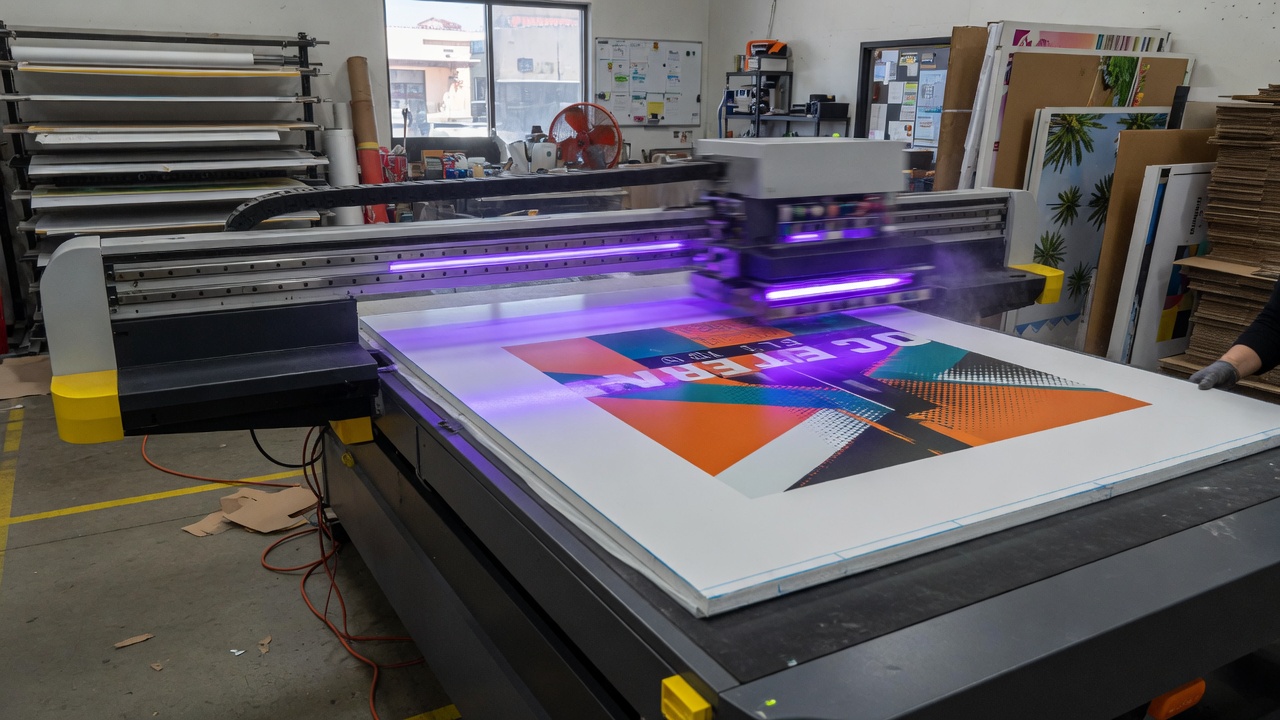
If you need flatbed printing near me in Irvine, you need a UV flatbed that will actually hold your sheet: up to 4×8 feet, up to about 2 inches thick, rigid, and flat enough for vacuum. Avanti Printing at 15321 Barranca Pkwy prints that work. Confirm size, material, quantity, finish, and date on the quote.
The search phrase is a location question. The useful question is a geometry question. A UV flatbed is a vacuum table with print heads that fly a fixed height above whatever you set on it. If the sheet is bigger than the table, thicker than the gantry will clear, warped so the vacuum cannot grab it, or flexible enough to lift into the heads, it does not belong on this press. The rest of this guide is that envelope: thickness, sheet size, jigs, edge-to-edge ink, registration, and the jobs that should go to a roll-fed printer instead.
We run this work on an Océ Arizona 460 GT. The rigid bed takes media on the order of 49.2 × 98.4 inches and up to 2 inches thick, with a print area a hair larger so true edge-to-edge is possible. Those are machine numbers, not a recommendation to hang a 2-inch slab or to send a 4×8 that you cannot get through a suite door. Quotes still confirm size, material, quantity, finish, and date. This article is how to send those five fields without pretending the bed is a magic box.
Who this is for in Irvine and Orange County
You are shopping flatbed printing near me because someone on your team said the graphic has to live on a board, a tile, a plaque, or an object, not on a roll of film. Typical callers from Irvine, Tustin, Costa Mesa, Lake Forest, Laguna Hills, Santa Ana, and the John Wayne Airport office corridor are facilities people, retail managers, fabricators who already cut the parts, agencies who were handed a 4×8 ACM spec, and owners who walked in with a sample and asked whether we can print “on this.”
That last sentence is the whole job. “This” might be a 3 mm aluminum composite sheet that vacuums down like a dream. It might be a stack of 4×8 expanded PVC that bowed in a hot van on Barranca. It might be fifty already-routed plaques that need a jig. It might be a piece of glass you do not want to flip twice. It might be a flexible graphic that should never have been on a flatbed in the first place. We are at 15321 Barranca Pkwy, Irvine, CA 92618. Call (949) 387-0787. Drive-in radius is local. If the panel has to be crated, say so before we print a 4×8 you cannot stand on edge in a sedan.
This is for you if you will specify a rigid substrate and you need to know whether it physically fits. It is not a tour of every lobby finish, not a card-coating article, and not a banner comparison. If the project is actually a roll of adhesive film, a fabric backwall, or a paper poster that will be mounted later, say that. The UV printing on a rigid flatbed we run here is direct-to-sheet ink, UV-cured as it lands. The sheet is the product.
Leased Irvine interiors change the geometry more than the printer model does. Irvine Company parks, University Research Park labs, medical suites on Barranca and Alton, and retail at the Spectrum often have elevator cabs, service corridors, and sign programs that cap what you can carry and hang. A 48×96 panel that prints cleanly can still lose to a 36-inch door. Measure the path out of our shop and the path into your suite before you fall in love with a full sheet.
- Fabricators and mill shops who already have cut parts and need print registered to those parts.
- Property and suite managers who need rigid IDs, directories, and wall panels that will not roll up.
- Retail and restaurant operators who want menus, window-facing boards, or dimensional pieces.
- Agencies handing off a board spec from an architect who drew 4×8 without asking about the bed or the elevator.
- Anyone who was told “just UV print it” and needs to know whether the object will clear the gantry.
The bed envelope: 4×8 feet and two inches
Start with the table, not the file. A UV flatbed has three hard limits: footprint, thickness, and flatness. Everything else is a conversation.
| Limit | Typical number on this bed | What that actually means | Where buyers get it wrong |
|---|---|---|---|
| Sheet footprint | About 49 × 98 in (a 4×8 sheet with a little air) | A 48×96 parent fits. A 60×120 parent does not, not as one piece. | Ordering 5×10 ACM because the mill sells it, then asking us to “just print the 4×8 part” without a cut plan. |
| Print area | Slightly larger than the sheet, enough for edge-to-edge | Ink can go off the sheet. Overspray lands on the bed or a mask. | Assuming full-bleed 48×96 with a polished edge is one pass and no trim. |
| Thickness | Up to 2 in (about 50 mm) | Heads will clear a thick object if it is flat and jigged. Most signs are a few millimeters. | Sending a 2-inch block because the spec sheet said 2 inches, then wondering why it looks like furniture. |
| Flatness / vacuum | The sheet must sit still under vacuum or under a jig | A bow, a twist, or a lightweight board that will not suck down is a head-strike risk. | PVC that cooked in a parked car, or a very light interior board the vacuum never seals. |
| Weight and handling | Two people for a full 4×8 of ACM or thick plastic | The bed will hold it. Your elevator and your installer may not. | Specifying one 4×8 when two 4×4 tiles would survive the building. |
Those rows are shop practice on a 4×8-class UV flatbed, not a lab certificate. Other shops run 5×10 or 8×12 tables. We do not. If your drawing is 60×120 of aluminum composite, we tile it, we cut the parent down, or we tell you the sheet does not fit. Do not send a 5×10 and hope the extra 12 inches hang off the end. They will not print, and they will fight the gantry.
The same honesty applies to small work. A 3×4 inch plaque fits the bed the way a postage stamp fits a dining table. It will print. It will also skate unless we jig it, tape it, or nest it with siblings on a template. Small is not easier. Small is a registration job.
If the graphic is larger than 4×8 and it must be one visual, we tile rigid sheets with planned overlaps or we move the oversized color to a different process under large-format printing for oversized graphics. Tiling is not a failure. It is how interiors larger than a parent sheet get built without lying about the table.
Thickness that prints versus thickness that is a gimmick
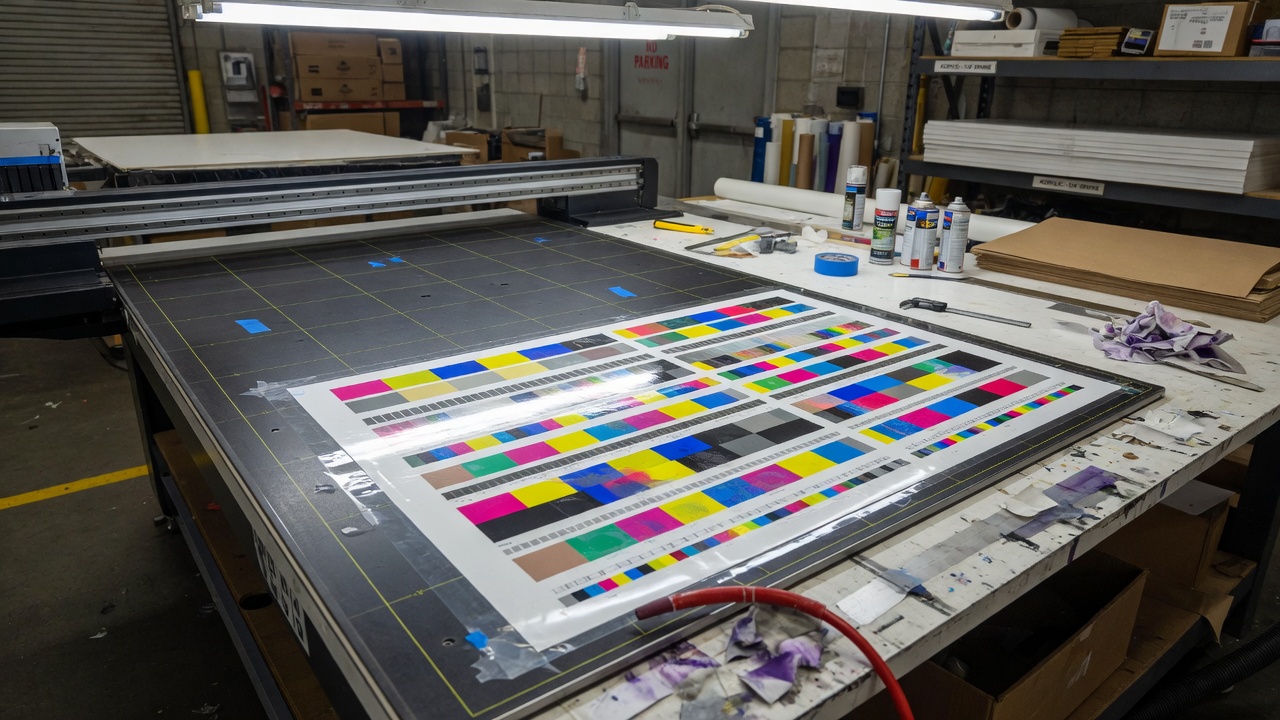
The two-inch number is the one people quote back to us from a brochure. It is real. It is also almost never the thickness of the sign you should order. Thickness on a UV flatbed is a clearance problem, a vacuum problem, and a product problem. Those are three different conversations.
| Thickness band | What usually lives there | Bed behavior | Watch-outs |
|---|---|---|---|
| About 1–3 mm | Thin ACM, thin PVC, some aluminum sheet, thin wood veneer on a backer | Vacuums well if the sheet is flat. Fast to load. | Thin PVC oil-cans in OC heat. Thin metal can have a mill curl. |
| About 3–6 mm | The middle of rigid sign work: 3 mm ACM, 3–6 mm PVC, 1/8 to 1/4 in plastics | This is the home turf of the table. | Still needs to be flat. A 4×8 of 3 mm PVC with a banana bow will not print until we flatten it or reject it. |
| About 6–12 mm | Thicker plastics, some wood, sandwich boards, already-built plaques | Heads up. Vacuum may need help. Jigs get real. | Weight, edge quality, and whether anyone can hang it. |
| About 12–50 mm | Objects, blocks, dimensional pieces, stacked jigs plus the part | Will print if height is consistent and we have a jig. | A 1.5 in part sitting on a 0.75 in jig is already eating the 2 in budget. Measure the stack, not only the part. |
Heads fly at a set height above the highest point they will cross. If a sheet is 3 mm in the middle and 8 mm at a warped corner, the heads are not reading a novel. They are about to strike. We can raise the gantry for a thick, even object. We cannot raise it for a potato-chip of PVC and still get a sharp droplet on the low spots. Flatness is a thickness spec.
Vacuum is the first thickness test
The table is a vacuum chuck. Air pulls the sheet down so it cannot lift into the heads and so the gap from nozzle to face stays consistent. A dense, flat 3 mm ACM sheet is an easy day. A bowed 4×8 of expanded PVC is not. A very light interior board can sit on the holes and never seal. When vacuum cannot win, we add a jig, a mask, weights at the margin, or we refuse the sheet. Weights at the margin only work if they stay out of the print path.
Orange County heat makes this worse. Expanded PVC left in a closed car on Barranca in August will take a set. So will some corrugated plastic. Bring us a flat sheet or budget time to let it relax under weight in the shop. Do not ask the printer to vacuum a sail flat. If the board was stored on edge in the sun against a stucco wall, tell us. We would rather recut a parent than crash heads.
Porous materials (raw MDF, some woods, unsealed lightweight display boards) leak vacuum. We can still print them. We mask the table, we seal the back, or we hold them mechanically. Say the material by name. “Wood” is not a vacuum spec. Sealed maple plywood and a rough pallet slat are different jobs.
The two-inch object
We will print a thick object when the object is the product: a routed plaque with height, a block, a fixture face, a part that already exists and only needs a graphic. The gantry has to clear the highest point, including any jig under the part. If you bring a 1.75 in object and we need a 0.5 in template under it, you are over the envelope. Measure the stack. Write the stack on the quote.
Thick and uneven is the failure mode. A cutting board with a juice groove, a casting with a sprue, a frame with a raised lip around a recessed panel: the heads see the lip. We can print the recess only if the lip is outside the print path or if we treat the job as a nested, masked pass. Send a photo with a tape measure on the height, or bring the object. A verbal “about two inches” is how you buy a crash, not a print.
Do not order two-inch stock for a wall sign because the machine can take it. You are buying weight, cost, and a hanging problem. Most Irvine wall panels want a few millimeters of the right plastic or composite, not a slab. Save the thickness budget for objects and for jigs.
Height maps and mixed stacks
Some jobs mix thicknesses on one load: a 3 mm tile next to a 6 mm tile, or a nested set of already-cut letters on a 12 mm template. Mixed heights on one pass force the heads to the tallest piece. The short pieces then sit farther from the nozzles. Quality drops. Split the load by height, or build the jig so the print faces land on one plane. That is a fabrication hour, not a RIP checkbox.
If you need rigid sign printing in Irvine on mixed materials in one visual, we can still do it. We print the parts in height groups and assemble. We do not pretend a 3 mm ACM logo and a 10 mm dimensional frame are one pass unless you have built them to one print plane.
Sheet size, oversize, and why 4×8 is not always 48×96 of ink
A 4×8 bed does not mean every job is 48×96 of image. Parents, trims, bleeds, clamps, and the building all eat inches.
Industry parent sheets for rigid graphics commonly land at 48×96 inches. Some aluminum composite lines also stock 48×120, 60×120, and metric 49.2×98.4. 3A Composites’ DIBOND sheet chart is a useful example: 3 mm white is sold at 48×96 and at 60×120, and some colors ship at 49.2×98.4. That last size is why European-metric ACM sometimes sits on this table with almost no waste, and why a 60-inch-wide parent does not. If your purchasing department bought 5×10 because that is what the distributor had, tell us before we build a file to 48×96 and then watch 12 inches of expensive composite go to the drop.
On this bed, a true 48×96 sheet fits. We can print it with a margin and trim, or we can run edge-to-edge and accept that the extreme edge is a different quality conversation. We cannot print 60 inches of width in one piece. We cannot print 10 feet of length in one piece. We will not hang 12 inches of unprinted sheet off the table and “do our best.”
Finished size versus parent size
Say both numbers. Finished size is what hangs on the wall. Parent size is the sheet we load. A 36×48 panel can come out of a 48×96 parent with nesting, or it can be cut from a smaller blank we already have. A 48×96 finished panel with full-bleed art and a clean edge is a print-then-trim (or print-then-route) sequence. If you only write “4×8” we do not know whether you mean the sheet or the sign.
Bleed on rigid work is not optional because the sheet is already the size you want. If ink must die at the edge, we still need either overspray plus a wipe of the bed, or oversize print plus a cut. A file built to 48.000 × 96.000 with type sitting 1/16 inch from the edge will lose that type to a 1/8 inch trim. Keep live copy inside a real safe zone. 0.25 inch off trim is a sane starting point; more if a frame or standoff cap will sit on the corner.
Tiling when the wall is bigger than the bed
A 6×10 graphic on rigid stock is two or more sheets. Plan the seam. Vertical seam or horizontal, through a quiet field or along a panel joint that already exists in the architecture. Do not put a face or a thin letter across the cut unless you like puzzles. We can print overlap and field-trim, or we can print to a revealed joint. Those are different files. Draw the tiles. Number them. Mark the face and the hang direction. Irvine corridors are full of panels that were tiled in the file as 48×48 squares and then installed 90 degrees off because nobody marked top.
Seams on glossy rigid stock show. They show as a hairline, as a gloss change, as a slight plane change if the wall is not flat. If the point is a seamless mural, rigid tiles may be the wrong product and a wall covering may be the right one. That is a process fork, not a bigger flatbed.
The path through the building
A 48×96 sheet is 8 feet on the long side. Measure doors, turns, freight elevators, and the last interior door into the suite. Irvine Company towers and medical buildings on the Barranca corridor often have passenger elevators that will not swallow a full sheet on the diagonal the way a warehouse door will. Service elevators are better. Stairs are a two-person argument. If the panel must ride up a passenger cab, consider 4×4 or 4×6 tiles. Printing a heroic 4×8 that then gets cut in the garage is a waste of edge quality.
Pickup at our dock is the easy half. We can slide a 4×8 into a van or a box truck. We cannot slide it into a compact SUV with the seats up and a stroller in the way. Say how it is leaving. Crating is a line item. Blankets and a two-person carry are a line item. “I’ll figure it out” is how a corner gets snapped in the Spectrum parking structure.
Edge-to-edge, bleed, and the last eighth of an inch
People say “full bleed” when they mean three different products. On a UV flatbed those products have different times and different risks.
- Print oversized, then cut. The image is larger than the finished panel. A router, saw, or shear cuts to the line. This is the cleanest edge-to-edge for a rectangle. You get ink to the knife. You also get a fabrication step. Put it on the quote.
- True edge-to-edge on the finished sheet. Heads print off the sheet. Ink lands on a mask or on the bed. Vacuum at the extreme edge is weaker because air leaks around the perimeter. The last few millimeters can look different: a little more grain, a little less density, a little overspray wrap onto the edge. Fine for many signs. Not fine if you promised a museum-smooth face right to a polished arris.
- An unprinted rim. We hold a margin so we never print off the sheet. Fast. Honest. Wrong if you wanted color to the edge. Right if the panel sits in a frame or a reveal that hides the rim.
Pick one in writing. “Bleed it” is not a pick. If the panel will be polished, framed, or held by standoffs, the edge treatment and the print treatment have to agree. You do not polish first and then run true edge-to-edge with overspray onto a finished arris. Sequence is cut and dress the edge, then print with a margin — or print oversized on a parent and cut after, knowing the cut edge will show core, not ink, unless we ink the edge as a separate operation.
Overspray wrap onto a thickness can be a look (a printed edge) or a mess (ink on a face you wanted clean). On thin ACM it is a whisper. On 6 mm PVC it is a visible stripe. If you want a painted or printed edge, say so. If you want a mill edge, we mask or we keep the margin.
White ink at the edge is its own leak. A flood of white that is supposed to die at trim will show a white hairline if the cut misses by a tenth of a millimeter, or a dark hairline if the white falls short. Build white as a channel with the same bleed rules as color. Do not send a flattened JPG and a note that says “white under the logo, full bleed.”
Edge-to-edge on a vacuum table is a print mode plus a cut plan, not a checkbox. If you need color to the knife, say finished size, parent size, and which of the three edge methods you want. If you do not know, describe the hardware: frame, standoffs, raw edge, or polished. We will pick the method. You still have to describe the edge.
Jigs, nested parts, and registration on a vacuum table
A jig is anything that holds a part still and in the right place while the heads pass. On a flatbed the table itself is the jig for a full, flat sheet. Everything smaller, thicker, already-cut, two-sided, or odd-shaped needs more than hope and a tape gun.
Vacuum as the first jig
For a full parent of ACM or PVC, vacuum plus a square to the registration pins or to the bed ruler is enough. We load, we tap a corner, we print. That is the easy case. It still fails when the sheet is smaller than the vacuum zones and air howls around it. Then we mask the open holes with a blank sheet, a purpose-cut mask, or we move the part onto a dedicated template that has holes only where we need them.
Do not bring a stack of 8×10 blanks and expect us to eyeball them in a grid. We will build a nest or we will charge time to tape fifty rectangles square. Nested parts on one template print faster and register better than a pile of one-offs. If you have twenty identical plaques, say twenty identical. If you have twenty names on one layout, that is variable copy on a shared jig, and the file has to be imposed to that jig, not designed as twenty separate letter-size PDFs named Final_v7.
Pin jigs, pocket jigs, and tape
Three shop tools, in the order we actually use them:
- Registration pins or a bar. The sheet or the template hits pins. Flip-to-back for two-sided work uses the same pins so face and back share an origin. This is how a 4×8 gets a second side without guessing.
- Pocket jigs. We cut (or you supply) an MDF or PVC template with recesses that hold already-cut parts. The part drops in, the print face sits at a known height, the heads see a consistent plane. This is the right tool for routed logos, numbered tiles, coasters, and any part whose outline already exists.
- Tape and stops. Fine for a one-off that will never repeat. A poor plan for a run of fifty. Tape thickness is now part of the height. Thick tape at one corner and none at the others is a tilt.
If you already have a fixture from your mill, bring it. If it is 18 mm MDF and the part is 12 mm, the stack is 30 mm plus any riser — still inside 2 inches, but we need to know. If your fixture has clamps that stand 3 inches tall at the edge of a 4-inch part, the clamps are in the gantry. Low-profile holds only. No C-clamps in the print path. That sentence has paid for itself more than once.
Jig design is part of the job when the parts are small or already shaped. Budget it. A template we will reuse for a quarterly name-plate run is cheaper on job two. A template for a one-off may cost more than taping. Ask. Do not assume “UV print these cut letters” includes a nested pocket board because it is obvious to you.
Print-then-cut versus cut-then-print
This is the registration fork that reprints more rigid work than bad color does.
Print-then-cut. We print on a parent, including registration marks or a contour, then a CNC router or a saw cuts the shape. The cut follows the print (or follows a path we output from the same file). This is the default for shaped panels that start as rectangles. The ink is already on the sheet; the knife finds the line. Registration is a machine problem, not a loading problem.
Cut-then-print. The part already exists. We must put the image on a shape that will not be trimmed back to the art. That is a jig-and-camera problem, or a jig-and-pins problem. Tolerances stack: how true is the cut part, how tight is the pocket, how repeatable is the drop-in. A routed letter with a 0.03 inch variance will show that variance as a white sliver or as clipped type. If you are supplying cut parts, supply them consistent, and supply one extra for setup. If we are cutting and printing, let us pick the sequence. We usually print first on rectangles unless the part has to be held by its finished shape (an already-polished object, a part you own that we are only decorating).
Fiducials (registration marks) belong on the parent if we are cutting after. They do not belong in the live field of a finished sign. Put them in the waste. If you impose the file yourself, leave the marks. If you crop them off to “clean up the PDF,” you cleaned up the thing the router needed.
Two-sided registration
Two-sided rigid printing is a flip. The back side has to land on the front side, not almost. We register to pins, to a bar, or to marks. You still have to tell us which edge is the hinge. A 48×96 flipped the short way is a different origin from flipped the long way. Write “flip on the 48-inch edge” or draw it. Head-to-head versus head-to-toe is not a vibe. It is a loading instruction.
If both faces must be opaque, the sheet has to block light or we have to print a blockout stack (white, sometimes a dark flood, then white, then the second face). A single flood of white on 3 mm PVC is not a blockout in a sunlit Irvine storefront. Two-sided window-facing pieces are a substrate decision as much as a print decision. Say if daylight will sit behind the panel.
Second-surface work on clear sheet (print reverse, view through the plastic) is a mirror at the RIP. Send the file right-reading. We will flip it. If you pre-flip “to help,” mark that in large type or we will flip it again. That reprint is yours if the note was missing. This is a bed-and-file issue; it shows up on any clear or translucent sheet.
Head clearance on the jig
The gantry does not care about your design. It cares about the tallest thing in the lane. Locating pins that stick up, a clamp knob, a warped corner, a stray screw in the template, a part that sits proud of its pocket — those are strikes. We mill pin heads flush or we place them outside the print pass. If you supply the jig, countersink anything metal and tell us the finished stack height in millimeters. A tape measure photo from the side is better than a guess.
Request a UV flatbed print quote
Rigid sheets that belong on this bed
This is a fit-and-behavior list, not a catalog of lobby materials and not a ranking of which board looks expensive in a reception. If the sheet is rigid, reasonably flat, and inside the envelope, we can usually put UV ink on it. Whether you should is a different sentence.
| Sheet family | Why it sits on a flatbed | Bed notes |
|---|---|---|
| Aluminum composite (ACM) | Flat, stable, prints clean, hangs as a sign | 48×96 fits; 60×120 does not as one piece. Faces can be painted white, mill, or brushed. Brushed is a directional grain — mark the direction. |
| Expanded PVC | Light, easy to cut, common interior and short-term exterior board | Warps in heat. Vacuum can lose a bowed 4×8. Keep it in the shade until it hits the table. |
| Corrugated plastic | Yard and event boards, fluted, light | Flutes leak vacuum. Orientation of flutes changes stiffness. Not a fine-art face. |
| Aluminum or other metal sheet | When you need metal, not a composite | Watch mill curl, burrs, and oily mill film. Clean it. Burrs on the back fight vacuum. |
| Wood and wood-based panels | Plaques, rustic faces, furniture parts | Must be flat and, preferably, sealed enough not to dump dust into the gantry. Grain will telegraph. Moisture movement is real. |
| Glass and some clear plastics | When the sheet is the glazing or the object | Weight, edge safety, and which face is view. Reverse print is a stack decision. Height is usually small; handling is not. |
| Already-finished objects | The part exists; we are decorating it | Jig, height, and a surface we can actually wet with ink. Coatings, powders, and oily fingerprints are adhesion problems. |
Adhesion is not guaranteed because the machine can reach the part. UV-curable ink wants a clean, dry, compatible face. Mill oils, silicone, some powder coats, and some plastics (the classic low-energy ones) will fail a tape pull. When the substrate is unfamiliar we do a shop tape pull on a corner before we commit a full sheet. If you need a documented adhesion rating, that is a separate test, not a free extra on a production run. Send a sample we can ruin. A full 4×8 of mystery plastic is an expensive test.
We can prime or flame-treat some faces. We cannot rescue a sheet that is still shedding CNC chips or still wet with a cleaner that left a film. Wipe with what we specify, usually isopropyl on plastics, and keep bare hands off the print face. Fingerprints are oleic adhesion failures dressed up as “the ink didn’t stick.”
Two notes on what this list is not. It is not a reception-materials catalog. Very light interior boards can sit on the table when they vacuum, and they fail when they do not; that is a bed note, not a lobby program. And it is not a reason to force every graphic onto rigid stock. If the job wants to roll, keep reading.
When a roll-fed printer is the better press
A UV flatbed is a bad roll-fed printer. It can, on some configurations, take a roll attachment. That does not make it the right press for fifty feet of film. If the media wants to stay flexible, if the run is long in one direction, or if the graphic will be mounted to a wall or a vehicle as a film, send it to roll-fed. We print that work in the same building as large-format printing for film and other roll media. The file setup, the bleed, and the finishing are different. So is the price per square foot on long runs.
| Choose the UV flatbed when | Choose roll-fed when |
|---|---|
| The substrate is rigid and is the finished object. | The substrate is a film, paper, fabric, or vinyl that should stay rolled until install. |
| You need ink on an already-cut or already-thick part. | You need a graphic longer than 8 feet with no seam in the print. |
| You need edge-to-edge on a board without a laminate or a mounted print. | You will mount the print to a board later (sometimes cheaper, sometimes the wrong look). |
| Registration to a jig or to a second side of a sheet matters. | Volume of identical posters or panels that are really just paper or film. |
| White ink as a real underlayer on a colored or clear rigid face. | The install is a wrap, a wall mural as film, or an adhesive window graphic. |
Mounted prints exist in the middle. Print on roll-fed photo stock or vinyl, then mount to ACM or PVC. You get a laminate option, a different scratch behavior, and a seam of adhesive. Direct UV on the board has no film to peel and no mount lines. Direct UV also has no laminate to hide a scuff unless we add a clear coat. If the panel will be touched all day, talk about a flood clear or a different face. Do not assume direct-to-board is automatically tougher than a laminated mount. It depends on the ink, the coat, and the abuse. Tell us the abuse.
Long graphics are the cleanest fork. A 4×12 wall of color as one image is not a 4×8 flatbed job. It is a tile of two rigid sheets, or it is a roll-fed mural. If you wanted one sheet, you wanted a bigger table than we have, or you wanted film. I will say that on the quote instead of silently tiling you into a surprise seam.
Flexible media laid on a flatbed is a party trick. Thin films lift, wrinkle, and wander. We can tape them. We should not. If your “board” is actually a sheet of magnet, a thin polystyrene, or a cling, ask which press. Some of those can live on the table with a carrier. Many should be roll-fed or should be a different product. The test is simple: if you can roll it without ruining it, start the conversation on the roll press.
Vehicle film, wall film, and paper posters are roll-fed conversations. Rigid van boards and magnetic sheets that must stay flat are flatbed conversations. Do not mash them into one line item called “the graphics.” Send two specs if you have two processes.
File setup that matches the bed, not a poster
The RIP will scale a poster file onto a 4×8. It will not invent a white channel, a cut path, a jig nest, or a flip. Build the file for the object.
- Size. Actual size, or a clean even scale (50 percent) with the scale in the filename and in the email. A 48×96 layout in a 17-inch Illustrator board with no scale note is how type lands at the wrong size.
- Color. CMYK. RGB will be converted. Neon screen blue is not a promise. If a coated PMS must be close, say the number and whether it sits on white board, on mill aluminum, or on a color sheet.
- Resolution. For a panel viewed at a few feet, 150–200 ppi at output size is a typical industry band. Reception pieces can want more. A 72 ppi web hero stretched to 48 inches will look like a web hero. Rigid gloss is happy to show you that.
- Bleed. 0.125 inch past trim if we are cutting after print; more if the cut is a rough field saw. Safe type 0.25 inch inside trim, more at standoff corners.
- White. A spot swatch or a layer named WhiteInk, 100 percent where white should print. White in CMYK is a hole. On clear, mill, black, or colored faces, that hole is the sheet showing through.
- Cut and holes. Their own layer, a spot named Cut or Holes, not 0.25-pt cyan that might print. Closed paths. Offset for bit diameter if you already know the tool.
- Imposition for jigs. If we built a nest, we will impose. If you built a nest, send the template drawing and the art already in position, plus a labeled photo of the jig.
- Two-sided. Two pages or two files, named Front and Back, with the flip edge written in the email. Right-reading unless we asked for a reverse.
Vector for marks and type: PDF, AI, or EPS, fonts outlined. Photos embedded. Do not send a screenshot of a Google Slide. Do not send a Dropbox link to a 12-layer Photoshop file named NEWNEW and expect the night shift to guess which layer is the white flood. If the only art is a PNG from a brand portal, say so. We can rebuild some marks. That is design time.
Registration marks for print-then-cut stay in the waste. Crop marks for a guillotine stay in the waste. If the finished panel is the whole parent with true edge-to-edge, there is no waste — which is why that mode and a cut-path file do not belong in the same breath unless you are cutting a smaller shape out of the printed parent.
If the rigid panel sits next to other graphics from the same campaign, keep type hierarchy consistent. That is design, not press, but it is cheaper to fix in the file than on a 4×8 of ACM. A board that has to match a window graphic or a mounted print is still two processes; send both files. For mixed rigid programs that have left the flatbed conversation, see sign printing on other rigid substrates as a separate line, not as a hope that one pass covers every wall.
Mistakes that reprint a rigid sheet
Reprints on flatbed work hurt because you paid for a board, a load, and sometimes a jig, not only for ink. The pattern is repetitive.
- A 5×10 parent on a 4×8 bed. It does not fit. Cut it first or tile it. Do not bring it “to see.”
- Bowed PVC. Heat-set curve, vacuum loss, head-strike risk. Flatten, replace, or refuse.
- No stack height on a jig job. Part plus template plus tape plus proud pins. Measure from the table up.
- Cut-then-print without a jig. The image wanders on the shape. You see white slivers. We reprint on a template.
- Pre-flipped reverse files with no note. The second flip puts type backward. Mark the view side.
- Type in the last eighth of an inch on a print-then-trim panel. The knife takes the phone number.
- White sitting in a flattened RGB file. There is no white channel. Clear or black sheet shows through the logo.
- Oily or dusty mill film left on metal or ACM. Ink sits, then you can tickle it off. Clean the face.
- Mixed heights on one pass. Short pieces print soft. Split the load.
- True edge-to-edge promised on a polished, already-finished edge. Overspray on the arris. Sequence was wrong.
- Two-sided flip on the wrong edge. Back is 90 degrees from front. Draw the hinge.
- A 4×8 that cannot enter the suite. The print is fine. The building is not. Tile it.
- Roll-fed work forced onto the table. Film wrinkles. You wanted a different press.
- Missing date, finish, or quantity. The sheet is ready the day after the installers were booked. Quotes confirm size, material, quantity, finish, and date.
Head strikes deserve their own line. If the gantry kisses a warped corner, you can lose a head, a sheet, and a day. We would rather reject a banana board in the morning than explain a crash in the afternoon. If your fabricator says the sheet is “pretty flat,” have them check it with a straightedge. Pretty is not a tolerance.
Adhesion failures get blamed on ink when they are often handling. A sheet that sat under a silicone spray in a woodshop, a glass panel wiped with a furniture polish, a powder-coated part that was never meant for inkjet: those fail a tape pull. Send a sample. Name the coating. If you do not know the coating, we will test a corner. We will not guess on your only part.
Orange County conditions that change what you send
Local color only matters when it changes the sheet, the path, or the permit. These do.
Heat and storage. Inland Irvine in late summer cooks a cabin and a south-facing loading area. Expanded PVC and some corrugated plastics take a bow. ACM stays flatter, which is one reason it exists. Do not store rigid plastics on a dark asphalt lot “for an hour” while you run into the Spectrum. Bring sheets inside. If they arrive bowed, we may wait, weight them, or recut. That wait belongs on the calendar, which is why the date on the quote should not be the same afternoon you found the warp.
Sun on the installed face. This is not a banner article. It is a reminder that a first-surface UV print on a west wall along Jamboree is a different life than a panel in a windowless corridor. Direct-to-board ink is durable relative to office inkjet. It is still a film. If the install is unshaded exterior, say so. We will talk substrate and clear coat, not just CMYK. Reverse print on a clear sheet puts plastic between sun and ink; opaque ACM puts a stable face into the weather. Pick on purpose.
Elevators, corridors, and office-park docks. University Research Park, the Irvine Business Complex, and medical buildings off Barranca and Alton often want deliveries through a service dock with a time window. A 4×8 standing in a passenger lobby is a security conversation. Measure the last door. If the landlord requires a certificate of insurance for an installer, that is not a print spec, but it is why the date might move. Tell us who is hanging the panel.
Anaheim Convention Center freight. If the rigid panels are booth walls or counters going to Anaheim, they still have to fit a crate, a truck, and the show’s inbound rules. Full 4×8 sheets are common. So are 4×8s that get a corner crushed because they rode loose. Crate or crate-equivalent. Label the face. Do not lean ACM on a freight dock in the sun for three hours. Show site is not a warehouse.
UCI and campus interiors. Department suites can take a rigid panel. Public corridors and exterior campus faces are someone else’s sign program. If you need a board for a lab door, measure the door and the hardware. Card readers and vision lites eat the real estate you drew in the file.
HOA and City of Irvine sign rules. A 4×8 that prints is still a sign when it faces the public. The City’s sign permit instructions start with wall-sign elevations, dimensions, and leased frontage. Office-park criteria books still win on the corridor side of your suite. We will print a non-compliant panel if you insist. We will also still tell you to read the binder. Residential HOAs in villages such as Woodbridge or Northwood are not looking for a commercial 4×8 on a garage. Home-based businesses run into this constantly.
Wind is a handling problem, not a print mode. A 4×8 of 3 mm ACM is a sail on an open dock. Two people, or it becomes a kinked 4×8. Santa Ana wind days are when we see more corner damage at pickup, not more ink problems.
None of that changes the bed envelope. It changes whether you should order the maximum the bed will take.
What to send so the quote is real
Send one email a person can estimate from. If you skip fields, you get a range, and ranges stall jobs.
- Finished size. Width × height, view-side, in inches. If it tiles, the tile grid and the overall.
- Parent or blank size. What we will load, or “cut from 48×96.” If you already own the sheet, the actual measured size, not the mill nickname.
- Material. ACM, PVC, corrugated, metal, wood, glass, object; thickness in mm or inches; color of the face; indoor or sun-exposed.
- Quantity. Identical versus versioned. Nested small parts versus full sheets.
- Finish. Edge-to-edge method (oversize-and-cut, true bleed, or rim), edge treatment, holes, first or second surface, white flood or selective white, clear coat or not, jig already exists or not.
- Registration. Print-then-cut or cut-then-print. Two-sided, and which edge is the flip. Supply of a template, yes or no.
- Date. The day it must be on the wall or on a truck, not “ASAP.” Jig-built jobs are not counter work.
- Path. Pickup at 15321 Barranca Pkwy, crate, or install. Elevator constraints if you know them.
Attach the file or say you need us to rebuild. State whether a landlord, brand manager, or show site must approve a proof. If an architect already drew 4×8 tiles, send the drawing. We would rather print to their grid than invent a seam.
Walk-ins are welcome Monday–Friday, 8:00 a.m. to 5:00 p.m. Bring a tape-measured size and, if the part is odd, the part. You can also start on the Irvine Printing site and send the same fields through the quote form. Either path works. A photo of a wall with no dimensions does not.
Send sheet size and thickness for pricing
Questions Irvine buyers ask before they load the bed
How large can you print on the UV flatbed?
About 4×8 feet of rigid media, with a print area slightly larger so edge-to-edge is possible. A 48×96 parent is the everyday maximum. A 60×120 parent does not fit as one piece. Handling, doors, and elevators usually cap the job before the gantry does. If you need a larger visual, we tile rigid sheets or we move the oversized run to roll-fed. Tell us the finished size and the parent, not only “as big as the machine.”
How thick of a part can you print?
Up to about 2 inches, including the jig. Most signs are a few millimeters. Objects, blocks, and nested parts on templates are where the height budget gets spent. Mixed heights on one pass are a quality problem; split the load or build to one print plane. Send a side photo with a tape if the part is not a simple sheet.
Can you print edge-to-edge on a board?
Yes, as oversize-and-cut, as true overspray off the sheet, or as a near-edge with a small rim. Those are three products. True overspray can look different in the last few millimeters and can wrap the thickness. If you need color to a knife-cut edge, say so and expect a cut step. If the panel sits in a frame, a rim may be the smarter, cheaper edge.
What is a jig, and do I need one?
Anything that holds the part still and in the right place: vacuum for a full flat sheet, pins for a flip, a pocket template for already-cut shapes, tape for a one-off. You need a jig if the part is small, shaped, thick, two-sided, or supplied already cut. You do not need a custom template for a single 48×96 ACM sheet that vacuums down. If you have twenty plaques, you want a nest, not twenty acts of tape.
When should I use roll-fed instead of the flatbed?
When the media is flexible, when the graphic is longer than 8 feet with no seam, when you are mounting a print later, or when the run is really posters or film. Use the flatbed when the board is the object, when you are printing an already-cut part, or when you need white ink and registration on a rigid face. If you can roll it without ruining it, start on roll-fed. If it has a thickness you can measure with a caliper and it must stay that object, start on the table.
Can you print both sides in register?
Yes, with pins or a bar and a written flip edge. Opacity is separate: two-sided in a window may need a real blockout stack or an opaque sheet. Send front and back as two named pages, right-reading. Do not pre-mirror unless we ask. Do not assume a single white flood will hide the other face in daylight.
What files do you need?
Vectors for marks and type, CMYK, white as a spot or layer when the face is not a white sheet, actual size or a labeled scale, bleed if we cut after print, cut and hole paths on their own layer, two-sided files named and with a hinge. Photos at a sensible ppi at size. A PNG of a logo and a hope is not a 4×8 file. If the parts nest in a jig, send the template drawing too.
How fast is flatbed work, and can I wait?
Straightforward full sheets with a clean file are a different clock from nested, two-sided, reverse, jig-built objects with a polished edge. Rush exists when the sheet is in house, the file is clean, and the finish is simple. A custom pocket jig plus fifty unique names is not a while-you-wait counter job. Put the needed-by date on the quote. “ASAP” is not a date. Call (949) 387-0787 if the date is already too close; we will say yes or no.
Load the bed on purpose
Direct-to-substrate UV printing in Irvine is a geometry product: a vacuum table, a gantry, and a sheet or an object that has to fit. The choices that matter are the ones in this article — 4×8 versus a parent that does not fit, a few millimeters versus a two-inch stack, vacuum versus a pocket jig, oversize-and-cut versus true overspray, print-then-cut versus cut-then-print, and whether the job should have been roll-fed. Everything else is decoration.
If you searched for flatbed printing near me and you are in Orange County, you are in the right radius. Avanti Printing is at 15321 Barranca Pkwy, Irvine, CA 92618. Bring size, material, quantity, finish, and date. Bring the part if the part is the puzzle. If the file is ready, we can talk like an estimator instead of a mind reader. If it is not, say that too. The bed will still be here. It will print better if we do not have to guess whether your 4×8 is a sheet, a sign, or a wish.