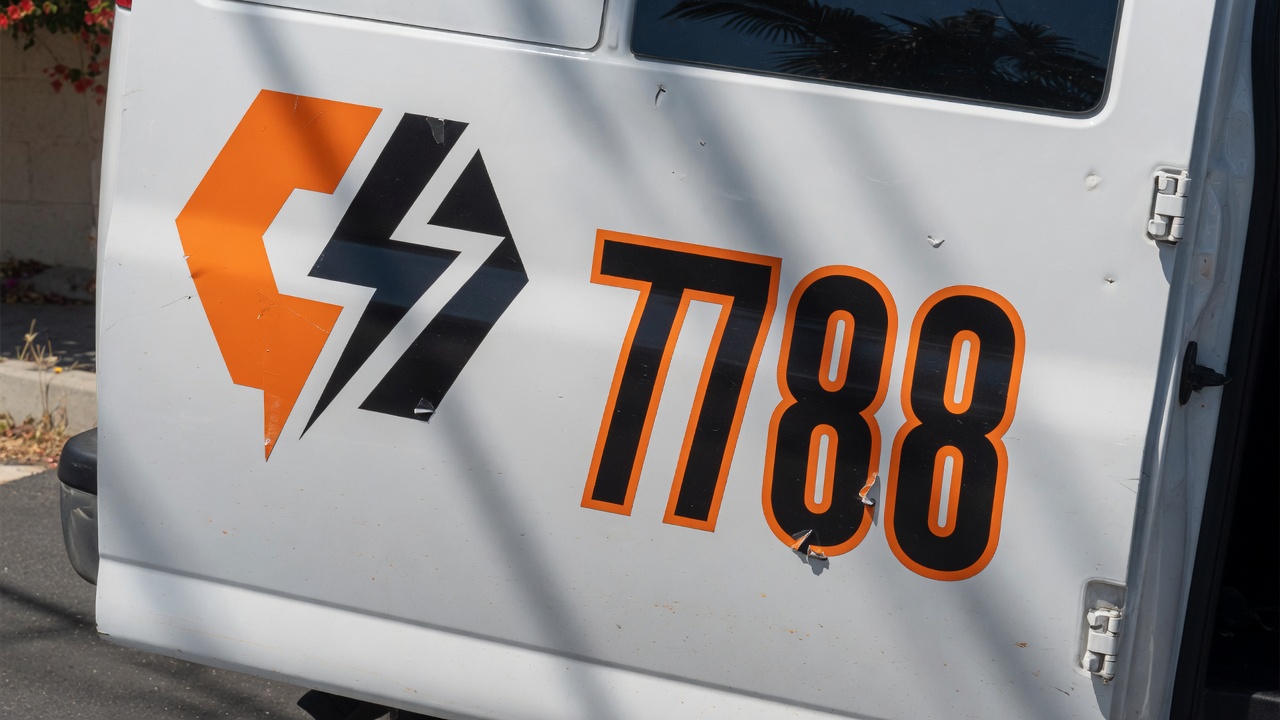
Van door graphics Orange County buyers actually need are vinyl on the front and rear cargo doors: cut lettering and logos, or a printed door panel. The decision is cut vinyl versus print, a phone number large enough to read from a driveway, optional reflective film for night work, and an install that returns the van the same morning.
The catalog shot is always a wrapped Sprinter on a wet studio floor. Your van is a white Transit with a dent in the sliding door, last year’s number still on the rear barns, and a dispatcher who needs it on the 405 by lunch. Door kits are the grown-up answer to that van. Avanti Printing at 15321 Barranca Pkwy, Irvine, CA 92618 plots, prints, and installs them. Call (949) 387-0787 if you already have a vector and only the doors need to look like a company truck. Quotes confirm size, material, quantity, finish, and date.
This is a door article, not a wrap article. Coverage here means the front doors and the rear cargo doors. It is not a partial side wrap, not a color-change, and not a debate about magnets. If you want vinyl that stays on the paint of a door, stay here. If you also need a matching job-site board or a rigid color chip, that is a different ticket under the same roof. Van door and vehicle graphics in Irvine are how we spec that door kit instead of guessing from a phone photo of someone else’s truck.
Cut vinyl versus a printed door panel
Start with the process, not with a PNG named FINAL_VAN. Cut vinyl is solid-color film that a plotter cuts, a person weeds, and an installer burns onto the door with transfer tape. A printed door panel is ink on printable vinyl, usually laminated, cut to the door field, and applied as a skin with reliefs at the handle. Those are two products. They share a van and they do not share a file, a finish, or a failure mode.
Cut vinyl wins when the brand is a one- or two-color mark, a name, a license number, and a phone number on relatively flat door skins. The color is the film. There is no laminate to peel at the letter edge. The door paint is the background. A black wordmark on a white door is still the cleanest service-van graphic we install. Printed panels win when the brand is a photograph, a gradient, a color the cut-vinyl library cannot hit, or a field that has to hide ghosting from old lettering. They are not automatically more professional. They are a different construction.
Use the table as a shop filter. Typical industry practice for Orange County service vans is cut vinyl on the fronts first, then a matching rear mark, then a printed panel only if the art actually needs ink. Your ticket will lock process, film class, and which doors. It will not lock a wrap because someone said “make it pop.”
| Kit | What you are buying | Color source | Typical door downtime | Where it earns its keep | Where it fails |
|---|---|---|---|---|---|
| Cut vinyl lettering | Plotted logos, name, phone, license; tape and burn | Film color, not CMYK | About 1–3 hours for a pair of fronts | White or simple paint; 1–3 colors; long-term lettering | Hairline script, tiny counters, cheap calendered on a hot door |
| Cut vinyl + color block | A solid rectangle or contour plus lettering on top | Two or more film colors | A little longer than lettering alone | Need contrast on silver or dark paint without printing | Stacked edges that collect dirt if you overbuild the block |
| Printed door panel | Laminated print cut to the door field, handles relieved | CMYK on white (or printable) vinyl | About 2–4 hours for two fronts | Photo, gradient, odd brand color, covering a weather ghost | Tiny type over a body line; no laminate in OC sun |
| Printed panel + cut numbers | Skin for the field, plotted numbers as a second hit | Print plus film | Plan the longer of the two, plus registration time | Want a photo field and a phone number that can change later | Two jobs that have to line up around a handle |
| Reflective cut copy | Retroreflective lettering, usually name and phone | Reflective film color | Similar to cut vinyl; weeding is slower | After-hours HVAC, plumbing, tow, utility, night driveway work | Treating it as a wrap film, or covering lamps and cameras |
Read the color-source column twice. If the brand red only exists as a coated PMS on paper, cut vinyl is a film-chip conversation. We pick the closest roll and you approve the chip in daylight, not a monitor. Printed CMYK on white vinyl can get closer to a weird brand color than a standard cut library. That is an honest reason to print a door. It is not a reason to print a simple black logo on a white door. Black cut vinyl on white paint still reads from the sidewalk after the laminate on a cheap printed panel has taken a brush wash.
Edges are the other fork. Cut vinyl has an edge around every letter. That is a lot of edge if the mark is a script with a thin stroke. Dirt halos start there. Printed panels have one perimeter plus the handle reliefs. That is fewer edges and more film. If the crew throws ladders against the door, a laminated panel will take a nick better than a 2-inch cut letter at the leading edge. If the door is clean and the mark is bold, cut vinyl has less to peel because there is less sheet.
Cut vinyl is letters. A printed door panel is a skin. Pick the one the art actually needs. Do not print a two-color wordmark because a rendering of a wrap looked expensive, and do not cut a photograph because you wanted to save the laminate.
Thickness and film class still matter on a flat door. Cast cut films in the fleet-lettering neighborhood are the long-term choice. Quality calendered cut films exist for simple, flatter doors and shorter campaigns. Printed panels that have to dive into a character line or wrap a door cup want a conformable print film and a matching overlaminate. Calendered print film on a deep Sprinter pocket is how you buy a lift in August. We will name the series on the quote. “The good vinyl” is not a series.
Do not upgrade yourself to a side wrap in this conversation. Sides, hoods, bumpers, and roofs are a different coverage map, a different downtime, and a different article. Door kits are how most Orange County service companies actually get identified. Start there. Add later if the doors are not doing the job.
Who orders van door graphics in Orange County
You are shopping van door graphics Orange County because someone said the truck looks anonymous, and then went quiet on whether that means a phone number, a license line, or a photograph of a smiling tech. Typical callers from Irvine, Tustin, Santa Ana, Costa Mesa, Newport Beach, Lake Forest, Laguna Hills, Anaheim, and Huntington Beach are not shopping a wrap in the Instagram sense. They are shopping a readable door.
Drive-in radius is local. We are at 15321 Barranca Pkwy, Irvine, CA 92618. HVAC shops in Tustin, plumbers working Woodbridge, electricians on the IBC, solar crews staging near the Spectrum, restoration vans, pest and landscape, janitorial, IT couriers, medical couriers, and property-maintenance fleets serving Irvine Company parks all treat this as a door job. If the van cannot sit in our bay, say so. Mobile door kits exist. Mobile printed skins in afternoon wind are a different conversation.
This guide is for California buyers who will own the van after we peel the tape. It is written in second person because you are the one who will park in a driveway on a cul-de-sac and hope the homeowner can read the number without walking up to the glass. It is not for someone collecting wrap mood boards. If the graphic is actually a rigid job-site sign, a yard board, or a window film on the shop, stop forcing a door to do that work. Keep the ticket on vehicle vinyl when the object is a door, and put the boards under rigid sign printing in Irvine as their own line.
- HVAC, plumbing, electrical, and solar shops whose vans sit in Irvine and Tustin driveways and need the phone number readable from the sidewalk.
- Restoration, pest, landscape, and janitorial companies that want matching front and rear doors across a handful of units, including the ugly spare.
- Property-maintenance and facilities teams serving Spectrum-area retail and Irvine office parks who need a professional door mark, not a carnival wrap.
- Owner-operators with one Transit who will live with the graphic for years and should not cheap out on intermediate film just because the door looks flat in a photo.
- After-hours and emergency trades who may need reflective copy so headlights find the name, not a decorative chrome script.
If you are a home-based contractor in Woodbridge, Turtle Rock, or Northwood, a tasteful door logo is easier to defend overnight than a full-side photograph. We will still print the photograph if you insist and if it is legal on the road. We will also still say the door kit is the better neighbor. City sign rules generally care about signs on buildings, not about a van in motion. A van used as a parked billboard can wander into parking and HOA conversations. Do not plan door graphics as a substitute for a prohibited monument sign.
Phone numbers that actually get called
The phone number is the job. Everything else on a service-van door is supporting copy. A beautiful mark with a 2-inch number is a beautiful mark that does not ring. Orange County mixed area codes make this worse: 949, 714, and 657 sit on the same freeways. Seven-digit numbers are a hobby. Put all ten digits, large, high contrast, and not on a handle.
Viewing distance sets the height. A homeowner at the end of a driveway, or a driver two cars back on the 405, is not reading a business card. Front-door numbers that work in this trade are several inches tall — think in the 3- to 6-inch neighborhood for the digit height on a cargo-van door, larger if the paint is busy or the van is tall. Rear-door numbers should be larger still, because the viewing time is a red light and the audience is a windshield. Those are typical shop ranges, not a City ordinance and not a promise that a 3-inch number will save a low-contrast layout. If you only remember one sentence: the rear barns are the billboard. The fronts are the handshake.
Hierarchy that survives traffic:
- Name or mark first on the front door, large enough to identify you as the company they called.
- Phone number second, larger than the URL, larger than the slogan, larger than the “since 1998” line.
- License line where it is legal and still readable after we cut around hardware. Do not hide it in a 12-point footer.
- URL last if it must live on the door. Nobody is typing a twenty-character domain at 45 miles an hour. If the URL is the point, put it on the rear and keep it short.
- Nothing else. Taglines, QR codes, and “call for a free estimate” in a second color are how you shrink the number that actually gets called.
QR codes on a moving door are a decoration. A parked van at an open house or a job-site curb can maybe earn a QR if the code is large, quiet, and aimed at someone standing still. A QR on a rear door in the fast lane is artwork. If the point of the door is inbound calls, print the number. If the point is a landing page, you still need a number for the people who will not type.
Contrast beats brand gray. Navy on black paint disappears. Yellow on white looks loud until you try to read it at noon on Barranca. Dark digits on a light door, or light digits on a dark door, are the insurance policy. Cut vinyl makes this easy: pick a film that is not the paint. Printed panels make this easy if you build a solid field behind the number. Printed panels make this hard if you knock the number out of a photograph of a coil, a roof, or a smiling crew. Faces and equipment photos are busy. Numbers need a quiet rectangle. Give them one.
Vanity numbers still have to function as digits. 1-800-FLOWERS is a radio ad. On a door, the digits have to be readable as a phone number to someone who does not already know the gag. If you insist on the word, put the digits under it at the same visual weight. We will cut both. We will not pretend the word is a keypad.
Versioning is a kit list, not a surprise at install. Some shops want the dispatch number on every van. Some want a direct tech line. Some want English on one van and English/Spanish on another. Say which. Two phone numbers on one door is allowed if both are large. Two phone numbers plus a URL plus a QR plus a slogan is how none of them work. If each van has a different number, that is a template plus a list. It is not “use the same file, we’ll change it in the bay.”
When the number changes, recut the number. Do not stick a small rectangle over the old one unless you want the van to look like a van with a small rectangle on it. Disconnected numbers on rear doors are worse than a white door. They train the 405 to call nobody, or worse, the former owner. We can turn a replacement number quickly when the template and the vector already exist. We cannot make a rolling error look intentional.
Licensed California contractors have a second line that is not optional copy. If the van is a commercially registered vehicle used in the construction business, the California Contractors State License Board expects your business name and license number on the vehicle, and it treats vehicle lettering as advertising. Letter-height rules are stricter for some classifications — plumbing C-36, sign C-45, and well-drilling C-57 have long had taller side-mark requirements and, for those classes, a permanent business address on the vehicle — and more general for others. Typical published floors have been on the order of 3/4 inch for many classifications and 1-1/2 inches for those three, but this paragraph is not a compliance opinion and those numbers move when the Board or the code says they move. Send the exact business name as registered, the license number, and any address line your class requires. We will cut it at a size you can see, which should be larger than the legal floor anyway. Confirm current CSLB vehicle-lettering rules yourself before you approve a door that is missing the number. A beautiful kit with no license line is still a problem if the Board cares, and it is a reprint if we have to add the number later as a patch.
Area-code honesty belongs on the ticket too. If the shop is 949 and the tracking number you bought for ads is 714, the door should show the number you actually answer. Do not put a tracking number on the rear barns if the person who picks up cannot take a service call. Door graphics are not a PPC experiment. They are a rolling identity.
Reflective film for night work, not decoration
Reflective vinyl is a different film, not a finish checkbox on ordinary cut vinyl. Retroreflective films — the constructions shops mean when they say 3M Scotchlite reflective graphic films in the 680 class and cousins from other mills — return headlights to the driver. The lettering you cannot see on a dark street becomes a name and a number when a car turns into the driveway. That is the product. It is not chrome. It is not a glitter overlay. It is not DOT red-and-white conspicuity tape for trailers.
Say whether you need it. Do not assume the estimator will upgrade you because the van rolls after dark. Most Orange County service vans do not need reflective copy. Daytime HVAC, landscaping, janitorial, and office couriers get more from contrast and size than from a reflective premium. After-hours emergency plumbing, HVAC no-heat calls, tow, utility, and some restoration crews do get something: a homeowner who can confirm you are the truck they called before they open the door at 11 p.m. That confirmation is the reason to spend the film, not a catalog rendering of a glowing logo.
What reflective is not:
- It is not a substitute for required lamps, reflectors, or DOT conspicuity marking on a vehicle that actually needs those devices. We cut around lights. We do not invent a lighting package with film.
- It is not a full printed wrap film you stretch around a mirror. Commercial reflective lettering films are cut copy. Printable reflective exists as a special construction; it is a different quote and a different install.
- It is not available in every brand color. Daytime appearance is a limited palette. If the brand red must be a coated PMS in daylight and also return light at night, you may be choosing. Say which job wins.
- It is not HOA-neutral on a van that parks overnight in a planned village. Reflective copy can look like emergency equipment under headlights. A tasteful non-reflective door kit is the quieter neighbor. If the van lives in Woodbridge after 8 p.m., think about that before you spec 680 on a 12-inch mark.
Weeding reflective is slower. The film is typically thicker, the adhesive is different, and small counters are meaner. Bold sans letters and simple marks weed. Hairline scripts fight you and then fight the driveway. If the brand is a script, print a laminated panel for daytime and put a separate, bold, reflective phone number on the rear. Two films, two jobs, one van. That is still cheaper than weeding a script in reflective and watching the counters fail.
Install is still a door kit: clean paint, transfer tape, squeegee, post-heat on edges. Reflective can be less forgiving on compound curves and deep texture. Door skins on a Transit are usually honest enough. Door cups, deep character lines, and corrugated utility bodies are where I will talk you into a simpler layout or a printed non-reflective panel. Do not ask reflective film to be a wrap.
Care is the same family as other fleet vinyl, with less tolerance for brush tunnels. Hand wash, mild soap, no solvent, no green pad, no pressure wand at an edge. A scuffed reflective letter still looks like a letter in daylight and looks like a dead patch at night. If the company ritual is a $12 brush wash every Friday, reflective copy is the wrong film or the ritual has to change.
If you only need a small reflective strip so a tech can find the van in a dark lot, that is a mark or a number, not a full door skin. Keep it simple. Headlights do the rest.
Front doors and rear barn doors
Front doors and rear doors are two kits that happen to share a van. Design them as two surfaces. A file that says “same art, both sides, plus the back” is how the phone number sits on a handle in front and on a camera pack in the rear.
Front doors are the driveway conversation. The audience is a homeowner, a guard at a gate, or a property manager at a suite entrance. They see the door from an angle, often with the door closed, sometimes with it open if the tech is already in the attic. Put the mark and the number on the flatter field of the door, clear of the handle, the character line, the speaker or keypad if the van has one, and the mirror cap. Leave the mirror cap in paint unless you have a real reason and a conformable film. Mirror caps are compound curves. Door skins are not.
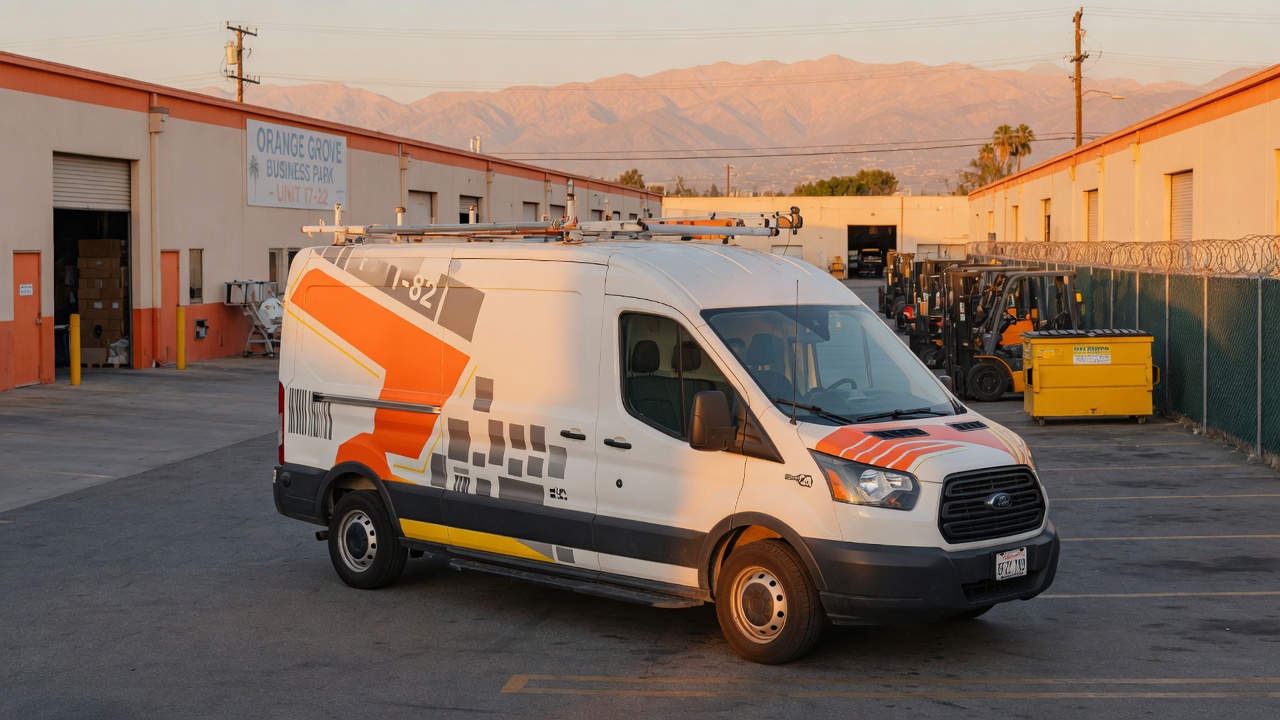
Rear barn doors, or the hinged cargo pair on a Transit and Sprinter, are the freeway conversation. The audience is the windshield behind you on the 405, I-5, the 55, and the 73. They get a second at a light. They do not get your carefully kerned front fender. Put the phone number and a short name where that driver can read them. Keep the third brake light, the camera, the license plate, the plate lamps, and the reflectors clear. A mockup that paints a mural across those objects is lying about the hardware. Bring the van, or send a daylight photo of the actual rear, and we will show you the cut lines on the metal.
Alignment across two rear doors is a real spec. A number that splits on the gap will read as two numbers if the doors are not shut the same way every time, and cargo doors are not shut the same way every time. Keep a digit from landing on the gap. Keep a logo from depending on both doors being perfectly even. Centered-on-the-pair layouts look heroic in a drawing and tired in a parking lot. Center a mark on one door, or build a pair that still reads when the doors are a half-inch off, which they will be.
Sliding doors are not front doors. A passenger-side slider is a different panel, often with a handle track, a step, and a window package. This article does not promote sliding-door wraps. If you want a mark on the slider, say so as a third kit: usually cut vinyl, usually above or beside the handle, usually not a printed mural unless you have left door-only territory. Window glass in the cargo side is not a vinyl door. We do not put opaque film on glass the driver needs.
Pickups are door kits plus a tailgate, not a van. Tailgates have handles, cameras, and a habit of being dropped into gravel. Cut vinyl on pickup doors is the everyday ask. A printed tailgate skin is a different edge and a different abuse story. Say the body. Do not send a Transit layout for an F-250.
Hardware that eats copy on every one of these doors: handles, keyholes, body character lines, sensor dimples, aftermarket keypad locks, and the fuel door if someone tried to put a rear mark on the wrong end. We cut around them. If the art cannot survive that, the art is wrong. A 10-inch phone number that looks heroic on a side-view PNG will lose two digits to a handle. Measure, or let us measure. Do not design on a stock photo of a van that is not yours.
Film on paint: what the door will accept
Vinyl sticks to clean, cured, sound paint. It does not stick to dirt, silicone, rust, or a ceramic coating you forgot to mention. Door kits fail this test constantly because the van works for a living: drywall dust, overspray, tree sap in Irvine lots, and a coat of wax from a well-meaning weekend detail.
Prep is the first half of the install. We wash. We decontaminate if the paint is bonded with grit. We wipe with the solvent the film bulletin wants, not with a random degreaser from the van’s side box. Wax and many ceramic coatings reduce surface energy. If you coated the van last month, say so. We may need a more aggressive prep, a different adhesive, or a “this might not be the week” conversation. Fresh paint is the other trap. Typical industry guidance is to let new paint cure on the order of 30 days before you letter it, because solvents still leaving the paint will bubble vinyl. That is a typical range, not a chemistry lab on our floor. If the body shop delivered the van yesterday and you want doors today, we will say no or we will say wait.
Old graphics come off before new graphics go on. Stacking a new number over an old number that is already lifting is how you stack two failure modes. Sun-baked adhesive on a west-facing door can leave ghosting. We will tell you if the paint under a ten-year-old decal is a different color than the rest of the door — it often is — so the new, smaller logo does not sit in a weather print of the old one. Sometimes the honest kit is a printed door panel that covers the ghost. Sometimes it is a body-shop blend. We are not a body shop. We will not pretend vinyl is paint repair.
Cast versus calendered, in door language rather than wrap language: a relatively flat front door can live on a quality calendered cut film if you accept a shorter outdoor life and you keep the letters off the most aggressive body lines. Long-term lettering, anything that has to look like it still belongs in year four, and anything that dives into a pocket should be a cast cut film. Printed panels that are truly door-flat can sometimes live on an intermediate print film for a short campaign. Printed panels you want for years in an Irvine west lot should be a cast print film with a matching overlaminate. Mixing a cheap calendered panel with a cast letter is possible. Mixing them without naming both series on the ticket is how you get two fade rates on one door.
Laminate belongs on printed panels. It is UV and abrasion insurance, and it is the surface you actually wash. Gloss pops color and shows swirl marks from a gas-station wash. Luster or satin hides some of that and is the less annoying finish on a working van. Cut vinyl usually is not laminated. The color is in the film. An overlaminate on small lettering is extra edge and extra weeding. If the door takes a beating from racks and tool handles, that is an argument for a printed-and-laminated panel, not for laminating 3-inch letters.
Adhesive is a third decision. Air-egress constructions help a door-size printed panel go down without a thousand pinholes. Slideable, repositionable adhesives help register a skin to a handle before it locks. High-tack exists for low-energy paint; it is also harder to remove later. Removable adhesives exist for leased vans and short campaigns. Removable is not “leave no trace after five years in OC sun.” If the van is leased and the contract wants paint back, say the end date so we spec for removal, not for a decade of bond.
We will not put a fake year count on this page. Manufacturer finished-graphic stories are component systems and zone-rated. Southern California is not a Midwest bulletin. Vertical doors last longer than hoods. Typical industry talk puts quality cast lettering and printed-and-laminated vertical door graphics in a multi-year window and calendered intermediate in a shorter one. Your parking lot, your wash habits, and whether the last installer stretched film around a cup will move you inside that window. Give us a duration — two years until you sell the van, five until you rebrand — and we will spec film to that, not to a brochure “up to” line.
If you need to see a color on a hard surface before you commit a door, we can UV-print a chip or a small rigid proof in the same building. That proof is not the door film. It is a color conversation. Process notes for the bed live under flatbed UV printing on rigid boards. Do not confuse a rigid chip with vehicle vinyl. They are different constructions that happen to share an address at 15321 Barranca Pkwy.
Files, cut paths, and door templates
The file is not the homepage hero and it is not a screenshot of another company’s truck. It is a door-size layout on a template for that year, make, and door style, in vector for every mark we will cut, and in high-enough resolution for every photo we will print. Door kits fail in prepress the same way every time: a 400-pixel logo, a phone number in 18-point type, a CSLB line somebody will “add later,” and a white door treated as if it were a poster.
Logos, license numbers, URLs, and headlines belong as vectors: AI, EPS, PDF with outlines, or a packaged file we can actually open. A PNG from the website header will stair-step at door size. We cannot invent a wordmark that is also your legal name on a van parked at a Spectrum loading dock. If the brand team cannot find the vector, that is a brand-team problem, not a plotter setting.
Cut paths need to be clean, closed, and not 0.25-point strokes. We plot, weed, and tape. Tiny counters — the hole in an A, a 4, an 8, or a 0 — can fall out in weeding if the type is small and the font is delicate. If the mark is a hairline script, we will tell you to print it on a panel instead of cutting it. That is not us being precious. That is us having weeded that script before. Reflective makes the same problem meaner. Bold the number. Simplify the mark. Save the script for the website.
Printed panels are judged from a parking stall, not from a 300 dpi poster standard. For vehicle-size print, about 150 dpi at final size is a typical industry target that holds at a few feet. 100 dpi can hold a soft background. 72 dpi web heroes look like 72 dpi web heroes, even in a driveway. Do the pixel math before you buy stock. A door-width panel at 150 dpi is still thousands of pixels across. Phone shots and website banners rarely have it. If the photo is the product, shoot it for this size. If the photo is atmosphere behind a vector number, the number is doing the work — put the work in vector.
White in a print file is unprinted white vinyl, not white ink, unless we spec a print-white construction. On a cut-vinyl door, white is the paint showing through. Do not send a file with a white box behind the logo and assume we will print a white panel on a white door. That panel is an extra rectangle you will see. If you need a color field behind the mark, that is a printed skin or a second color of cut vinyl, and it belongs on the quote as coverage.
A door template is a technical drawing of a specific door, not a three-quarter marketing photo. Year matters. A 2015 Transit and a 2023 Transit are not the same door. Camera packs and revised character lines showed up in facelifts. We would rather you send year, make, model, and a set of daylight photos — both fronts, both rears, handle close-up, sliding door closed — than a template you found on a forum. We have templates. We will pick the one that matches the metal, or we will measure the door.
Safe zones: keep live copy off handles, off character lines, off sensor dimples, off the gap between rear doors, and off the bottom few inches that eat road grit. Bleed printed panels past the edge we will wrap under. Keep cut-vinyl letters away from that same edge so they are not hanging into a gap. If you design on a photo, the number will sit on the character line. We see that file every week. We send it back.
Color is CMYK for print, film chip for cut. Van paint is a sixth color in the design whether you like it or not. A logo that looks fine on white can disappear on Oxford White versus a metallic silver versus a dark blue Transit. Tell us the paint color. Send a photo in daylight. Approvals that matter should be on a printed chip or a film chip, not on a laptop in the shop office. Orange County sun will also shift what you think you approved. High contrast is the insurance policy.
File delivery: PDF/X or a high-quality PDF with fonts outlined and images embedded is fine for printed panels if the template is right. Native AI with outlined logos is better for cut vinyl. RGB will be converted; neon blue will dull. Do not send a Canva link and a hope. Do not send a JPEG of a JPEG of a business card. If the only art you have is a brand-portal PNG, say so early so we can tell you whether it holds at door size.
Quote cut vinyl and printed van door kits
Install, downtime, and the first week
Downtime is the hidden spec on every Orange County door quote. The vinyl can be ready. If the Transit is on a coil-change in Woodbridge, it is not getting graphics today. Plan the install like you plan a bay in the shop: a start, a finish, and a van that is empty enough to open the doors. We would rather you tell us Thursday 7 a.m. to 11 a.m. than “ASAP, but it has to be out for a 9 a.m. leak.”
Typical shop ranges for door-only work — not a promise, a planning tool:
- Cut logos and numbers on two front doors, van already clean: often about 1–3 hours including wash, place, squeegee, and a heat pass on the edges.
- Printed door panels, two fronts, handles relieved: often about 2–4 hours.
- Rear barn-door kit on top of the fronts: add a couple of hours, not a full second day, if the van is already here and dry.
- Reflective lettering: similar to cut vinyl, plus slower weeding before you arrive. The van hours are still a morning if the doors are simple.
- Old-graphic removal: a labor line of its own. Sun-baked calendered film on a west door can take longer than putting the new kit on a bare door.
- A small fleet of door kits: stagger. Three vans on door logos in a day is a different schedule from three printed-panel jobs. Do not drop five units on Monday morning and expect five units out Monday night.
Those hours assume a van that is clean, dry, and here. They do not assume a van that just left a crawlspace, a van with a ladder rack still loaded against the door we need to stand at, or a van whose old lettering was applied over wax in 2019 and has become a new geology. Unpack the door path. We still need the doors to open and a place to stand. A van packed to the headliner is a van we will ask you to unpack. That unpack is your downtime, not ours, and it still counts against the dispatcher.
Where the van sits matters. Install at 15321 Barranca Pkwy, Irvine, CA 92618 is the controlled version: wash, bay, heat, lighting. Mobile install exists for fleets that cannot leave a yard in Anaheim or a shop in Santa Ana. Mobile is weather, slope, and wind. Orange County afternoon wind on an industrial-park lot is a real limit on a door-size printed panel. We will do cut lettering in more conditions than we will do a full printed skin. Say where the van will be. Do not make us discover a 6 percent grade and a leaf blower at 8 a.m.
After-hours and Saturday door kits are how trades keep the truck on the board. Saturday cut-vinyl mornings are normal. Saturday printed panels are possible if we booked the bay and the file is already approved. Sunday-night emergencies with a logo that is still a PNG are not a vinyl problem; they are a file problem that happens to have a van attached. Put the first available window on the quote, and put the first day the van must roll on the same line. Those are not the same date if the film still has to print and laminate.
Cure time is downtime you take with you. Pressure-sensitive vinyl wants time to wet out and for edges to set before you run it through a touchless wash or a brush tunnel. Typical industry practice is to keep a fresh install away from automatic car washes and pressure wands for at least a couple of days, often longer in cool weather. Hand wash, no harsh solvents on the film, no picking at an edge to “see if it stuck.” If the crew’s ritual is a wash on the way back from a Newport job, tell them the new doors are closed for that ritual this week. We can put a care card in the glove box. We cannot follow the van to the gas station.
Temperature at the panel matters. Pressure-sensitive films want a working range that is typically in the neighborhood of 50–90°F at the surface, depending on the adhesive bulletin. That is a typical industry range. A metal door that has been sitting in July sun in an Irvine lot is hotter than the air. A metal door at 7 a.m. in January in a shaded Santa Ana yard can be too cold for the adhesive to wet out. We schedule the metal, not only the calendar. If your only window is a 6 a.m. drop before a west-facing bake, we may start later than your dispatcher wanted, or we may do the install inside.
Pickup versus install: cut-vinyl door kits can leave on transfer tape if your shop has someone who has burned vinyl before and you want to own the risk. Most printed panels should be installed by people who do this all week. A first-time dry-apply of a laminated door skin on a windy lot is a wrinkle factory. Tell us who is on the van. Do not discover at 4 p.m. that the helper has never held a squeegee.
Orange County lots, HOAs, and freeway reading
Door graphics in Orange County do not age in a warehouse. They age on a closed metal box in a parking lot. West- and south-facing stalls along Barranca, Jamboree, and the Spectrum, asphalt that runs hotter than John Wayne’s official temperature, and a cargo bay that becomes an oven at 2 p.m. in July are the climate stack. Inland Tustin and Irvine bake harder than a morning marine layer in Costa Mesa, then the layer burns off and you still have a high-sun afternoon. If you park one van in Newport overnight and one in an inland lot, they will not fade on the same calendar. The inland west-facing door usually looks older first.
UV is the slow clock. Magenta and yellow in printed photos tire first. A navy cut-vinyl wordmark can chalk. A laminate buys time on printed ink; it does not buy immortality. There is no honest single lifespan number for “van door graphics orange county” as a search phrase, because a north-facing garage stall and a west-facing strip-center lot are different climates, and because a brush car wash will retire an edge faster than the sun. Give us a duration. We will spec film to that.
Heat is the mechanical partner. Cast film that was stretched too far around a door cup will try to shrink back when the door hits afternoon temperature. That shrink is how you get a lifted edge. Calendered film on a hot door will also shrink and can tunnel. This is why we do not treat a cheap intermediate film as a door-wrap film, and why we post-heat edges. It is also why we would rather stop a printed panel at a factory gap than drag a single sheet around a deep pocket because the rendering was seamless.
Coastal air near Newport, Costa Mesa, Huntington, and Laguna is a hardware-and-edge climate more than a PVC-dissolving climate. Salt and damp sit on door bottoms, around wheel spray, and on rear doors that eat freeway grit. Edges that were not post-heated, or that were cut short of a wipeable margin, collect crud and then lift. Rinse the van when you rinse the tools. Do not storage-park a freshly installed van under a sprinkler. Irrigation spots on new vinyl look like a print defect until you wash them, and then they sometimes still look like a print defect if the mineral sat in an edge.
Santa Ana events pack grit into handles we just wrapped around and scuff leading edges. After a blow, rinse. Inspect the leading edge of the front door and the rear barns. A starting lift is a five-minute heat-and-squeegee if you catch it. It is a reprint if you pick at it for a month. We would rather you call (949) 387-0787 and bring the van in for a ten-minute edge than live with a flag of vinyl on the 405.
Parking and property rules are not film, and they still kill jobs. Irvine Company office parks, Spectrum-area retail, and a lot of HOA communities have opinions about what a contractor van may look like in a stall overnight, and about where it may idle at 7 a.m. A tasteful door logo is easier to defend than a full-door photograph of a grinning mascot. We will print the mascot if you insist. We will also still say the cut-vinyl kit is the better neighbor. Do not leave the van as overnight advertising in a lot that tows. UCI, medical campuses on Barranca, and apartment communities add their own vendor-entrance habits. A readable name and number get you through a gate. A circus door gets you a conversation with security.
The 405 and I-5 are why rear doors are not an afterthought. If the only branded surface is a front door that faces a hedge while you sit in traffic, you paid for a handshake nobody in the next lane can see. Spec the rear as its own kit. Put the number there. Keep the lamps legal. That is Orange County geography, not a design flourish.
Mistakes that reprint a door kit
Most reprints we see on van door graphics are not RIP errors. They are tiny numbers, photo files instead of templates, cheap film on a cup, and vans that went through a brush wash on day two. This is the short list we would rather walk through before we plot or print.
- A photo instead of a door template. The logo sits on a handle, the phone number eats a character line, the rear camera is in the headline. Design on the door you actually have.
- Web-resolution marks. A 600-pixel PNG stretched to a 24-inch door logo is about 25 dpi. It will look soft from the sidewalk. Get the vector.
- Printing a two-color wordmark. You paid for a skin, a laminate, and extra edge so a black logo could live on white paint. Cut vinyl was the kit.
- Cutting a photograph. You cannot weed a gradient. Print a panel, or drop the photo.
- Calendered film asked to be a wrap on a door cup. Intermediate vinyl on a curve will lift and shrink. Cast on compound curves; calendered on simple flats, on purpose.
- No laminate on a printed panel in OC sun. Ink scuffs, UV gets a head start, the first brush wash writes on the graphic. Laminate printed door film.
- Tiny type and script logos. Hairline scripts weed badly and disappear at speed. Phone numbers that need a parked reader are not phone numbers. Go larger or print a panel.
- Seven-digit phone numbers, or a 714 tracking line nobody answers. Put the ten digits you actually pick up. Mixed OC area codes are not a suggestion.
- Missing CSLB name or number on a contractor van. Then a patch. Then a door that looks like a patch. Put the legal line in the first file.
- A number that splits on the rear-door gap. Cargo doors do not shut like a picture frame. Keep digits off the split.
- Old vinyl left underneath. Stacked failure, weather ghosts, and an edge that never had a chance. Remove, prep, then apply.
- Fresh paint or a ceramic coat nobody mentioned. Bubbles, fish-eyes, or a bond that never really happens. Cure times and coatings belong on the ticket.
- Covering sensors, lamps, plates, and glass the driver needs. We will cut around them. If the art cannot survive that, the art is wrong.
- Reflective specced as decoration, or not specced for night work that actually needs it. Say yes or no. Do not make us guess from the trade name on the invoice.
- Brush wash and pressure wand on a new edge. You will lift the leading edge and then blame the adhesive. Hand wash while it sets.
- All five vans on the same Monday. The fleet is now in Irvine and the phones are in the field. Stagger downtime.
- Leased van, permanent adhesive, surprise end date. Removal is now a body-shop conversation. Say leased and say when it goes back.
- A full-wrap rendering when you needed doors. You will wait on a bay you did not need and park a truck you needed. Match coverage to the job.
Leftover phone numbers deserve their own sentence. Fleets keep old decals because “the vinyl is still on there.” The vinyl is still on there and it is still lying. When the offer, the area code, the domain, or the owner changes, reprint or recut. A rolling error is not a brand.
What to send so the quote is real
A useful quote for van door graphics names the vans, the doors, the process, the film, the quantity, the finish, and the date the trucks need to roll. “Need decals for the van” is a voicemail. Send the following to Avanti Printing and we can price without twenty questions. Walk-ins Monday–Friday, 8:00 a.m. to 5:00 p.m. at 15321 Barranca Pkwy, Irvine, CA 92618 are fine if you bring the van or a door. Phone is (949) 387-0787. You can also start on the Irvine Printing site with the same fields. Quotes confirm size, material, quantity, finish, and date.
- Vehicle. Year, make, model, door style (fronts, rear barns, pickup doors). Daylight photos of both fronts and both rears, plus a handle close-up. Note sensors, cameras, aftermarket locks, and existing vinyl.
- Coverage. Fronts only, fronts plus rear, printed panel versus cut vinyl versus mixed. Which doors, in words, not “make it pop.” Sliding door only if you mean it as a third kit.
- Copy. Business name as registered, phone number you actually answer (all ten digits), URL if any, CSLB number and any address line your class requires. Version list if vans differ.
- Process and film. Cut vinyl, printed panel, reflective yes/no, or “recommend from the art.” Cast versus calendered if you already care. Laminate gloss versus luster on printed work.
- Quantity. Number of vans and number of kit versions. Identical four-door kits are a different setup than four one-off doors.
- Condition. Owned versus leased and any return date. Old graphics to remove, yes or no. Paint condition, ceramic coat, recent respray.
- Install window. Drop-off at Barranca, mobile at your yard, after-hours, how many vans can sit at once, first day they must be on a job.
- Date. The day the first van must roll branded, not “ASAP.” A clean cut-vinyl kit on stock film is a different clock from a laminated printed panel that still needs a proof.
Attach the file or say you need a rebuild. Rebuild time is design time. Put rebuild / not rebuild on the quote with size, material, quantity, finish, and date. On door work, size means which doors and a template, material means series and whether it is cut, printed, or reflective, quantity means vans and kit versions, finish means laminate and gloss on printed work, and date means both print-ready and install-window. If any of those is missing, the number you see is a guess. Rush exists when the film is in house, the vector is clean, and the van can sit. It does not exist when the logo is a screenshot and every truck is only free tomorrow morning.
If the same campaign also needs a job-site board, a shop hours panel, or a rigid color chip, list those as separate lines. Different process, different file, different finishing. Mixing them into one “just brand everything” instruction is how outdoor sign board gets specified like a door graphic, or a door template gets treated like a poster. Start with door graphics and vehicle lettering for the vans, and keep the boards on their own specs.
Send door photos and copy for a quote
Questions buyers ask before we letter the doors
Should I use cut vinyl or a printed door panel?
Use cut vinyl when the brand is one, two, or three solid colors, the door paint is a clean background, and you want lettering that will still look like lettering in a few summers. Use a printed door panel when you need a photograph, a gradient, a color the film library cannot hit, or a field that has to hide ghosting. Most Orange County service vans should start as cut vinyl on the fronts and a matching rear mark. Print is an upgrade for art that needs ink, not a personality upgrade. Do not print a black logo on a white door to look more “wrapped.”
How large should the phone number be?
Larger than you sketched. Front-door digits in this trade often live in the 3- to 6-inch height neighborhood; rear-door digits should be larger, because the audience is a windshield on the 405. Those are typical shop ranges, not a law. Contrast and placement matter as much as height. Keep the number off handles, off character lines, and off the gap between rear doors. Put all ten digits. A 3/4-inch legal minimum for some contractor marks is not a design size. If people cannot read it from the sidewalk, it is not a phone number. It is decoration.
Do I need reflective vinyl?
Only if headlights have to find the name after dark. After-hours emergency trades sometimes want reflective cut copy for driveway confirmation at night. Daytime fleets usually do not. Reflective is a different film, a limited color set, and a slower weed. It is not DOT conspicuity tape and it is not a wrap. Say yes or no on the ticket. Do not assume we will upgrade you because the invoice says HVAC.
How long will the van sit for a door-only install?
Plan 1–3 hours for a clean pair of cut front doors, a few hours for printed door panels or a rear kit, and extra time if we are removing old vinyl. Those are typical shop ranges, not a stopwatch guarantee. Saturday mornings exist so the truck can still take a Monday call. Stagger a fleet so you are not parking every door in Irvine on the same morning. After install, keep it out of brush washes for a couple of days while the adhesive wets out.
Can you match doors across a few different vans?
We can match the brand: same mark, same colors, same hierarchy, same phone number if that is the policy. We cannot use one template for a Transit, a Sprinter, and a pickup. Each door gets its own layout so the logo does not sit on a handle or a wheel opening. Send year, make, model, and photos for every unit. If you add a van later, send that van. Cropping is not a template.
Will you install over my existing door lettering?
Almost never, and never as a default. Old vinyl comes off, adhesive gets cleaned, then the new kit goes on. Stacking new film on lifting old film is a reprint with extra steps. If the paint under a decade-old decal is a different color, we will tell you before we put a smaller logo in the ghost. Removal is a labor line. Put it on the quote.
Are magnetic door signs an option instead?
Not on this page. This article is vinyl that stays on the paint: cut lettering, printed door panels, and optional reflective copy. Magnetic signs are a different product and a different request. If you needed magnets, say that somewhere else. If you needed doors that still look like doors after a summer on Barranca, stay here.
What if I need the van back on a job tomorrow?
Call (949) 387-0787 with year, which doors, a usable vector, the ten-digit number, and the hours the van can sit. A clean cut-vinyl kit on a stock film is a different rush than a laminated printed panel on a high-roof Sprinter that still has old vinyl on it. Quotes still confirm size, material, quantity, finish, and date — including a date that is soon, if we can meet it. We will say no if the honest answer is no. A PNG and a 7 a.m. leak are not a vinyl problem we can plot overnight.
Letter the doors you actually park in driveways
Van door graphics in Orange County fail when you buy a wrap fantasy for a lettering problem, when the phone number is too small to read from the sidewalk, when you skip reflective for night work that needed it or spec it as chrome, or when every van in the company sits in the same bay on the same Monday. They work when you pick cut vinyl or a printed panel on purpose, lock the number, name the film, and budget the hours the truck is not on a call.
Bring us the vans, the doors, and the file. Avanti Printing, 15321 Barranca Pkwy, Irvine, CA 92618, will spec a door kit against that metal, plot or print on a series that belongs on a working truck, and schedule install so the fleet still rolls. Call (949) 387-0787 or send the quote form with size, material, quantity, finish, and date. We will tell you if you should have ordered cut vinyl instead of a printed skin. On a lot of OC service vans, you should have.