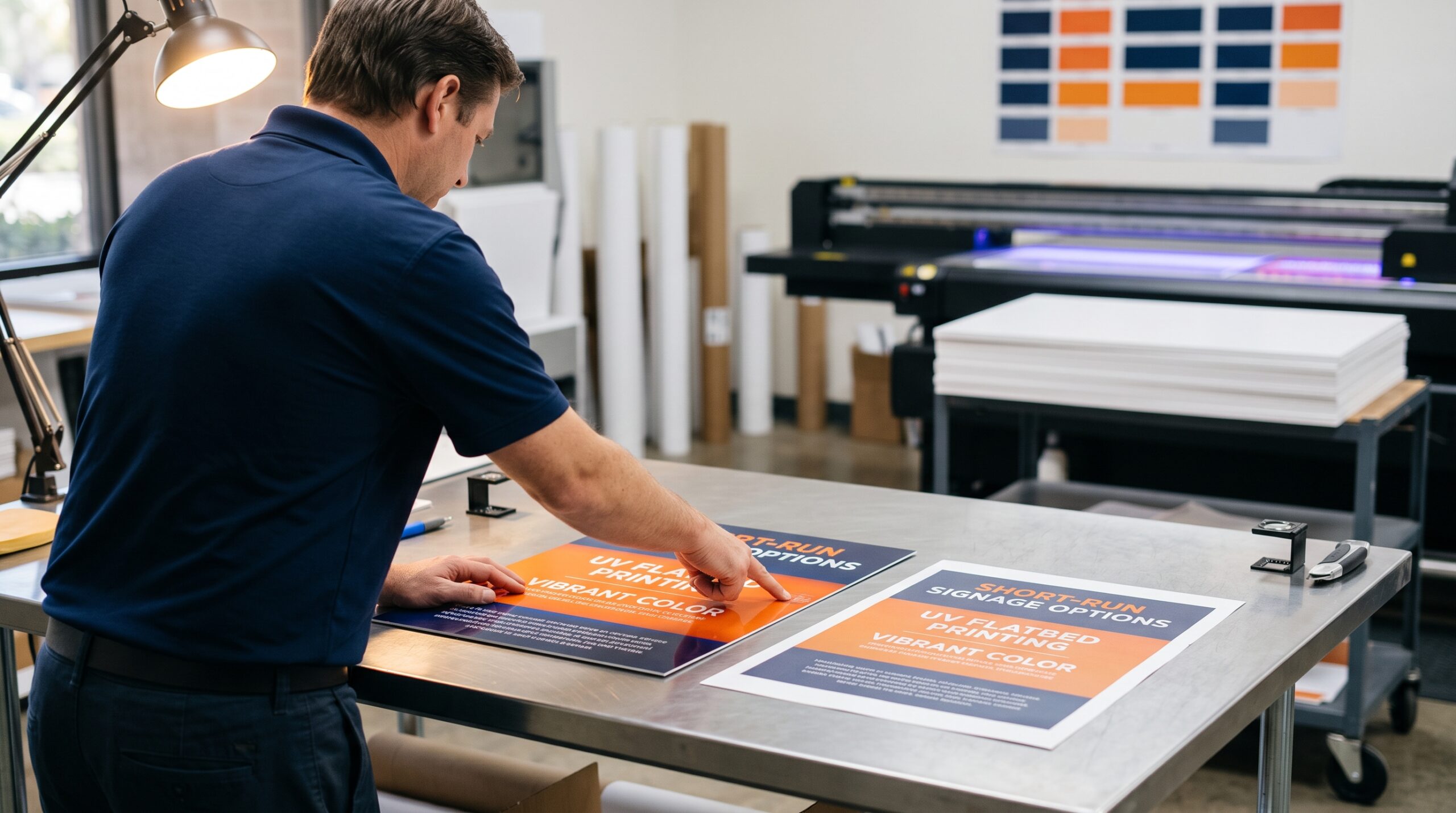
For businesses in Firestone Park, the choice between UV printing and offset for short-run signs usually comes down to speed, material flexibility, and cost per unit. If you need 50 to 500 pieces with quick turnaround and variable data, UV digital printing is almost always the right call. If you are producing over 1,000 identical pieces on standard paper stock, offset still wins on unit price. This guide breaks down the technical differences, cost factors, and practical scenarios specific to Irvine sign buyers so you can order with confidence.
Why Short-Run Signage Is a Different Beast in Orange County
Short-run means different things to different print shops. In the commercial printing world, a short run is typically anything under 1,000 units. For signs specifically—think yard signs, A-frame boards, window clings, and small posters—the run length is often even shorter, sometimes just 25 to 100 pieces.
Irvine businesses face unique pressures. Commercial rents in Firestone Park and the surrounding Irvine Business Complex are high, which means marketing budgets need to work fast. A sign that takes two weeks to print might as well not exist if your promotion ends Friday. That immediacy is the single biggest reason UV digital printing has become the default for short-run sign work in this area.
Another factor is the variety of substrates. Firestone Park businesses range from auto repair shops to medical offices to food retailers. Each needs different sign materials—corrugated plastic, aluminum composite, acrylic, or vinyl. Offset printing is essentially limited to paper and thin cardstock. UV printing handles all of the above without changing the core process.
How UV Printing Works (and Why It Matters for Signs)
UV printing is a digital process. The printer sprays liquid ink onto the substrate, and ultraviolet light cures—or dries—the ink instantly as it is applied. Because the ink is cured with light rather than absorbed into the material, it sits on top of the surface. That creates a sharper image with more vibrant colors, especially on non-porous materials.
For sign work, this is a game changer in practical terms. You can print directly onto rigid boards, acrylic sheets, metal, and even textured surfaces without worrying about ink bleeding or smudging. The instant curing also means the sign is ready to handle, cut, and install immediately after printing. There is no drying rack time, no waiting for solvent-based inks to off-gas.
The process is fully digital, which means setup is minimal. You send a PDF, the printer calibrates, and the job runs. There are no plates, no chemical washes, and no make-ready sheets wasted on getting the color right. For a 50-piece run of yard signs, the first piece out of the printer is identical to the last.
Substrate Versatility for Firestone Park Signage
Local sign buyers often need materials that can withstand Southern California sun and occasional marine layer moisture. UV printing works well on:
- Corrugated plastic (Coroplast) for temporary real estate and event signs
- Aluminum composite (Dibond) for permanent exterior signage
- Acrylic for illuminated or high-end lobby signs
- Vinyl and adhesive film for window graphics and vehicle magnets
- Foam board for indoor displays and trade show panels
Offset printing simply cannot run these materials. It is a paper-based process. If you need a rigid sign, UV digital is the only practical option between the two.
How Offset Printing Works (and Its Remaining Strengths)
Offset lithography is the traditional commercial printing method. Ink is transferred from a plate to a rubber blanket, then onto the paper. It is a mechanical process that requires a plate for each color used—typically four plates for full-color CMYK work.
For large quantities, offset is still the most economical process in commercial printing. The plates cost money and take time to produce, but once they are made, the press runs fast and the per-unit cost drops dramatically. If you are printing 5,000 brochures or 10,000 flyers, offset will beat digital on price every time.
Offset also has a slight edge in color accuracy and detail on coated paper stocks. The ink lays down in a thin, even film that produces crisp halftones and smooth gradients. For high-end catalogs, art books, and corporate collateral on premium paper, offset remains the gold standard.
When Offset Makes Sense for Firestone Park Businesses
There are still scenarios where a local business should choose offset. Consider these examples:
- Direct mail postcards in quantities of 2,000 or more
- Menu inserts that need to match a specific Pantone brand color exactly
- Multi-page brochures where the cost of digital printing per page adds up fast
- Letterhead and business cards on premium cotton or textured stocks
If your project is paper-based, the quantity is high, and the deadline is flexible (5-10 business days), offset is still a smart financial move.
Cost Comparison: UV vs. Offset for Short Runs
Pricing structures for the two processes are fundamentally different. Digital UV printing has a low setup cost and a relatively flat per-unit cost. Offset has a high setup cost and a low per-unit cost. The crossover point varies by shop, but it generally falls between 500 and 1,000 units for paper products.
| Project Type | UV Digital (Short Run) | Offset (Long Run) |
|---|---|---|
| 50 yard signs (Coroplast) | $300–$500 total | Not cost-effective (plate setup alone exceeds total) |
| 250 window clings | $400–$700 total | Not practical (substrate limitations) |
| 1,000 flyers (full color) | $250–$400 total | $200–$350 total (slightly cheaper at this volume) |
| 5,000 brochures (8.5×11, folded) | $1,200–$2,000 total | $800–$1,400 total (clear offset advantage) |
The table above reflects typical commercial pricing in Orange County. Note that the UV digital costs include no setup fees for most standard jobs, while offset quotes typically include plate charges that range from $75 to $150 per plate.
Turnaround Times: What Firestone Park Businesses Can Expect
Speed is where UV digital printing separates itself from offset. A typical UV digital sign job—say, 100 yard signs or 50 acrylic panels—can be printed, cut, and ready for pickup in 24 to 48 hours. Rush orders are often possible within the same business day for smaller quantities.
Offset printing requires plate making, press setup, and a longer curing time for the ink to dry. A standard offset job takes 5 to 7 business days. Rush offset is possible but expensive, and the cost of rushing often erases the per-unit savings that made offset attractive in the first place.
For a Firestone Park retail store running a weekend sidewalk sale, the math is simple. A UV digital print job ordered Tuesday is installed by Wednesday afternoon. Offset would not even have plates ready by Wednesday.
Color Accuracy and Quality Differences
Both processes can produce excellent color, but they achieve it differently. UV digital printing uses a CMYK plus white ink configuration. The white ink layer is critical for printing on transparent or colored substrates—it provides an opaque base so the CMYK colors remain true.
Offset printing uses Pantone spot colors more efficiently. If your brand has a specific orange or purple that must match perfectly across all materials, offset gives you the ability to run a dedicated spot color ink. UV digital printing relies on process color simulation, which is very close but not always an exact match for Pantone formulas.
For most sign applications, the visual difference between UV digital and offset is negligible to the naked eye. The average customer walking past a Firestone Park storefront cannot tell whether the sign was printed digitally or offset. They can tell if the colors are vibrant and the text is sharp—both processes deliver that.
Resolution and Detail for Small Text
If your sign includes fine print, disclaimers, or small regulatory text, resolution matters. Offset printing can hold extremely fine detail because the ink transfers cleanly from the blanket to the paper. Modern UV digital printers, however, are not far behind. Most production-grade UV printers run at 1200 dpi or higher, which is sufficient for text as small as 4-point on rigid substrates.
The real limitation with UV printing is not resolution but substrate texture. On heavily textured materials, the ink may not lay down perfectly flat. For smooth surfaces like acrylic, aluminum, and vinyl, UV digital output is effectively indistinguishable from offset.
Durability and Outdoor Performance in Irvine Climate
Irvine gets roughly 280 sunny days per year. That means outdoor signs face intense UV radiation, heat, and occasional Santa Ana wind conditions. Sign durability is not just about the printing method—it is about the ink and substrate combination.
UV-cured inks are inherently more resistant to fading than solvent-based or latex inks. Because the ink is fully cured and polymerized, it forms a hard, durable surface that resists scratching and chemical exposure. For outdoor signs expected to last 2 to 3 years, UV digital printing on aluminum composite or acrylic is a solid choice.
Offset printing is rarely used for outdoor signage because paper is not a durable substrate. Even laminated offset prints degrade quickly in direct sun. If your sign needs to live outdoors, UV digital printing on a rigid substrate is the practical answer.
Variable Data and Personalization Capabilities
One of the hidden advantages of UV digital printing is variable data. Because each piece is printed individually from a digital file, you can change text, images, or codes on every single piece without slowing down the press. This is impossible with offset, which prints the same image on every sheet.
For Firestone Park businesses, variable data opens up practical marketing options:
- Personalized direct mail where each recipient’s name appears on a postcard
- QR codes that track which specific sign or window cling generated a visit
- Sequential numbering on tickets, raffle entries, or inventory tags
- Localized signage for multi-location campaigns with different phone numbers or addresses
If your short-run sign project benefits from any form of personalization, UV digital is the only choice between the two methods.
Common Mistakes When Ordering Short-Run Signs
Even with the right printing method, sign projects fail for avoidable reasons. Here are the most common errors I see from local businesses ordering short-run signage:
Submitting Low-Resolution Artwork
Signs are viewed from a distance, but that does not mean low-resolution images are acceptable. A 72-dpi image pulled from a website will look pixelated when printed at 24 inches wide. For UV digital printing, provide artwork at 150 to 300 dpi at final size. If you are unsure, ask the print shop to check your file before production.
Ignoring Bleed and Safe Margins
UV digital printers print to the edge of the substrate, but your artwork needs a bleed—usually 0.125 inches on each side—to ensure no unprinted white edges appear after cutting. Keep all critical text and logos at least 0.25 inches inside the trim line. A professional print shop like Avanti Printing Inc will usually catch these issues, but it is faster if you get it right in the file.
Choosing the Wrong Substrate for the Environment
Coroplast is fine for a 30-day event sign, but it will warp and fade if left outdoors for a year. If your sign needs to last, invest in aluminum composite or acrylic. The substrate cost difference is often less than the cost of reprinting a failed sign.
How to Decide: A Simple Decision Framework
When a Firestone Park business asks me which method to use, I ask five questions:
- What is the quantity? Under 500 units, UV digital. Over 1,000 units, offset.
- What is the substrate? Paper only, or rigid/plastic? Rigid means UV digital.
- What is the deadline? Under 3 days, UV digital. Flexible, either works.
- Is variable data needed? Yes, UV digital. No, either works.
- What is the outdoor lifespan needed? Over 6 months, UV digital on rigid substrate.
If the answers point to UV digital, you are in good company. The vast majority of short-run sign work in Irvine is produced digitally because it is faster, more versatile, and cost-competitive at low volumes.
What to Prepare Before Requesting a Quote
To get an accurate quote and a fast turnaround, have these items ready before you contact a print shop:
- Final artwork in PDF, AI, or EPS format with bleeds included
- Exact dimensions for each sign, including thickness if you need rigid material
- Quantity for each design variant
- Substrate preference or a description of where the sign will be used
- Deadline and whether you need delivery or will pick up
Providing complete information on the first call eliminates back-and-forth emails and reduces the risk of production delays. Most reputable shops in the Irvine area can provide a firm quote within a few hours if your files are ready.
FAQ: UV Printing vs. Offset for Short-Run Signs
Can UV printing match offset quality for photographic images?
Yes, for sign applications. Modern UV digital printers produce excellent photographic reproduction on smooth substrates. The color gamut is slightly different from offset, but most viewers cannot tell the difference. If you need a precise Pantone match, offset is still more reliable.
Is UV printing more expensive than offset for 500 signs?
For rigid signs, offset is not even an option, so UV digital is the only comparison. For paper-based signs like posters, UV digital will be slightly more expensive per unit than offset at 500 pieces, but the difference is usually small—often under $50 total. The faster turnaround usually justifies the small premium.
How long do UV-printed outdoor signs last in Irvine weather?
On aluminum composite or acrylic, a UV-printed sign typically lasts 3 to 5 years before noticeable fading. Coroplast signs last 6 to 12 months. The UV-cured ink is highly resistant to sun damage, but the substrate will eventually degrade from heat and wind exposure.
Making the Right Call for Your Next Sign Project
For short-run signs in Firestone Park, UV digital printing is the practical default. It is faster, works on more materials, and costs less at the quantities most local businesses need. Offset remains valuable for high-volume paper projects, but it is rarely the right tool for signage.
Start with your deadline and substrate. If you need a rigid sign in under a week, go UV digital. If you are printing 2,000+ paper pieces with no rush, get an offset quote. The right choice becomes obvious when you match the method to the project requirements.
When you are ready to move forward, work with a local commercial printer that handles both processes. A shop that offers UV digital and offset can recommend the most cost-effective approach for your specific job without bias. That is the kind of guidance that saves Firestone Park businesses both time and money on every sign order.
Visit Avanti Printing Inc