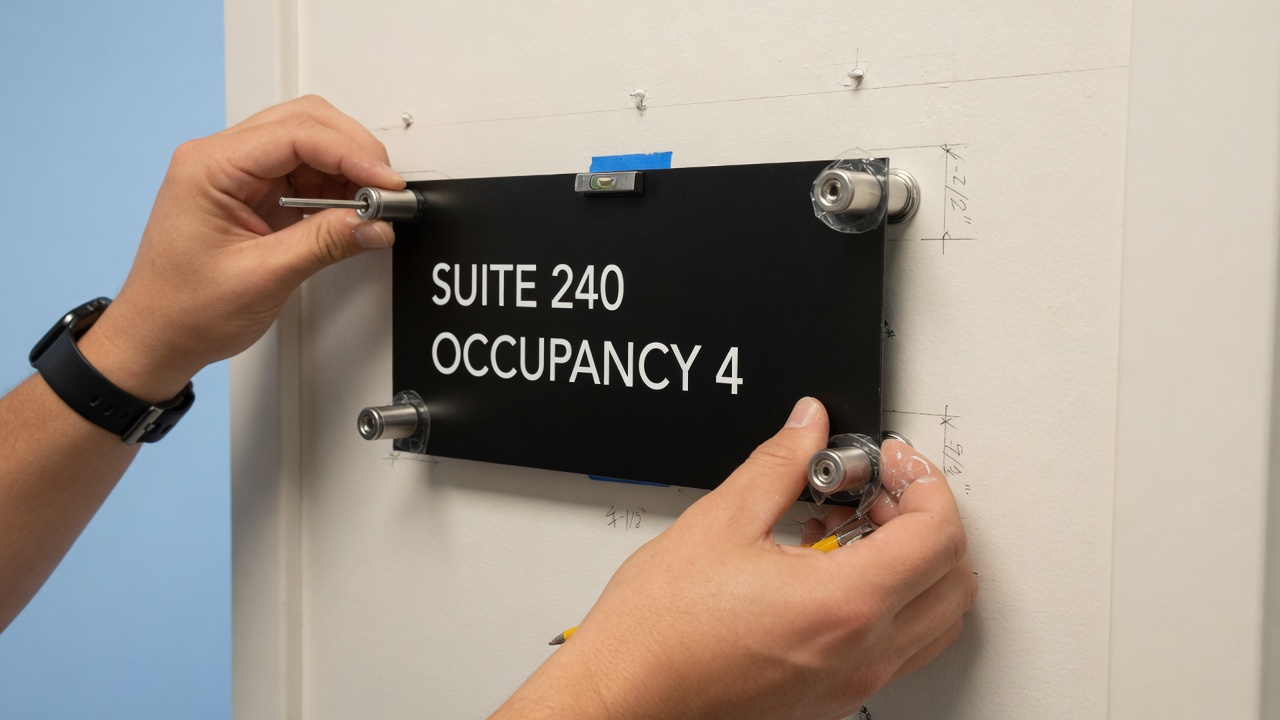
Rigid sign mounting in Irvine suites is tape, standoffs, or a frame — picked against the lease, the wall, and whether you must leave without paint scars. Removable hardware protects the drywall; permanent hardware only belongs where the landlord already said yes. Avanti Printing at 15321 Barranca Pkwy, Irvine, CA 92618 prints those panels. Quotes confirm size, material, quantity, finish, and date.
The search sounds like a hardware-store errand. On the counter it is a permission problem that happens to include a printed board. A 18×24 of 6 mm PVC on four stainless barrels is a different product from the same art on VHB, in a snap frame, or sitting on a desk because the corridor wall is not yours. Get the hang right and the suite looks finished on Monday. Get it wrong and you own a floor plaque, a paint crater, and a move-out invoice from a painter who bills by the patch.
This is a mounting article, not a lobby-directory article, not a sheet-thickness catalog, and not a press-family comparison. We put graphics on rigid faces in the same building as rigid sign printing in Irvine. The job here is how that face meets a leased wall. Call (949) 387-0787 if you already have a panel in the car and a property manager who said “no new holes.”
Who this is for in leased Irvine suites
You are shopping rigid sign mounting in Irvine because a lease, a TI punch list, or a managing partner said the suite has to look occupied, and then went quiet on who owns the paint. Typical callers from Irvine, Tustin, Costa Mesa, Lake Forest, Laguna Hills, Santa Ana, Newport Beach, and the John Wayne Airport office corridor are office managers, facilities people, tenant-improvement coordinators, medical and dental administrators, and small-firm owners who will personally stand on a step stool Saturday morning.
Drive-in radius is local. We are at 15321 Barranca Pkwy, Irvine, CA 92618. Buyers from the Irvine Business Complex, University Research Park, Spectrum-area office, medical suites on Barranca and Alton, and Jamboree-corridor parks treat this as a counter job. If the panel has to ride a passenger elevator to a tenth-floor suite, say so before we print a 36×48 you cannot turn in the cab.
This guide is for California tenants who will own the hang, the next reprint, and the move-out walkthrough. It is written in second person because you are the one who will explain a four-inch paint scar to a property manager. It is not for someone collecting reception photography. If the graphic is actually a wall mural, a window film, or a corridor plaque the landlord already specified, say that. Those are related products, not the same ticket.
- Tenants in Irvine Company parks who were handed a criteria PDF that forbids corridor vinyl and still need a brand panel inside the suite.
- Medical, dental, and therapy suites on Barranca, Alton, and Culver that need hours, a name, and a check-in panel on walls they do not want to patch in two years.
- Law firms, accountants, and professional offices sharing a floor, a card reader, and a no-drill clause.
- Retail and restaurant operators in Spectrum-adjacent space who can drill inside the unit and cannot touch the mall-side glass.
- TI contractors and architects who already drew a signage schedule and need the printer to follow the hardware note instead of inventing barrels.
If you are a home-based business in Woodbridge, Turtle Rock, or Northwood, a commercial suite plaque on a garage is still a sign to an HOA. We will print it. The architectural committee will not grade us on VHB dwell time.
Removable versus permanent: pick the hang first
Start with the hang, not with a file named LOBBY_LOGO_FINAL_v9. Rigid sign mounting in Irvine suites fails more often from the fastener than from the ink. Tape is not a smaller standoff. A snap frame is not a cheaper acrylic float. A desk sign is not a failed wall sign if the wall was never yours. If your email says “mount it” and attaches a PNG, you have not specified a job. The table below is shop practice for leased Orange County interiors, not a load table and not a warranty.
| Hang | Leaves the wall | What it actually does to paint | Honest use | Do not use it for |
|---|---|---|---|---|
| Removable mounting strips / hook systems | Designed to stretch off | Low on clean, cured, smooth paint if you follow the package; still a gamble on orange peel and eggshell | Tiny plaques, short-term notices, a name that will change before the lease does | A 24×36 rigid board, anything a visitor will lean on, west glass in August heat |
| VHB / high-bond acrylic foam tape | Semi. The tape often wins against the paint | Can pull latex, take a paper face off wallcovering, or leave a ghost even when it “comes off” | Small, light, interior panels on a unified, clean surface you own, when holes are forbidden and you accept the paint risk | Heavy ACM, large acrylic, dusty eggshell, fresh paint, a corridor the landlord already specified |
| Snap frame, poster frame, or channel rail | The face swaps; the frame stays | Screw holes for the frame only, in a known pattern | Hours, offers, tenant names, anything that will change without a new hang | A one-time reception object you wanted to look like floating glass |
| Magnetic face on a steel or magnetic-receptive backer | The face pulls off; the backer is the hang | Whatever you used to mount the backer | Menus, rotating names, leasing lists inside a suite you control | A public corridor where magnets walk home in a backpack |
| French cleat or hanging rail | The panel lifts off; the cleat stays | A horizontal line of fasteners, easier to patch than four random holes | Heavy opaque boards you may swap; a panel you want level without four people | Clear or reverse-printed acrylic, because you will see the cleat |
| Standoffs (barrels and caps) | Permanent-looking; removable only if you fill the holes | Four or more discrete holes, plus whatever the anchor does inside the gypsum | A float look on a wall you are allowed to drill, inside the suite | No-drill leases, common corridors, glass you do not own |
| Screws with painted caps | Same as standoffs, less theater | Holes. Washers if the sheet is PVC | Utilitarian interior boards, ACM, anything that should not pretend to float | A 3 mm sheet without washers; overtightened caps on thin plastic |
| Desk, easel, slatwall, or cubicle hang | Fully removable | None on the landlord’s drywall | When the wall is forbidden and the message still has to exist | The only identification for a suite if the corridor already has a program plaque |
Read the paint column twice. In an Irvine office park, “removable” is a marketing word until you name the paint. High-bond tape on dusty eggshell is a floor panel with a souvenir of the wall still stuck to the foam. Standoffs on a corridor the criteria book already specified are four illegal holes with a pretty cap. A snap frame with two screws at studs is often the adult answer people skip because it photographed less like a hotel lobby.
A rigid suite sign is a reprint plan with a wall. If you cannot name the hang, the owner of the paint, and what happens at move-out, you do not have a mounting spec. You have optimism and a step stool.
Weight, area, and dwell time beat the brand name on the tape. A small 8×10 PVC nameplate on clean, cured, satin paint can live on a high-bond tape if you accept the paint conversation later. A 24×36 of 1/4-inch acrylic on the same tape is how you donate a glass-looking object to gravity. Manufacturer shear numbers are laboratory numbers on stainless or painted metal. They are not a promise about an Orange County suite wall that was rolled five years ago and dusted by HVAC ever since.
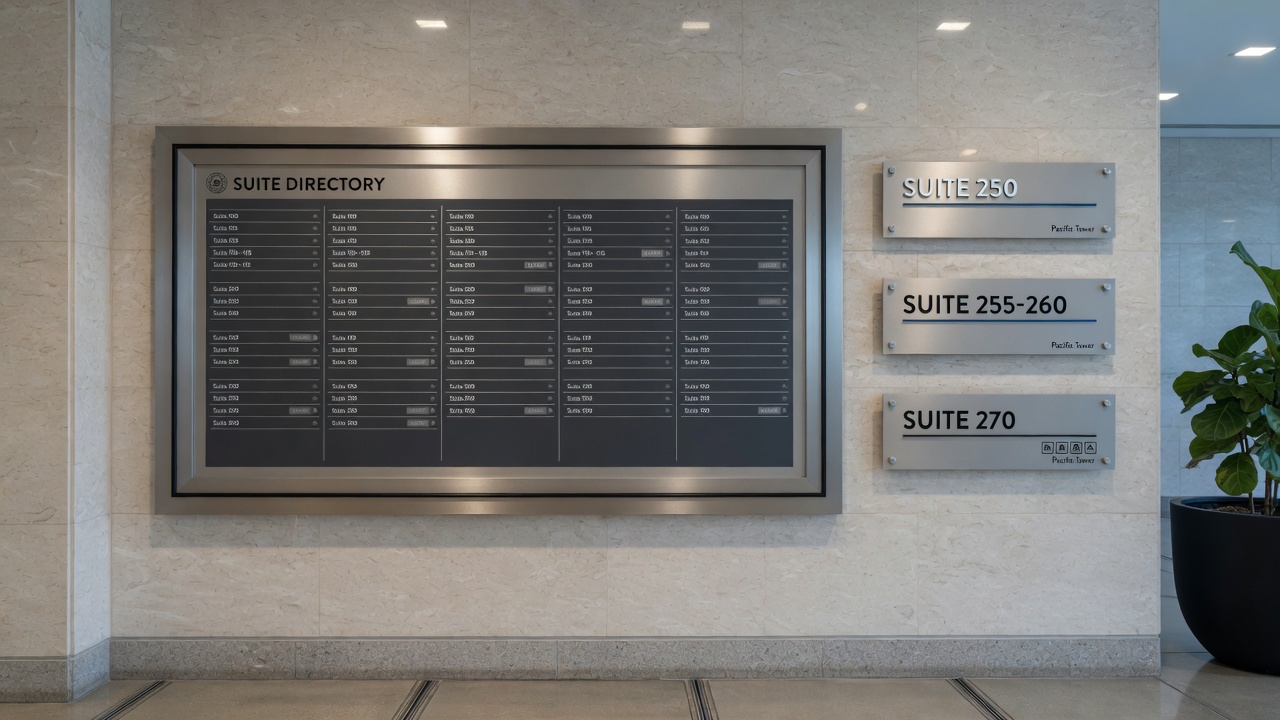
What Irvine landlords actually allow on the wall
Irvine is a planned city with a planned attitude toward signs, and that attitude is stricter in office parks than buyers from other counties expect. Check three desks, in this order: landlord or property manager, then the City if the sign is visible from the public side, then us. Printing first is how panels sit in a closet, or worse, how they hang for a week and then come down with a notice taped to the glass.
Office parks — especially Irvine Company properties around the Spectrum, Jamboree, the Irvine Business Complex, and University Research Park — usually have a sign program. Suite-door plaques, directory strips, monument slots, and even the typeface on the elevator directory may already be specified: size, material, mounting, sometimes an approved vendor. Your custom 12×18 logo panel may be allowed inside the suite and forbidden on the corridor. A floating object in a shared lobby can also be a problem if it was never in the criteria book. Ask the property manager for the PDF before we drill anything that will live on their drywall.
Typical constraints we actually see, without pretending every campus uses the same numbers:
- No new holes in common corridors. The hang is their frame, their backer, or nothing. Do not invent standoffs because a hotel photograph looked expensive.
- Specified hardware only. Painted heads, a particular barrel finish, no decorative caps, no tape on vinyl wallcovering. The binder wins.
- No applied vinyl on corridor glass. Hours and logos on the suite-side of your own glass can still be a criteria fight. Window film is a different process under large-format printing for window and wall graphics. Do not smuggle it in as a “mounted sign.”
- Approved vendors in common areas. Some parks want their installer in the elevator lobby. We can print and you can hand the stack to their vendor. Say that on the quote so we do not schedule a hang we cannot perform.
- Restoration at move-out. Commercial leases in this market commonly want walls returned to a paintable state. Four standoff holes are four patches. Tape that lifted the paper face of the wallcovering is a bigger invoice. Design the hang for the walkthrough, not only for Monday’s photo.
- Monument and parking ID. Building names, lot letters, and tenant slots on a monument are almost never a tenant DIY. Those are landlord or City conversations that happen to include a printed face.
Inside the suite, the rules relax and the lighting gets worse. You usually control the feature wall behind reception, the conference glass you actually lease, and the interior doors. You usually do not control the public face of the floor, the elevator alcove, or the storefront if the park treats it as architecture. Solve the corridor with the binder. Then we can talk about the reception object and whether it floats, frames, or sits on a ledge.
Medical buildings on Barranca and Alton add a second binder: hospital or professional-building criteria on top of the park rules. Practice names, suite numbers, and after-hours instructions are normal. A 24×36 team photograph on the corridor is often not. HIPAA is not a print spec, but a temporary paper that names a patient-facing program in a public hall is an operations problem that happens to be on our substrate. Keep patient names off wayfinding, and keep the hang as quiet as the copy.
The City of Irvine treats many exterior signs as a permit question. Interior suite plaques and elevator directories usually are not a City counter job. A panel on the building face, a monument slot, or a sign visible from the public right-of-way can be. Start at the City’s sign rules for Irvine when the object leaves the suite and faces the street. Wall signs typically need an elevation, dimensions, and the length of the leased frontage. We can print to a permitted drawing. We cannot issue the permit, and we will not tell you a storefront logo is “probably fine” because the standoffs are pretty.
UCI and other campus facilities have their own brand and facilities rules. A department suite ID is one queue. A public-corridor panel is another. Bring the spec they already wrote. Anaheim, Costa Mesa, and Newport jobs that still pick up on Barranca bring their own city rules; do not assume Irvine’s packet applies. The constant is the quote: object plus location plus permission plus hang.
Tape that holds, and tape that takes paint with it
Tape is the first thing tenants ask for and the last thing I will bless on a heavy panel. It is also sometimes the only legal hang in a no-drill suite. Treat it as a system: surface, area of tape, temperature, dwell, and an exit plan. Treat it as a sticker and you will meet the floor.
Three families show up in this trade. Do not mash them into “just use tape.”
- Removable mounting strips and hook products. Stretch-release adhesives sold for picture frames. The package weight is a small, indoor, painted-wall number. It is not a 24×36 ACM number. Fine for a 5×7 name, a temporary notice, a lightweight PVC that will come down before anyone forgets it. Not fine for a reception feature, a panel over a sofa, or anything a child or a visitor can tug.
- High-bond acrylic foam (the VHB class). This is the tape people mean when they say “the strong stuff.” It can hold metal to metal for a long time when the surfaces are clean, unified, and within the manufacturer’s temperature window. On latex paint over gypsum, it often holds the panel and the paint. That is a successful bond and a failed move-out.
- Removable or low-tack mounting tapes. Better exit, worse hold. Useful for short-term interior graphics on a wall you will still have to look at. Useless as a substitute for VHB on a panel you wanted to forget about for the rest of the lease.
3M publishes application guidance for VHB that estimators actually use. Their applying 3M VHB tapes notes start with surface preparation: a unified, clean, dry face, typically wiped with an isopropyl alcohol and water mix, then a dry wipe. Oily films want a degreaser first, then the alcohol step. Porous surfaces want a sealer because foam tape does not like to drink. Those are manufacturer instructions, not a folk recipe from a facilities closet. Skip the wipe and you bonded to dust.
Bond build is a clock, not a slap. 3M’s published curves for many VHB families put a large share of ultimate adhesion in the first minutes at room temperature, most of the rest by about twenty-four hours, and a full cure on the order of three days. Those are manufacturer curves on clean, unified surfaces. They are not a promise on dusty eggshell in a suite that was painted last week. Do not hang the panel at 4 p.m. Friday and lean on it during the Monday open house. Pressure matters: roll or firmly press the tape so the foam wets the surface. A fingertip dab in each corner is how a “defective tape job” becomes four air gaps.
Temperature is the Orange County footnote. Acrylic foam wants a reasonable room temperature to wet out. A west-facing suite along Jamboree that sat empty with the HVAC off in August is a hot wall, not a bonding laboratory. A Monday morning after a weekend of A/C blast can be a cold wall. If the wall is outside the tape’s application window, wait. Heat after a bad bond does not magically fix a dusty surface. Heat after a good bond on a dark panel in a sun-loaded window can soften adhesives and creep the panel down the glass. Say sun-loaded if it is sun-loaded.
Paint and wallcovering are the real substrate, not “the wall.”
- Cured satin or eggshell latex. The everyday Irvine suite. Tape can work on small, light panels if the paint is fully cured and clean. Fresh paint is not a bonding surface. Let it cure per the paint manufacturer, then clean. A wall painted Thursday is not a Friday tape job.
- Orange peel and knockdown. The tape only touches the peaks. Contact area is a fraction of the rectangle you measured. Either use more tape than your optimism wanted, switch to mechanical fasteners, or pick a smaller panel.
- Vinyl wallcovering. Common in medical and professional buildings. High-bond tape can delaminate the covering. The panel stays on the vinyl; the vinyl leaves the wall. That is not a print defect.
- Glass. Often a better tape surface than paint, which is why people try it on corridor storefront they do not own. Permission first. Then cleaning that actually removes the film the window crew left. Then a conversation about heat, because west glass in Irvine cooks adhesives.
- Fabric, acoustical, and tackable panels. Not a tape surface. Not a screw surface without backing. Put the sign on a wall that is a wall, or put it on a desk.
How much tape is a geometry problem. Shop practice for a small interior PVC plaque is tape near the corners and along the top edge so the panel cannot peel from the top. A continuous picture-frame of tape on a large sheet can trap a bow. Dots only at four corners on a 24×36 is how the middle drums and then the corners peel. I would rather you use a frame than invent a tape pattern for a panel that wanted screws. If you insist on tape, tell us the panel size, the sheet, and the wall so we can say no while it is still cheap.
Removal is not the inverse of application. Heat can soften acrylic foam. A fishing-line or floss cut behind the panel can separate foam from wall if you are lucky. Adhesive leftover still needs a remover that will not burn the paint. Even a “clean” release can leave a gloss ghost where the tape sealed the paint from HVAC dust. Budget a painter if the lease wants a perfect wall. Anyone who tells you VHB on latex is fully reversible is selling tape, not living with the walkthrough.
Command-style stretch release is more honest about leaving, and more honest about weight. Use it for what it is. Do not stack six strips on the back of a 6 mm ACM and call it engineering. If the panel is heavy enough that you are inventing arrays, you wanted a frame or a cleat.
Standoffs, barrels, and holes you cannot hide
Standoffs are the default Irvine lobby look people want inside the suite: stainless barrels, cap heads, a shadow gap, four corners. They are a hardware product, not a personality trait. They look proportional on a panel that was designed for them. They look like bolts on a cracker when the sheet is too thin, the barrels are too long, or the wall was never allowed to receive them.
Typical barrels for interior suite work land in the 1/2-inch to 1-inch length range, with longer hardware when you want a deeper float. Those are typical industry sizes, not a promise that your campus uses any of them. The hole in the panel is sized to the barrel or to the screw, depending on the set. We can drill to a template. We cannot invent the template if you have not chosen the hardware. Give us either the kit or a spec: barrel diameter, barrel length, screw size, finish (stainless, black, brass), and whether the cap sits in front of the sheet or the sheet sits on hidden studs.
Front caps are easier to install and easier to overtighten. Hidden-stud hardware keeps the face clean and is less “retail display.” Either way, the wall still gets holes. The gypsum still gets an anchor. The painter still gets a call at move-out. A standoff is not a no-damage hang. It is a decorative fastener.
Hole placement wants a margin. A hole too close to the edge on thin sheet is a crack waiting for the last turn of a screwdriver. A typical safe margin is on the order of 1/2 inch to 1 inch from edge to hole center, more on thin sheet, more if the edge is already polished and you do not want a chip. Mark holes in the file as a non-printing layer, or send a dimensioned sketch. “Put holes in the corners” is not a dimensioned sketch. People mean different corners and different offsets. A phone number under a 3/4-inch cap is a reprint.
Large panels need more than four points. The rule of thumb is about the span between supports, not a superstition about squares. If the unsupported run is getting past two feet on thin sheet, add hardware. If the wall is only two studs and a lot of air, talk about a backer or a cleat instead of asking four decorative bolts to carry a heavy 36×48. Anchors must match the wall: toggle or molly in drywall, a real masonry anchor in concrete, glass hardware on interior glass you are allowed to drill. Drywall powder is not a stud. A standoff in powder is a time-release floor sign.
Glass-mount standoffs exist for interior office glass. Confirm with the landlord before you drill a storefront. Confirm the glass type. Confirm you are allowed to. A lot of Irvine glass is not yours. Tempered glass does not want a surprise hole from a hardware-store bit on a Saturday. If the program says no glass hardware, the answer is a desk sign or a panel on a drywall you lease, not our optimism.
Overtightening is the mechanical reprint. A decorative stainless cap cranked like a lag bolt will star-crack acrylic and pull through PVC. Hand-tight plus a quarter turn, a washer where the sheet is plastic, and an installer who has hung this product before. If your installer is a general handyman who has only hung frames, write the torque note on the packing slip. We can supply panels drilled and ready, or panels plus kits. Installation in common areas of an office park is often restricted to approved vendors. Ask the property manager before you schedule anyone with a drill.
Corridor standoffs are a criteria question, not a taste question. If the binder drew painted heads flush to a specified plaque, do not upgrade yourself to 1-inch barrels because a reception photograph in another city used them. Inside a private suite, standoffs are fair game when the wall can take the load and the lease can take the holes. On the public face of the floor, the binder still wins.
Frames, rails, and faces you can swap
Frames are how tenants stop reprinting architecture every time the hours change. The hardware stays. The face comes out. That is the product. It photographs less like a boutique hotel than standoffs do, and it survives a restack. If your copy will change — hours, a partner name, a promotion, a directory line — start here instead of falling in love with a fused panel.
Snap frames (the poster-frame family with a spring or hinged edge) are the everyday interior version. Specify a size by the daylight opening, not by a marketing name. A “24×36 frame” from two vendors is two different openings. Measure the reveal. The insert must match thickness as well as width and height: a 1/8-inch sheet in a 1/16-inch channel does not enter; a paper insert in a humid vestibule curls. Thin PVC or a thin ACM insert is the adult version of that paper. Interior snap frames belong indoors. Outdoor-rated frames exist; they are a different quote, and they are the wrong object for a suite wall anyway.
Channel rails and slide-in strips are the cousin for lists: tenant names, room IDs, a menu of services. Measure the pitch. Common strip heights in this trade land around 1/2 inch, 3/4 inch, 1 inch, and 1.5 inch. Those are typical industry sizes, not a promise that your existing rail is any of them. Bring a dead strip. We impose names to that height. Twenty Word files named “new hours” will not stack.
Lockable frames belong where the public can reach the face and you do not want the insert walking away. Reception-adjacent directories, a waiting-room notice, a required posting. A lock is not a design flourish. It is a theft and fidget spec. If the frame sits behind a desk, skip the lock and buy a cleaner profile.
Slim trays and U-channel let a rigid face sit like glazing: finished edge hidden, swap still possible if we leave a way to lift the sheet. Useful when you want a quieter look than a snap frame and you still refuse to glue the graphic to the wall. A French cleat behind an opaque panel is the heavy version of the same idea. The panel lifts off. The cleat is a straight line of fasteners, which a painter can hide later more easily than a constellation of standoff holes. On clear or reverse-printed acrylic a cleat is a visual problem because you will see it. Opaque board, cleat. Clear float, standoffs — if holes are allowed.
Magnetic systems are a frame without the frame: a steel or magnetic-receptive backer on the wall, printed faces with magnetic tape or a steel sheet. Honest inside a suite for rotating copy. Dishonest in a public corridor. Kids, vendors, and a bored visitor will test whether the magnet is decorative. Design the backer hang as the real hang. The magnets are only how the copy changes.
Do not treat a frame as a way to hang a panel the wall cannot take. A 36×48 of 1/4-inch material in a snap frame is a heavy object with a pretty edge. The frame still needs anchors. The wall still needs to be yours. Frames reduce reprint drama. They do not repeal gravity or the lease.
Quote tape, standoffs, or frames for this suite
Match the hang to the board, not the mood board
The sheet is the second decision after the hang, not a way to ignore the hang. The same art is different products on 3 mm PVC, 6 mm PVC, 3 mm ACM, and a reverse-printed acrylic. If your email says “suite signs” without a substrate and a hang, you have not specified a job. Direct UV-cured ink on those rigid faces is the process we run on the flatbed; the process background lives under flatbed UV printing on rigid suite panels. This page is how the object leaves the wall at move-out.
| Face | Typical interior hang | Tape? | Watch-outs |
|---|---|---|---|
| Expanded PVC, 3 mm | Snap-frame insert, small screws with washers, tape only when small and light | Maybe, small plaques, clean paint, you own the wall | Thin; drums in the middle; pull-through without washers |
| Expanded PVC, 6 mm | Screws with washers, frames, light standoffs | Rarely as the only hang on anything past a small plaque | Still not a monument; west sun through glass will move a large dark sheet |
| ACM, 3 mm | Screws, frames, standoffs, cleats | No, not as a 24×36 wall hang on latex | Needs real fasteners; edge shows a core stripe; heavier than people guess |
| Acrylic (interior object) | Standoffs if allowed; a frame if the edge is unfinished; desk feet if the wall is forbidden | No on anything you would mind on the floor | Weight, star cracks, landlord glass; this is not a tape product |
| Insert in an existing landlord frame | Their retention: tape tab, magnet, slide-in, screw caps | Only if that is how the frame retains the insert | Must match pitch, thickness, and retention; do not invent a new object |
Acrylic belongs in a reception as an object when the wall can take standoffs, not as the default corridor ID, and not as a taped rectangle. Reverse-printed clear with barrels is a different ticket. If you want that object inside a suite you control, say so. If you wanted a 4×8-inch insert for an Irvine Company frame, do not upgrade yourself to a polished slab because a hotel photograph looked expensive. The property manager will not be moved.
Foam-centered poster board is the other upgrade people try. It dents, it shows a paper edge, and it looks like a school project in a Spectrum-area suite. Do not specify it for a hang that has to look intentional for the rest of the lease. Temporary, maybe. A tenant ID, no. This article is not a foam-board catalog and not an acrylic UV tour. If the panel is a poster for a weekend, say so and we will talk about a cheaper face. If it is a suite object, pick a real sheet and a real hang.
Hardware recap, because it reprints more jobs than color does:
- Existing frame or backer. Measure, reprint the insert, stop inventing holes.
- Screws with washers. PVC wants washers. Do not overtighten small plaques; this is still a suite, not a furniture shop.
- Standoffs. Inside the suite, if allowed. In a common lobby, only if the program drew them.
- Tape. Small, light, short-term, clean paint you own. Not a 24×36 directory. Not a panel a hand will lean on.
- No-drill walls. Their frame, a desk sign, a ledge, slatwall, or a panel on a wall you actually lease.
Outdoor-adjacent faces — garage, porte-cochere, uncovered walk between buildings — leave the interior hang behind. ACM or a specified metal blank, real fasteners, and a conversation about sun. Orange County west light through a garage opening will chalk a face that lived happily in a corridor, and it will cook tape that lived happily in a conference room. Say outdoor if it is outdoor. Do not call a garage interior because there is a roof, and do not specify VHB on stucco because it worked on the suite drywall.
Holes, keep-outs, and files that survive hardware
Good mounting dies in prepress as often as it dies on the wall. The printer is not confused. The file was a brand poster with a phone number in the corner you later asked us to drill.
Send vector for marks and type: PDF, AI, or EPS, fonts outlined, logos as paths. Photographs can be raster. For a plaque people stand two feet from, 200–300 ppi at output size is the band we want. For a panel read from a reception sofa, 150–200 ppi is a typical industry band. A 72 ppi web hero stretched to 24×36 on gloss ACM will look like a web hero. Rigid gloss is happy to show you that.
Work in CMYK. RGB neons are a monitor event. If a brand color must hit a coated PMS number, say the number and understand the ground: that chip was printed on white paper. On brushed metal, on a dark backer, and on a reverse-printed clear, the same ink recipe is a different visual. Approvals that matter should be on the actual face. Landlord approvals should be on the actual layout the binder expects, not on a poster you wish they had specified.
Bleed: 1/8 inch past trim if ink goes to the edge and we cut after print. Safe type: keep live copy off frame lips, off standoff caps, off strip overlaps, and off any tape that might show through a thin translucent sheet (rare, but clear acrylic will show a VHB square as a ghost if you try it). If you do not know the cap diameter yet, keep a 1-inch keep-out in each corner until hardware is locked.
Holes belong on their own layer, named Holes, not drawn in 0.25-pt cyan that might print. Include diameter and offset from edges. If the panel is a custom contour, the cut path must be a clean closed vector, and the holes must still have meat around them. A script logo with a hole in a 1/4-inch stroke is a crack path.
White channel: a spot color or a layer named WhiteInk, 100 percent where white ink should print, when the sheet is not a white ground. Black plaques, brushed metal, and colored PVC all need this decision. White in a CMYK file is a hole. On those faces, the hole is the sheet.
Notes that belong in the email, not in a Slack screenshot: finished size (width × height, view-side); hang (tape, standoffs, existing frame, screws, desk); substrate and thickness, or “insert for existing frame” plus the measured opening; single or double-sided; holes; indoor or garage; quantity; date; who must approve (landlord, brand, GC). Photographs of a previous plaque, a website screenshot, and “it’s on the building directory, can you pull it” are not print files. Rebuild time is design time. Put rebuild / not rebuild on the quote with size, material, quantity, finish, and date.
If the same move-in also needs a wall mural or window film, list those as separate lines. Different process, different file, different hang. Mixing them into one “just mount signs” instruction is how interior PVC gets specified like a monument, or a taped nameplate gets specified like a 1/4-inch float.
Irvine walls, west glass, and move-out paint
Local color only matters when it changes the hang, the sheet, or the permission. These do.
Irvine Company and similar parks. Spectrum-area office, Jamboree, the Irvine Business Complex, University Research Park: criteria books, specified plaques, specified directories, sometimes specified vendors. Interior suite walls are usually yours. The corridor, the elevator lobby, and the monument are not. A 12×18 brand panel in the shared lobby is a sign-program problem that happens to be printed well. A 12×18 brand panel on your reception drywall is a hang conversation: standoffs if you will patch, a frame if you will change it, tape only if it is small and you accept the paint.
Glass boxes. IBC ground floors and Spectrum-adjacent suites glare. Downlights, west glass, and white walls will show every fingerprint on a gloss float and every creep in a tape hang. Sample satin. Do not approve a high-gloss first-surface on a window wall because a reception object in another article looked good. Heat on west glass is why VHB that held in a windowless conference room walks down a storefront in August.
Medical and dental on Barranca, Alton, and Culver. Quiet hangs, wipeable faces, often vinyl wallcovering that hates high-bond tape. Hours belong on glass you control or on a desk panel. Corridor IDs belong in the landlord’s specified insert. Do not invent a floating practice logo in the hall.
UCI and campus-adjacent. Department suites can take a rigid ID. Public corridors and exterior campus faces are someone else’s program. Bring the spec. A conference-room name that changes every semester wants an insert, not four new holes each fall.
Parking structures and covered walks. ACM, real fasteners, larger type, weather. Interior PVC on tape is a leftover that will look like one. Lot letters and building IDs are usually landlord copy.
City of Irvine. Interior suite hangs are typically not a City sign permit. Exterior wall signs, monuments, and copy visible from the public side can be. Use the City’s sign pages when the object leaves the suite. We print to the drawing. We do not stamp the permit.
HOA villages. Woodbridge, Turtle Rock, Northwood, University Park: a commercial suite plaque on a garage or a fence is a CC&R conversation. We will still print. Read the document. Tape on a stucco garage does not charm the architectural committee.
Elevators and path. A 36×48 that prints cleanly can still lose to a 36-inch door or a passenger cab. Measure the path out of our shop at 15321 Barranca Pkwy and the path into the suite. Tile if you must. A heroic panel cut in the garage is a waste of edge quality, and it is a worse hang because you will then try to tape the tiles to hide the seams.
Move-out. This is the local condition buyers skip. Irvine commercial leases are not sentimental about your brand. They are sentimental about paint. Design a hang you can reverse: an insert in their frame, a frame you will take with you, a cleat a painter can spackle in a line, a desk object that never touched the wall. Four standoff holes are honest if you budget the patch. A VHB rectangle that lifted wallcovering is a negotiation you will not enjoy.
None of that changes the press. It changes whether you should order decorative barrels because a lobby in a different city used them.
Mistakes that scar the drywall
Reprints and patches on these jobs hurt because you paid for a board, a hang, and sometimes a painter, not only for ink. The pattern is boring and preventable.
- Printing before the criteria PDF. The panel is perfect. The corridor was never yours. Check the binder first.
- VHB on dusty eggshell, orange peel, or vinyl wallcovering. Floor plaque, paint crater, or delaminated covering. Clean, or do not tape.
- Tape as the hang for a 24×36 rigid board. Area and weight are not a personality test. Use a frame, a cleat, or screws.
- Standoffs in a no-drill suite. Four illegal holes with pretty caps. Desk, frame on a wall you lease, or their insert.
- Holes after the fact, on site, with a hardware-store bit. Chips, star cracks, a phone number under a cap. Drill in the shop to a template.
- Overtightened caps on thin sheet. Star cracks and pull-through are not ink failures. Hardware is finish. Write it on the quote.
- No washers on PVC. The screw head becomes a punch. Then a gust of HVAC or a bump and you have a hole, not a hang.
- Type in the keep-out. Suite number under a barrel, hours under a frame lip. Keep a margin until hardware is locked.
- Fresh paint, then tape the same week. You bonded to a film that is still moving. Wait the cure, then clean, then decide if tape is even the hang.
- West glass, dark panel, acrylic foam, August. Creep. Then a gap. Then a fall. Mechanical hang or a different wall.
- Corridor glass vinyl the program forbids. The print is fine. The glass was never yours.
- Foam-centered poster board as a “suite sign.” Edges crush, it looks temporary, and it is the wrong object for a lease that will outlast the corner.
- One fused panel for copy that will change. You will reprint the architecture. Build a frame or strips.
- Landlord surprise at install. Approved vendor only, or no barrels in the lobby. Ask before we drill.
- Missing size, material, quantity, finish, or date. You get a range instead of a price, and a stack the day after move-in.
Stacking printed PVC face-to-face in a hot trunk deserves its own sentence. The boards will scuff. Slip sheets, or keep the masking on until hang. Peeling a panel’s masking in a dusty lot and then standing it on gravel is how a “defective” face becomes grit in the ink. Peel at install, on a clean surface. Do not clean first-surface ink with a solvent wipe meant for mill oil, and do not “improve” a tape surface with a household cleaner that leaves a film.
Command-strip arrays on ACM, and a building super who says “just stick it,” are the cousins. That person will not be there when it falls. Mechanical fasteners or a smaller board, or a desk.
What to send so the quote includes the hang
Send one email a person can estimate from. If you skip fields, you get a range, not a price. Walk-ins Monday–Friday, 8:00 a.m. to 5:00 p.m. at 15321 Barranca Pkwy, Irvine, CA 92618 are welcome if you bring a dead plaque, a dead strip, a tape-measured opening, or a photo of the wall with a tape in the shot. You can also start on the Irvine Printing site with the same fields. Quotes confirm size, material, quantity, finish, and date. Add the hang, the wall, and the landlord constraint on this product line so we do not guess.
- Object and hang. Nameplate, hours, reception panel, insert for existing frame, directory face. Tape, standoffs, screws, snap frame, cleat, desk, or “recommend from the lease.” Separate lines if they are separate products.
- Size. Width × height, view-side, in inches. If it sits in a frame, the daylight opening, insert thickness, and retention method. A photo with a tape in the opening beats a phone app.
- Material and thickness. PVC 3 mm / 6 mm; ACM 3 mm; acrylic if it is truly an object; insert-only; or “recommend from hang and change plan.” Indoor versus garage.
- Quantity. Identical versus versioned. Suite list attached. Strip count plus extras.
- Finish and hardware. Gloss / satin / matte; flood clear; edge; holes (count, diameter, offset); standoffs, screws, existing frame, tape, or desk feet. Who supplies hardware. Who is allowed to install.
- Wall and permission. Paint, wallcovering, glass, or existing backer. Criteria PDF if you have it. No-drill yes/no. Landlord proof required yes/no. Approved vendor hang yes/no. City drawing if the object is exterior.
- Date. The day it must be on the wall for move-in, not “ASAP.” Drilled, framed, reverse-printed objects are not a while-you-wait counter job. A small PVC insert with a clean file is a different clock.
Attach the file or say you need a rebuild. State pickup versus crate versus hang. State whether a brand manager, GC, or property manager must approve a proof. If an architect already drew a signage schedule, send that sheet. We would rather print to their numbers than invent a plaque that misses the embeds in the millwork.
Photos that actually help: the wall straight-on, a tape in the shot, the obstacle (thermostat, strobe, card reader, chair rail, glass butt-joint), and the existing frame if there is one. A wide beauty shot of the lobby with no scale is a postcard, not a spec.
Send wall photos and panel sizes for a quote
Questions tenants ask before they drill
Can I mount a rigid sign with tape in an Irvine suite?
Sometimes, if the panel is small and light, the paint is clean and cured, you own that wall, and you accept that high-bond tape can take paint or wallcovering with it at move-out. Removable strips are more honest about leaving and less honest about weight. VHB-class acrylic foam is the opposite. Neither is a hang for a 24×36 of ACM or acrylic. If the lease says no holes and the panel is heavy, the adult answers are a smaller board, a desk or easel, a snap frame with the fewest legal fasteners, or the landlord’s existing backer. We will say no while it is still cheap.
Will VHB damage the paint at move-out?
It can. On stainless steel in a laboratory it peels as a tape. On five-year-old latex over gypsum in an Irvine suite it often peels as a paint film. Vinyl wallcovering can delaminate. Orange peel reduces contact and still scars the peaks. Heat and dental floss tricks help some of the time and never help the lease language that wants a paintable wall. If you need a clean exit, do not use high-bond tape as the hang. Use a frame, a cleat you will patch in a line, an insert, or a desk object.
Are standoffs allowed on corridor walls?
Only if the sign program says they are. Most Irvine office-park corridors want a specified plaque in a specified location with specified hardware. Decorative barrels on the public side of the floor are how you get a removal notice. Inside your suite, standoffs are a normal hang when the wall can take anchors and you will own the patch. Glass-mount hardware on corridor storefront is a permission problem. A lot of Irvine glass is not yours. Ask for the PDF before we drill.
What if the lease says no holes at all?
Then the hang is not standoffs, and it is probably not screws. Options that still look intentional: the landlord’s existing frame or backer with a reprinted insert; a desk or counter sign; a panel on an easel you own; slatwall or cubicle furniture that came with the suite; in some cases a small removable-strip hang on a wall you still might have to touch up. Tape is not a magic no-hole product if it takes the paint. If the message must live on a wall you cannot touch, the honest conversation is a smaller message or a different object, not a heavier tape.
Should I use a snap frame instead of reprinting the whole panel?
Yes when the copy will change and the hardware can stay. Hours, partner names, offers, a suite list, a required posting. Measure the daylight opening and the insert thickness. Interior frames indoors, outdoor-rated frames only if you somehow left the suite. A snap frame is not the right object if you wanted a floating glass slab. It is the right object if you wanted to stop paying to re-hang architecture. Magnetic faces on a steel backer are the same idea for lists you will shuffle monthly.
How heavy is too heavy for tape?
If you are asking, it is too heavy. Package ratings on removable strips are small indoor picture-frame numbers on smooth, clean paint. Manufacturer shear numbers on VHB are laboratory numbers on unified, often metal, surfaces. A 8×10 of 3 mm PVC on clean satin can be a tape conversation. A 18×24 of 6 mm PVC is already a maybe I do not like. A 24×36 of ACM or acrylic is a no. Add west glass, orange peel, or wallcovering and the answer gets shorter. Use mechanical fasteners or a frame, or shrink the panel.
Can Avanti install, or do I need the building’s vendor?
We can supply panels drilled to a template, hardware kits, and, when the site allows it, a hang. Common areas in Irvine office parks often require the landlord’s approved installer. Inside your suite the rules are usually looser, and you or your facilities person can hang a small interior board. Say who is allowed to touch the wall on the quote so we do not schedule a visit the property manager will turn away. A perfect panel with illegal holes is still an illegal sign. Call (949) 387-0787 if you already have a denied-install email and need the next spec to match the building, not the mood board.
What files and wall details do you need?
Vectors for marks and type; CMYK; white as a spot or layer when the sheet is not white; actual size or a labeled scale; bleed if we cut after print; holes on their own layer with diameters and offsets; keep-outs for caps and frame lips. For the hang: photos of the wall with a tape in the shot, paint or wallcovering or glass called out, no-drill yes/no, existing frame measurements, and the criteria PDF if it exists. Rebuild time is design time. Put rebuild / not rebuild on the quote with size, material, quantity, finish, and date. “ASAP” is not a date. Move-in Monday is a date.
Hang it like you still have a deposit
Rigid sign printing for Irvine suites is a hang plus a face. Tape, standoffs, and frames are not interchangeable finishes. Removable hardware protects the paint when the lease will outlast the logo. Permanent hardware belongs where the landlord already said yes and you will own the patch. Direct UV on PVC, ACM, inserts, and interior acrylic objects is how we put the graphic on the board at 15321 Barranca Pkwy. The wall still runs the job.
Avanti Printing is at 15321 Barranca Pkwy, Irvine, CA 92618. (949) 387-0787. Bring size, material, quantity, finish, and date. Bring the criteria PDF, the wall photos, and the measured frame if you have them. If the file is ready, we can talk like an estimator instead of a mind reader. If it is not, say that too. The stack will still be here. It will look finished longer if we do not have to guess whether your “just mount it” is a 4×8 insert, a no-drill tape job, or four barrels on a wall you actually lease.